

Five ambitions and ninety-three actions. The Scottish Government’s plans were enthusiastic. ‘A Fairer Scotland For Disabled People’ was a six-year plan, that supported and still supports today the needs of disabled people in Scotland. However, the question that now requires an answer: Is the Human Rights Scotland bill an addition to the Scottish Government’s plans from 2016. Or is the Human Rights Scotland bill a direct reaction to external shocks? If the answer to the question is the latter. And, the evidence from the Scottish Government’s Lived experience board suggests some of the Ninety-three actions have not resulted in the outcome desired. Can we as citizens of Scotland say with dedication the Human Rights Scotland bill will bring about A Fairer Scotland for All Scottish Citizens?
Lived experience board
As I member of the Scottish Government’s human rights lived experience board I am obligated to attend meetings. there is no obligation on me to write this blog. I write this blog for three reasons. The egotistical reason. Blog posts get more views than the pages on my website. Additionally, I want to get onto the Glasgow Social Enterprise board. I would also like to start my Non-executive board training and get onto a commercial commission/board.
The altruistic reason. Am more altruistic than most people, therefore it should surprise no one to learn I write this post to help others. I write this blog to help equality officers. I write this blog to help the Scottish Government bill team. Finally, I write this blog to help Scottish citizens understand their Human Rights.
Finally, I write this blog because I can. I have the right to do so.
A Fairer Scotland?
A Fairer Scotland. Are you sure?
[Covid19] and its outcomes did not of themselves create iequallties, but rather they exacerbated the structural inequalities and intersecting oppressions of discrimination and disadvantage on grounds of sex and gander, race and ethic origin, disabity and poverty
O’Hagan, 2021.
I do not apologise for the long quote. Angela O’Hagan was my Human Rights and Gender development lecturer. You may not be shocked to learn I agree completely with the quote. The conundrum is if ‘A Fairer Scotland For Disabled People was the Scottish Government’s plan for the United Nations Convention on the Rights of Persons with Disabilities to be incorporated into Scots law. How can the DWP report in 2019 that the number of disabled people living in poverty rose by 200,000 in one year? (Pring, 2019).
Poverty in Scotland 2021 Towards 2030 without poverty has a chapter on the experience of living in poverty, what though is the point of ‘Lived experience’ if things do not improve? Or as Pring writes, things get worse.
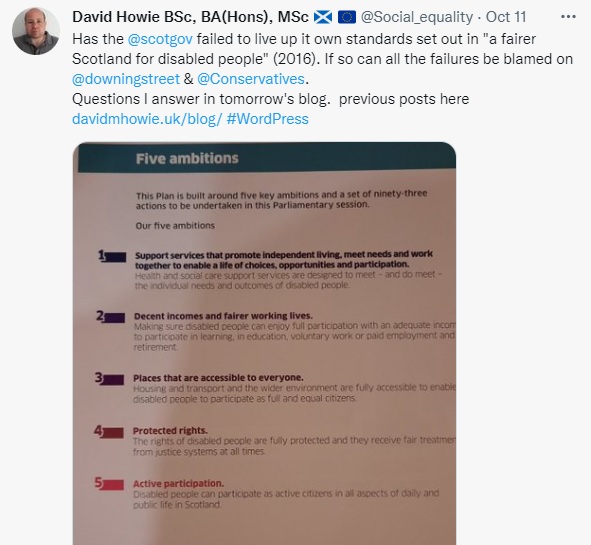
Has the Scottish Government failed to live up to its own standards set out in A fairer Scotland for disabled people?
the remainder of the tweet reads. If so can all the failures be blamed on Westminster and the Tories?
Poverty in Scotland 2021 says A Fairer Scotland For Disabled People as a plan runs til 2030. Yes, some parts do. However, I still have the right to be critical when the outcomes of the actions have come up short.
Where is the Scottish Government coming up short?
There are Five ambitions and Ninety-three actions in A Fairer Scotland For Disabled People. I will not analyse all Ninety-three of them. I am sure you are glad to hear this. There is no need to. There is a general concurrence across civil society to suggest, to empower, citizens to have Human Rights. All citizens must have dignity. Professor Alan Miller the Scottish Government’s adviser on Human Rights articulated this point this morning (13/10/21) at #BeingHuman22- a Health and Social Care Academy event.
Let us try something, Just for fun. vote in the poll below. let’s see what my readers think.
I was wanting to take the five ambitions and give feedback based on google search results. The problem is a basic google search does not provide enough quality new reports. And am not researching for a PhD in Human Rights. Using grounded theory. Unless you want to pay me.
Instead let us keep the interactive activities going read the ambitions and give it a thumbs up or down, depending on your subjective view.
remember the ambitions are for disabled people. So do/take part in the five questions below?
Support services that promote independent living. meet needs and work together to enable a life of choices, opportunities and participation.
Decent incomes and fairer working lives
Places that are accessible to everyone
Protected rights. Do you know what your rights are?
Active participation. Disabled people can participate as active citizens
this section was completely unplanned. I’ve never tried anything like this. it will be interesting to see what happens.
Power who has it? Who needs to have it?
What I will NOT do in this section. I shall not discuss the peripheries-devolved nations (Scotland, Walse, NI) and the centre-Westminister. What I shall do is discuss the peripheries- communities/citizens and the centre- The Scottish Government. In Scotland, as in all western nations, The Scottish Government passes acts of parliament to change the laws of the land. This type of approach is known as top-down. It works a little better than trickle-down economics but not so much better. In case the reader missed the political sense of humour. Am saying both trickle-down economics and top-down governments do not work. Or both are less effective than their counterparts.
I had not planned on having a section regarding power in this post. However, It was brought up in Alan Miller’s talk. It is a really important point not just for disabled citizens but for all citizens. I now wish I had not given my Open University politics books away.
I would like nothing more than to write about the social contract- by Jean-Jacques Rousseau or a theory of justice-John Rawls. I think readers would be put off for life. Instead, let us simplify it and say, The Human Rights (Scotland) Act would bring about a charter of rights. A charter of rights would give Scottish
citizens a document from which to identify their civil/political and economic/cultural rights.
The Human Rights (Scotland) Act 202…? will change the power dynamics in Scotland. instead of the top-down approach, we have at present The Human Rights (Scotland) Act shall be the enabler for the bottom-up approach to government.
In Scotland at present third sector organisations act as a second chamber to the Scottish parliament. Once the Human Rights (Scotland) act is passed third sector organisations will be required to take on the balance and check role. Some third-sector organisations’ do this presently. in other blogs, I have
called third-sector organisations that do this, civil servants by proxy. Once the Human Rights (Scotland) act become law, an additional number of third-sector organisations will be required to take on the civil servant role. The difference between the post-publication of The Human Rights (Scotland) act and now
is that the people of Scotland will provide legitimacy to the third-sector organisations.
While third-sector sector organisations shall hold legitimacy to hold the Scottish Government and Scottish parliament to account. The citizens of Scotland must also have the legitimacy to hold third-sector organisations accountable.
At present, the Scottish Government and parliament hold the power. Post-Human Rights (Scotland) act the people of Scotland will hold power. As it should be. The people of Scotland are sovereign.
note I could be completely incorrect about this. Am basing what I said on Alan Miller’s talk and months of meeting with the Scottish Governments Human Rights bill team as a lived experience board member.
On the idea of Human Rights as a progressive road map to a fairer Scotland. I want to say something about drug and alcohol misuse. Professor Alan Miller is the chair of the Scottish Government’s task force on drug and alcohol reduction. Professor Miller takes the view that focusing on providing dignity will empower citizens, increase well-being and reduce drug and alcohol misuse. I agree with Alan here. This is the approach A-LEAF is taking as we look to build community empowerment.
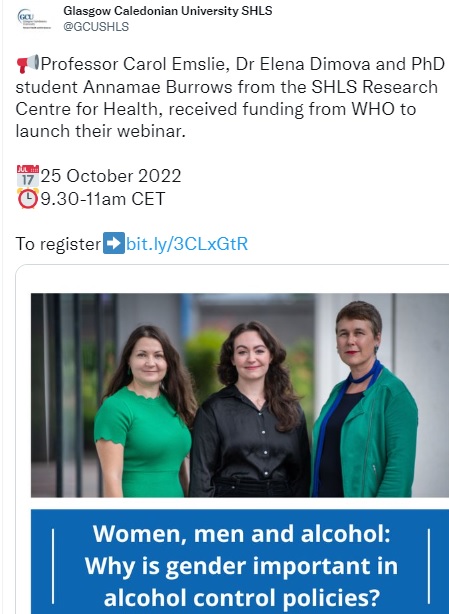
I am still 100 per cent in agreement with Porfessor Alan Miller. finding a way to give Scottish citizens back their dignity is how society builds a fairer, healthier Scotland. Professor Carol Emslie and colleagues at Glasgow Caledonian University’s School of Health and Life Sciences, however, instigates an interesting addition to the question this blog post asks.
Is it possible to have a Human Rights (Scotland) Act without having a chapter on gender equality?
Can Scotland be fairer for disabled people, if gender is not considered?
the link to register for the webinar (click) here
To conclude this section. In case it is not clear. In Scotland, at the moment the Scottish Government/ parliament have the power. The Human Rights (Scotland) Act will give more power to the people that live here in Scotland.
I note. Any power that is transferred from the Scottish Government to the people living in Scotland via The Human Rights (Scotland) Act will be subject to devolved powers only.
Discussion
This blog post has a triple bottom line. As a result, it has taken a different style from my other posts. Can readers please let me know which style is preferred? The title of the post: Is Scotland Fairer For Disabled People Today?, was chosen becuse as Angela O’Hagan’s introduction to Poverty in Scotland 2021: Towards A 2030 Without Poverty reveals Scotland is not a fairer place for a lot of people today.
I want to shine light on one action which I would suggest has completely failed
[The Scottish Government] will empower disabled people to know and claim their rights: following the changes in the Mental Health (Scotland) Act 2015 by promoting independent advocacy and advance statments, alongside a right-based approch in the statutory guidance on the use of mental health legislation to be in place in 2017
action 15. page 14, A Fairer Scotland For Disabled People
I say action 15 has failed not because of media stories. I I say action 15 has failed because of primary data from the Scottish Governments Human Rights lived experience board.
That brings me to the first reason for wanting to write this blog. I wanted to reflect on my time on the lived experience board, and what in anyway my experience has shaped the purpose, values and vision of A-LEAF. I do not think the lived experience on the board has shaped my purpose, values and vision. which are A-LEAF’s purpose, values and vision.
The second reason for wanting to write this blog was to have documentation on what I have been doing since completing my MSc in 2021. In a way I am trying to convice myself that the opportunity cost would not have provided me with the same if not more subjective well-being.
That brings me to the last reason for writing this blog. I want it to help someone. If only one reader is helped by reading this blog then my choice of staying on the lived experience board and working towards registering A-LEAF will be correct.
One last thought on the title/question. Is Scotland fairer for disabled people today? My conclusion is no. that said the Scottish Government could have quantitative data that says I am incorrect, Scotland is fairer for disabled people today. I can only base my conlusion on the qualiative data I have from the lived experience board and from meetings with third sector colleagues.
Conclusion
A fairer Scotland for disabled people was the Scottish Government’s delivery plan to 2021 for the United Nations Convention on the Rights of Persons With Disabilities. Do I think the delivery plan went to plan? No I do not. Covid19 may have had a hand in that. However, The Scottish Government cannot hide behind Covid19. As Angela said in the intorduction to poverty in Scotland 2021
[Covid19] and its outcomes did not of themselves create iequallties, but rather they exacerbated the structural inequalities and intersecting oppressions of discrimination and disadvantage on grounds of sex and gander, race and ethic origin, disabity and poverty.
O’Hagan, 2021.
Am sure Professor Carol Emslie and Professor Alan Miller would agree with Professor Angela O’Hagan. I know I do.
 David M Howie