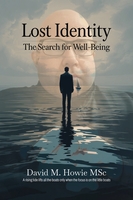
In the book ‘Lost Identity: The Search for Well-Being I talk about neurodiversity. I have come to the conclusion- after watching people talk about their neurodivergent minds – that I don’t understand neurodiversity- not even a little, not even at all.
If I don’t understand neurodiversity, when I self-diagnose as neurodivergent, post-childhood medulloblastoma, how can anyone who is neurotypical? I suppose they can’t, and I suppose they never will. That is, unless society starts to have a conversation about mental health.
As I say in the book, I have decent well-being; for the most part, I am happy with life. Of course, in an ideal world, I would be working in a profession focused on social policy and research, one that encompasses every citizen and fosters community development. Earth, however, is not a utopia. Earth is the island of necessity. On the island of necessity, no one gets what they want, and even fewer get what they require to live well.
For people who are neurodivergent, the WHO organisation suggests that it could be as high as 40%. We mask in plain sight. Not hiding, but also not having the strength to be ourselves.
I must admit, I find myself in a very unsettling situation. I thought that when I published the book, one of two things would happen. One. It would be the end of the project, and a new one would begin. Two. I would have achieved enough to move on with my life, so that I could perhaps now pursue a career on the neurotypical island of necessity. Something, though, is pulling me back. There are more chapters to be written. I alone can write them. I cannot explain it. There are many better writers than I. Why then must I be the writer of the next chapter? The only explanation available is that the book/project is not yet complete.
Someone on TikTok describes 24 hours in their life as a routine that they cannot complete, a never-ending cycle that never seems to end. Groundhog Day. Or a time loop, if you are a Sci-Fi fan. Lucky for me, my mind is not stuck in a time loop or doomed to repeat the same day over and over, like Bill Murray in Groundhog Day.
I don’t know how far down the rabbit hole the far end of the neurodivergent mind goes. From what I understand- from watching TikTok videos- it is disabling. What I do know is that I feel compelled to follow the white rabbit. Compelled. Yes. But in my own time. I am not free yet to leave the island of necessity and join the island of utopia.
I am not that far down the rabbit hole to qualify for free money from the state to do whatever I like all day. Not that that is what neurodivergent citizens at the dark end of the spectrum are doing. Remember, neurodivergent citizens are not a homogeneous group; it is not logical. It is more like a prison for the mind. I have a front row seat to the prison. Or at the movie theatre, if you prefer. The difference is I can leave and return. So many citizens don’t.
Physically disabled citizens
Subjectively, physically disabled people do not see the world in the same way as a neurotypical citizen. I don’t like the word damaged. That would be a neurotypical perspective. Without the lived experiences of a neurodegenerative citizen, it is impossible to understand how the neurotypical mind works.
That is why a one-size-fits-all approach to the integration of physically and neurotypical disabled citizens will not work.
What is next?

I start working on the second book: The Search for Well-being: Never Ends. It is a working title. It has no chapters, paragraphs, or words. The shape the next book will take shall depend a lot on what happens in 2026, after the Scottish parlament election. More importantly, though, the next book will depend on my subjective understanding of where my mind lies on the neurodivergent spectrum.
This blog post serves as a brief introduction to the steps that follow. As a neurodivergent person, self-diagnosed, my steps can change daily. What would it be like to live if your daily steps just repeated?
 David M Howie