Physical vs Mental disabilities

Lost Identity
M.Howie, David

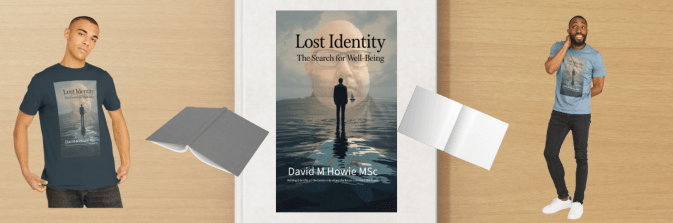
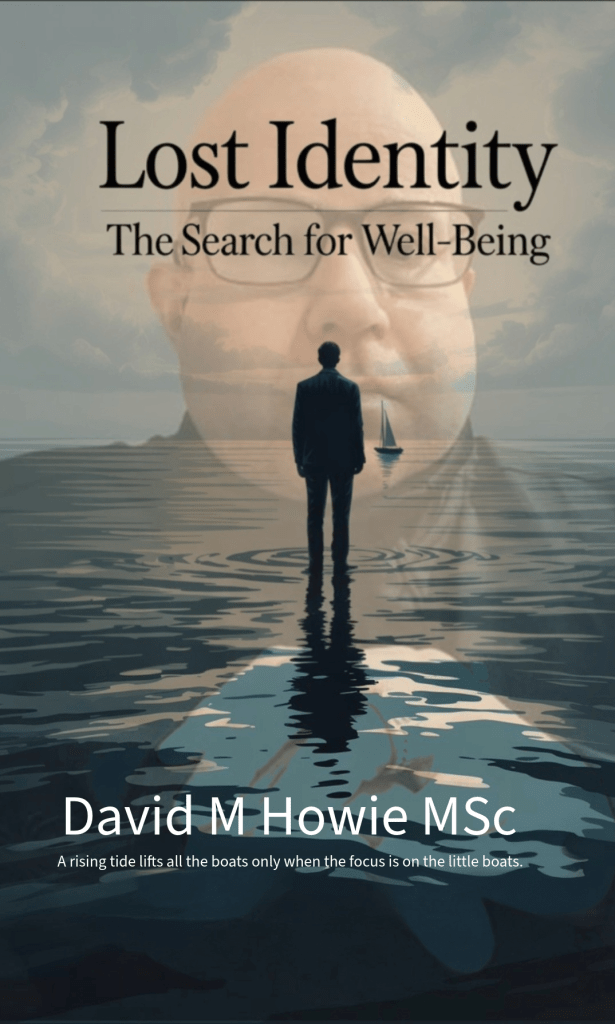
In the book ‘Lost Identity: The Search for Well-Being I talk about neurodiversity. I have come to the conclusion- after watching people talk about their neurodivergent minds – that I don’t understand neurodiversity- not even a little, not even at all.

If I don’t understand neurodiversity, when I self-diagnose as neurodivergent, post-childhood medulloblastoma, how can anyone who is neurotypical? I suppose they can’t, and I suppose they never will. That is, unless society starts to have a conversation about mental health.

As I say in the book, I have decent well-being; for the most part, I am happy with life. Of course, in an ideal world, I would be working in a profession focused on social policy and research, one that encompasses every citizen and fosters community development. Earth, however, is not a utopia. Earth is the island of necessity. On the island of necessity, no one gets what they want, and even fewer get what they require to live well.

For people who are neurodivergent, the WHO organisation suggests that it could be as high as 40%. We mask in plain sight. Not hiding, but also not having the strength to be ourselves.

I must admit, I find myself in a very unsettling situation. I thought that when I published the book, one of two things would happen. One. It would be the end of the project, and a new one would begin. Two. I would have achieved enough to move on with my life, so that I could perhaps now pursue a career on the neurotypical island of necessity. Something, though, is pulling me back. There are more chapters to be written. I alone can write them. I cannot explain it. There are many better writers than I. Why then must I be the writer of the next chapter? The only explanation available is that the book/project is not yet complete.

Someone on TikTok describes 24 hours in their life as a routine that they cannot complete, a never-ending cycle that never seems to end. Groundhog Day. Or a time loop, if you are a Sci-Fi fan. Lucky for me, my mind is not stuck in a time loop or doomed to repeat the same day over and over, like Bill Murray in Groundhog Day.

I don’t know how far down the rabbit hole the far end of the neurodivergent mind goes. From what I understand- from watching TikTok videos- it is disabling. What I do know is that I feel compelled to follow the white rabbit. Compelled. Yes. But in my own time. I am not free yet to leave the island of necessity and join the island of utopia.

I am not that far down the rabbit hole to qualify for free money from the state to do whatever I like all day. Not that that is what neurodivergent citizens at the dark end of the spectrum are doing. Remember, neurodivergent citizens are not a homogeneous group; it is not logical. It is more like a prison for the mind. I have a front row seat to the prison. Or at the movie theatre, if you prefer. The difference is I can leave and return. So many citizens don’t.

Physically disabled citizens

Subjectively, physically disabled people do not see the world in the same way as a neurotypical citizen. I don’t like the word damaged. That would be a neurotypical perspective. Without the lived experiences of a neurodegenerative citizen, it is impossible to understand how the neurotypical mind works.

That is why a one-size-fits-all approach to the integration of physically and neurotypical disabled citizens will not work.

What is next?

I start working on the second book: The Search for Well-being: Never Ends. It is a working title. It has no chapters, paragraphs, or words. The shape the next book will take shall depend a lot on what happens in 2026, after the Scottish parlament election. More importantly, though, the next book will depend on my subjective understanding of where my mind lies on the neurodivergent spectrum.

This blog post serves as a brief introduction to the steps that follow. As a neurodivergent person, self-diagnosed, my steps can change daily. What would it be like to live if your daily steps just repeated?

Scottish Parliament Elections

I just what to firstly apologies for not having posted, as of late. I will not go into the details.

Am back now. I also have a new plan. As everyone in Scotland knows. Or should know. The Scottish Parliament Elections are on 7 May 2026. Which is also my birthday. After, or before you vote, drop by and wish me happy birthday.

the plan

In the run-up to the Scottish Parliament Election, I am going to review as many third sector manifestos as possible. I’ll do this in video, and go into a lot more detail via blog posts. Below you can watch the video I completed last night, for Inclusion Scotland’s manifesto.

This video is 18 minuets long. If you don’t have 18 minuets you watch the 3 minutes edited video. The 3-minute video is also available on Instagram and TikTok,

I will write a more detail blog post on Inclusion Scotland’s manifesto mid week when I have more time.

Thank you watching my videos and reading my blogs

Lost Identity: The Search For Well-being

On June 18, I published the book Lost Identity: The Search for Well-Being. Since doing so, everyone and their grandmother has been lining up to tell me how to promote the book. Apparently, I require a cinematic trailer. Apparently, I need a social media manager. Apparently, I need to be more ruthless- put profiteering first. They say.

I fundamentally disagree. I wrote the book in the hope that it will empower others. I wrote it because I wanted to empower communities. I believe it is having that impact. People whom I have known for years are saying to me:

I did not know that was how your brain worked. That link with ADHD is so interesting

My book. On my desk at home

I have been living with the side effects of a childhood Medulloblastoma for thirthy-seven year, I have a unique view. However, I have to ask how did you think the brain was going to develop? Apart of it was cut out. Radiation was fired at at it. Chemotheropy resulted in Chemo-brain.

There is no objective evidence to say I have ADHD or ADHD like symptoms. However, a little common sense suggests my brain is not neurotypical. Perhaps that is why I put people and the planet before profit. Don’t get me wrong, I would love to make a living from writing books, telling my story, doing podcasts, radio, and TV interviews. Not though to make a profit. Just to live, just to enjoy what I do.

I hear you. Why should I get to enjoy what I do to generate an income? Not many people are happy in their jobs. Perhaps for the first time in my life, I am thinking of myself. I was dealt a S### hand. I turned it around. Why shouldn’t I make a little money from it?

Lost Identity
M.Howie, David

Yes. It is okay if I profit a little from the book. It is okay if I enjoy making social media content to support the book. I am allowed to write blogs to promote the book. I worked hard to get my MSc. I should use it to financially support myself. Shouldn’t I? At least if I make a small profit, I am doing so by empowering others.

Empowerment via storytelling

That is what I want to do. I wish to tell you my story. If you don’t like my story, fine. If you think I am ungrateful, I don’t really care. If you think I should get on with my life. IT has been over thirty-seven years. I can tell you that is precisely what I am doing. Every post, every TikTok, every blog. I am moving forward. I am getting up and I am showing up.

Do I use social marketing? Do I write and talk like I have a chip on my shoulder? Of course I do. The NHS didn’t rehabilitate me back in 1987. Why should they? They almost let me die. Then they gave me five years to live. After twenty years, they showed me the door. They gave me a phone number and told me to call if I ever need anything.

I need to know why they did not tell me about the long-term side effects. I need to understand why they did not tell me that I would be required to pay a personal trainer for rehabilitation, because the NHS doesn’t have the resources or the capacity.

I need to know why the NHS didn’t tell me that I would never belong. That my life would become a constant search to find myself. They did not KNOW! That is no excuse. Society talks about a cancer journey. When does that journey end? At the end of formal education? When I buy a house? When I say I do? I know it’s not when I buy a car, have children, or walk in a straight line. So when is it?

The truth is the journey never ends. “We exist here”, is a line from Star Trek: Deep Space Nine. Medulloblastoma don’t “exist here”. We exist wherever in time, the brain tumour and cancer injured the mind. The mind of a Medulloblastoma is not neurotypical. That is why, when organisations tell me that I should be profiting from a book written to empower others (and myself), I am hesitant to comply.

Lost Identity: The Search for Well-Being is my story. It’s raw, it is emotional, it is empowering, it’s me. I am so glad I got to write it. I am so happy that I get to tell my story to the world. My number one hope is that when you read it, you are empowered.

Life is not easy. Anything worthwhile having in life is worth working hard for.

What is next

I wish I knew. What I do know is I need a holiday. Has anyone got any suggestions?

August updates

August updates: Link to pursue the book.
Lost Identity
M.Howie, David

August 4. Which means it has been nearly two months since I published the book. A fantastic seven weeks it has been. I have sold 71 copies of the book across all platforms, with an additional ten copies having been given to people to read and promote. About eighty-one people so far have had the opportunity to read my book.

I want more people to have the opportunity to read the book. NOT because I want more sales, but because I believe what I have to say is essential. We live in a society which is fascinated with the flow of capital.

Ask a banker which they would rather have: flowing capital or water. Capital, I would put money on, being the response.

It’s not only bankers. Ever since I published the book, I have had a queue of beggars wanting to promote my book. Do you want to understand the term street furniture? Publish a book, and you’ll quickly understand the terminology. Have you ever walked around Glasgow and asked yourself why there are random plants everywhere? That is what I have been doing with my emails and socials for the last seven weeks.

Yes, the last seven weeks have been insane with businesses and so-called businesses trying to sell me fame. The other side of the coin is that I have had so many lovely people across my socials providing so many heart-warming messages. That’s why I wrote the book. To empower myself to empower others, not to make money. Not to see a flow of capital on a spreadsheet.

Why do I tell you this? For several reasons. Firstly, the personal brand I aim to build must be grounded in my values, vision, and principles. Secondly, it is a jungle out there. Your principles must be your map. When you lose your map, you can lose yourself. Finally, I share this with you about the vultures that will want a piece of you when you publish a book, because I want to be as authentic as possible. The authenticity I applied when writing the book was to establish legitimacy. There is nothing legitimate about chasing large book sales. That is not me. I almost forgot that.

Now I know who I am again, and readers have a better understanding of who I am. What is next? First of all, I have agreed with two local Glasgow bookstores to stock my books. More details to follow. Secondly, I will be cycling from Glasgow to Loch Lomond to raise funds for Men Matter Scotland, a mental health charity, in Drumchapel. For every copy of my book that I sell in August, I shall donate £1 to the charity Men Matter Scotland.

If you want to purchase the book from Amazon, click the link > Lost Identity.

Lost Identity: The Search for Well-being

Lost Identity: The Search for Well-being. Why did I write it?

There is no singular reason. Multiple videos on TikTok and Instagram have suggested the book is my equivalent to a PhD. It is. The publication of the book marks a milestone in my life, allowing me to move forward.   

The book is told in the first person. Yes, however, I don’t get to tell my story without the interactions I have had with others. A significant part of why I wrote the book was to express my gratitude.  As Dave Hume said, knowledge is images imprinted on the mind. Without others, I cannot build my knowledge bank.

The third reason I wanted to write was to help society. By society, I mean any citizen who requires a hand up. I also wanted to say to governmental institutions that they have to do better.

Lost Identity; available on Amazon

Me at four/five

Hopefully, I can achieve that goal. However, to reach my goal, I require your help. I kindly request that you purchase a copy of my book.  Not for you, for your MP or MSP. I want to get this book into the hands of the people who can change policy.     

While you are handing your MP/SMP my book, perhaps you could also ask them to watch the YouTube video embedded in the blog.  

I have come a long way in 37 years. I have two undergraduate degrees, a postgraduate degree, and I have written a book (equivalent to my PhD)

That’s why I wanted to write the book. I’ll cover in more detail what I want to achieve with this book.     

Social Enterprise: A-LEAF

Society is structured to grow the gross domestic product (GDP). However, allocating available resources to grow GPD results in the most vulnerable citizens becoming an afterthought. The social enterprise/ framework Iain and I designed after completing our MSc in social innovation empowers citizens and communities by focusing on the diversity, inclusion, and belonging model.      

It is of utmost urgency that we address the critical issue of empowering disadvantaged citizens in Scotland. The evidence is stark: Disabled individuals confront substantial inequalities and are at a higher risk of living in poverty. This is a policy concern and a societal crisis that demands immediate action. I am deeply concerned that the Scottish Government may lack the capacity and resources to enact the required changes. The time for action is now.

While I acknowledge that the A-LEAF framework may not be a panacea for all the Scottish government’s challenges, I am confident it could be a significant step towards a more inclusive and equitable society for disabled people. This is not just a proposal. It’s a beacon of hope, a potential catalyst for positive change. Given the opportunity, this framework could not only enhance the well-being of countless disabled citizens in Scotland, but it could also transform their lives, offering them a brighter future. Let’s unite to envision this potential, understanding the profound impact it could have on the lives of our fellow citizens.

The A-LEAF framework I propose is more than just an abstract idea. It is a practical solution rooted in my personal experiences and the expertise of my graduate colleague, Iain. With over thirty years of collective experience, A-LEAF is based on the belief that citizens’ well-being is enhanced when they have a personal and professional identity, when social policy supports their right to live in the community, and when social norms allow them to do so. This is not just a theoretical concept but a tangible framework that can be implemented to bring about real change, instilling confidence in its practicality and effectiveness.

The A-LEAF framework is essentially the Iron Triangle on Sustainable Steroids. It aligns seamlessly with the Scottish Government’s well-being/ circular economy policy and advocates for a new fourth social enterprise sector. This framework is designed to bolster green growth and foster co-production in the three existing sectors – third, private, and public. Its implementation could significantly enhance the Scottish Government’s initiatives and policies, leading to a more inclusive and equitable society.  

Network theory is the idea that organisations within society collaborate to make society function. Each node does its job or the job it has a competitive advantage in—it can complete the job better and generate more profit than any other node/organisation. The A-LEAF framework enhances the network for the common good by placing it in a strategic action field. Every action field network node works towards the well-being/circular economy.        

In academic social enterprise theory, there are three typologies of social entrepreneurship. Schumpeter inspires social engineering thinkers to believe that a newer, more effective social system is designed to replace existing systems when systems are ill-suited to address significant social needs. As a social innovation graduate, a citizen of Scotland and someone disabled by the medical model, I have sympathy for this thought pattern. However, such political philosophy/ social enterprise typology needs to be revised. Such philosophy has no place in contemporary society.

The typology operating in society presently is social bricoleur. Social bricoleurs perceive and act upon opportunities to address local social needs. They are motivated by lived experiences and know how to address social problems. However, while Social bricoleurs have the lived experiences and knowledge to address social issues, the barriers consist of capacity and resources. Social bricoleurs are typically charities requiring financial capital and rely on top-down government support. Providing resources and capacity exists in the state. I have zero quarrels about this social policy/typology. Fundamentally, the resources and capacity do not exist. Levels of poverty and SCOPE’s call to action show evidence enough. Additionally, I would suggest two things. One. The current political framework of the Scottish political system is based on the Social bricoleur typology. Therefore, funding is allocated to charities/social enterprises that can mitigate social problems over the short term—providing the Scottish government with outcomes that support the national performance framework. Two. Social bricoleur thinking resulted in A-LEAF not receiving funding from the Scottish government’s social enterprise funding body.  The Scottish Government’s refusal to fund A-LEAF lowers my subjective well-being as funding refusal has resulted in my continuing quest for a professional identity.

For readers unaware, the Scottish national performance framework is effectively the United Nations sustainable development goals (UN SDGs) as applied to Scotland.  The nugatory differentials between the UN SDGs and the Scottish national performance framework are significant enough to propel A-LEAF into the typology of social constructionists – social constructionists build and operate alternative structures to provide goods and services addressing social needs that governments, agencies, and businesses cannot.  

Iain and I had not advocated for a dramatic system change with the A-LEAF framework. Our request was merely to empower citizens and support the Scottish government’s social policy. The chapter has attempted to inform the readers of my subjective understanding of the operation of the Scottish political system, how the political system results in disabled people facing vast inequalities, and how Social bricoleur thinking provides possible barriers to necessary required system changes. The remainder of the chapter will spotlight the A-LEAF framework.      

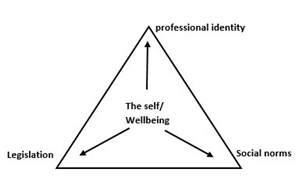
The fundamental theory of the A-LEAF framework is that a community’s collective well-being is empowered when citizens have a personal and professional identity that provides subjective well-being and simultaneously provides the person/self with good mental health. However, there is a direct correlation between personal and professional identity, social policy, and social norms. The workplace, the community, and government policy act as a tripod that supports citizens’ subjective well-being and provides good mental health. Absences of employment, paid or unpaid, reduces subjective well-being. Prohibition of the right to live in the community lowers subjective well-being. The perception that the government is not listening reduces citizens’ hope. As a society, we must ensure that citizens in our communities are provided opportunities to live well.

In the third sector, there is a focus on ‘self-management’. Self-management is an elongation that prolongs the required change. It is a mitigation method used to mitigate the effects of an ill-run society. I recognise that communities within communities can also empower citizens and foster the idea of citizenship. The problem, however, is that “a rising tide lifts all the boats” only when the focus is on the little boats.

Part one of the A-LEAF framework shows that citizens’ well-being correlates with each side of the tripod. The second part discusses what unites every citizen: waste. Rich, poor, disabled, and non-disabled, every citizen, every household, every institution, and every state produces waste.  How do you turn waste into a monetisation opportunity which empowers citizens? Run the four Rs of the circular economy in reverse. Instead of reducing, reuse, recycle, and remove. Society should focus on recycling, reusing, reducing, and removing. Waste has a value that can be monetised. Plastic, glass, metals, and fabrics can all be recycled. The fantastic part of recycling is that a community recycling project has the potential to unite and empower every citizen. Within every action field/network within a society, an organisation will have a competitive advantage in recycling. Providing people and the planet are prioritised over profits. The organisation offers the strategic action field/community with a common good.

Part one: step two envisioned the possible collaboration opportunities that could empower citizens with subjective well-being. To prevent repetition, I will forgo the literary details. The graphic is provided in the chapter notes.

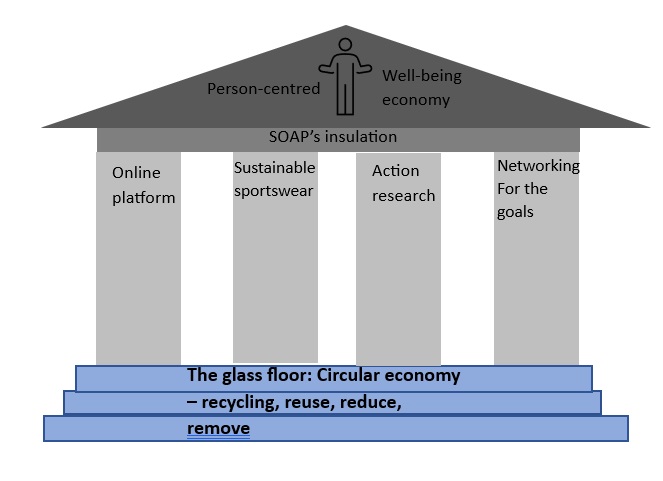
The final framework Iain and I designed before dropping the idea of A-LEAF as a social enterprise in 2023 was the House of Well-being. The House of Well-being is based on the Health and Social Care Alliance Scotland’s House of Care. The graphic I used, however, looks more like the US House of Representatives. That was either due to studying American-Russian international relations or watching too many American political TV shows.     The House of Well-being/ A-LEAF framework for the well-being circular economy is as follows: The stairs metaphorically represent the circular economy but in reverse. The framework focuses on recycling as a monetary policy for community wealth building. From left to right, the four pillars are: (1) Build an online platform for keeping goods in the community longer, preventing goods within their life cycle from ending in landfills. (2) Within the community, there should be a focus on reducing polyester clothing for gym wear. Polyester, when washed, produces microplastics. The effects microplastics have on the environment are well known. The impact of microplastics on human life requires further investigation. (3)  The action field/network should prioritise action research with all stakeholders in the field/community. This would reduce the requirement for lived experience boards, which, from my experience, reduces well-being. (4) Network for the UN SDGs goals.  Every node/organisation with a network operating within the field should focus on achieving one or more of the seventeen sustainable development goals. The field the framework proposes is more robust than anything currently in place in Scotland. The nodes within the fields work towards the same strategy on a page (SOAP). Each field, of which there could be numerous in a geographical location, could adapt its SOAP to achieve the outcome of the field while working towards meeting the UN SDGs. The SOAP’s key performance and business growth indicators, designed to achieve the SDGs, can then be linked to the National Performance Framework. Directly connecting the strategic action fields back to the Scottish Government’s social policy agenda and simultaneously creating a database of community assets.  Implementing the A-LEAF framework would create a person-centred well-being economy.

societal triangle

A-LEAF started with the idea that citizenship well-being is dependent on three areas. 1. Professional identity—without a sense of belonging and meaningful employment, well-being will remain low. 2. legislation. Government policy must support citizens in working on their own well-being. 3. Social norms of the community must support collaboration between citizens to develop a strong community.

Well-being circular economy.

To achieve the societal triangle, it was clear that the projects’ funding must be commercial. Removing community waste, upscaling, reusing, or recycling the community would generate a community wealth fund. Other commercial social enterprises could use the funds to develop projects that would empower citizen in their local community.

The circular image of well-being represents what Ian and I thought provided the best opportunities. Other projects are encouraged.

House of well-being

The House of Well-being was our last attempt to convince the funding bodies that A-LEAF, along with our Scottish government colleagues, had a solid plan for developing a well-being circular economy.

Emplyment: paid and unpaid

The definition of employment I am applying in this chapter is any work-related activity requested on behalf of an organisation. For example, I am including paid employment – Woolworths PLC and Sainsbury’s PLC. I also include unpaid employment – Macmillan Cancer Support, support worker, People Powered Health and Wellbeing reference group member and board, Scottish Government community eye care review, and the Scottish Government Human Rights lived experience board.

I commenced employment at seventeen while still attending Whitehill Secondary School. I have a confession: I initially worked for Big W – a retail chain owned by King Fisher Group. Multiple years after King-Fisher was liquidated, I wrote a paper on how dysfunctional King-Fisher’s board was. The paper was written for ‘Ethics, Governance, and Responsible Leadership – a module required for my MSc. Knowing in 2024 what I know about the King Fisher board, my only surprise is that my employment lasted nine years, not nine days.   

For readers unaware, Big W retail stores were the idea that customers could purchase products ranging from pick-n-mix to alcohol and from DVDs/ CDs to 40-inch LCD TVs. As a concept, Big W was an exciting idea. In the early 2000s, before video on demand – Amazon Prime, Netflix, and others- the idea of purchasing your weekend movie entertainment, alcoholic beverages, and perhaps even an LCD TV, even today, sounded convenient. The business idea for Big W, even today, sounds viable. Tesco, Sainsbury’s, and Walmart-Asda still apply framework variations in 2024. Big W’s problem was not that it was ahead of its time. Big W’s problem was that no one had ever completed a risk assessment. Or perhaps the risk assessment completed by Big W’s board put profit before people and the planet. In this case, liquidation should have been foreseen.  

The locality of the Big W store I had paid employment in was Glasgow Forge Retail Park. Glasgow Forge Retail Park and my birth area of Haghill have something in common. They both have public and private transport access routes. However, more worrying, according to the Scottish Index of Multiple Deprivation, Camlachie – an area of Glasgow in Scotland located in the East End of the city, between Dennistoun to the north and Bridgeton to the south – and Haghill are deprived of health, education, employment, and housing. Readers should not be surprised that Multiple Deprivation equals high crime. Here is why I believe no risk assessment was ever completed- the geographical size of Big W was too large, and the security personnel too slim to prevent mass shrinkage. For unaware readers, shrinkage is the loss of units/products via shoplifting internally or by the general public. The second reason I believe there was never a risk assessment completed was that most employees – at least weekends and evenings were directly hired from Whitehill and Bannerman High Schools. The UK army cannot recruit in Schools. Why could the Kingfisher Group? Even the recruitment process sounds unethical. My point, however, is this. School, college, and university students are not the correct employees to prevent mass shrinkage. Even a UK army regiment could not have prevented shrinkage in Big W.  

The collapse of Big W and, eventually, Woolworths was, in hindsight, foreseen.  From an egotistical – selfish viewpoint, I am glad the store remained operating until I completed my BSc in Multimedia. This chapter is titled employment: paid and unpaid. Therefore, the remainder of the chapter focuses on how employment affects my professional identity. Professional identity, or the lack of one, affects my well-being. If the reader thinks about it, I am sure it is the same for every reader. However, before getting to professional identity, I have to say something about personal identity. After completing my BSc in multimedia, two colleagues from Woolworths asked if I could help promote their band promotion company, GnG Promotions.

GnG Promotion was shorthand for Grant and Garry Promotions – much thought went into the name. Garry dropped from the promotion early on. Grant and I did go on to promote some successful nights in the Soundhaus, 13th Note, and Classic Grand in Glasgow. As part of GnG promotions, I worked alongside bands such as the Black Arrows, The Toi, and Day Break, to name a few. A memorable time was had thanks to Woolworths. Thank you for that. The good times did roll in those short three years. I want to thank all the bands and venues I had the opportunity to work with. Band promoting for me was a hobby – an expensive one at that. My personal identity and social capital were increased due to it. However, I never saw it as anything more.  Therefore, I could let it go without any loss of well-being.        

I was employed with Big W – Woolworths between 28 September 2000 and 9 Jan 2009. I received the equivalent of a year’s wages when Woolworths closed. Therefore, I was happy to be sent from position to position by the job centre-plus, as   I was using my existing skills and learning new skills.

Subjectively, the UK HM Revenue and Customs (HMRC) has its priorities discombobulated. Twelve months after no paid employment, I had two unpaid employments, one with Macmillan Cancer Support and another as an administrative assistant at Cross-Reach. Despite my economic contributions – travelling and saving Cross-Reach capital, I worked for free. Remploy, in 2010, partnered with Job Centre Plus, took the decision that I was required to contribute to the gross domestic product by paying taxes. Objectively, I understand – what gets measured gets done. Despite having a BSc in multimedia and working as an events coordinator for three years. Paid employment with Sainsbury’s loomed. In 2010, I had no intention of remaining in paid employment with Sainsbury’s longer than necessary. Somehow, the necessity has developed into thirteen years.      

I have the same employment in 2024 as in 2000—twenty-four years serving the public, replenishing shelves, and operating hot food counters. The repetitiveness itself lowers well-being.

Removing myself from the shackles of the repetitiveness after four years, without a doubt, prevented a mental breakdown. In 2014, returning to higher education to study politics, philosophy, and economics was my best move and simultaneously the worst. As the reader knows, I received my BA (Hons) PPE in 2019. My lack of personal and professional identity has nothing and everything to do with that degree. All be it, indirectly.

What has transpired between 2014 and 2024 has my well-being swinging on a pendulum.  2014, I joined The Health and Social Care Alliance Scotland (The Alliance). Knowing that I required lived experience – work experience and academic experience – to find paid work after completing my BA (Hons) membership at The Alliance was the logical choice. Membership of The Alliance as someone with long-term conditions costs me nothing but opportunity cost – time. Could my time have been better spent? Today, would my well-being be greater without The Alliance membership?

If you work hard, you will become successful, and once you become successful, you’ll be happy – Says Shawn Achor in The Happiness Advantage. I have worked hard for ten years but have not felt successful. I feel unpropitious. Unpropitious or perhaps Inauspicious: I believe society prevents my happiness/well-being by refusing to accept the system change required for a well-being/ circular economy. The social norms of society are not designed with childhood medulloblastoma survivors with a BA (Hons) and MSc in mind.

Childhood medulloblastoma survivors with a BA (Hons) and MSc are not supposed to have an interest in social policy. Challenging the top-down approach to governance is forbidding. Ironically, without membership in The Alliance, I wouldn’t feel so strongly that a system change is required.  

I interviewed numerous Alliance staff members for my MSc dissertation. A staff member who now works for the Scottish Government told me The Alliance’s remit is to strengthen the Scottish Government’s social policy, not contest the social policy. What is ironic is that by default, The Alliance is part of the system of governance, and The Alliance staff are civil servants by proxy.   

My first unpaid role with The Alliance was on the People Power Health and Well-being reference group. The Alliance set up the reference group. However, the reference group was funded directly by the Scottish Government. The remit of the reference group was to advise on the framework for the Public Bodies (Joint Working) (Scotland) Act 2014. My role as a person with lived experience or a person with long-term conditions was to attend meetings and provide professionals with insight into the daily lives of someone with lived experience.

As part of The People Powered Health and Well-being reference group, I did my first non-academic research, asking: Does engagement and inclusion promote well-being and recovery, and if so, how? The rousing thing was that that research was not part of the original plan. The original plan was for professionals to observe the reference group members and produce a subjective qualitative report. I could not be prouder that The People Powered Health and Well-being reference group members rejected that idea outright.

People with long-term conditions can do research, too. The reference group showed it. Now, society needs to acknowledge it.

Thank you to Lisa Curtice, the project lead on the People Power Health and Well-being project. I am not sure that without Lisa’s contacts at Strathclyde University, I would have had the opportunity to complete my first non-academic research. Readers can still watch the People Power Health and Well-being project’s Vimeo videos. Vimeo.com/pphw.

Interestingly, while I was in the process of being guided in research methodology by Dr Ailsa Stewart, a lecturer in social work and social policy at Strathclyde University, my Open University tutor worked in the same department. I cannot remember the name of the tutor I had for ‘Introducing the Social Sciences’. I cross-referenced Dr Ailsa Stewart’s published papers to see if I recognised any co-authors.  The name of the tutor still evades me. However, I recognised one name. Gillian Macintyre – Gillian also added to guide my knowledge of research methodology. It is fitting Gillian also receives a mention.   

I only mention my Open University tutor because, by the time I was given the opportunity to collaborate with the Scottish Government again, I was either studying DD203 Power, Dissent, and Equality or A222 Exploring Philosophy. The project I had the opportunity to be part of was the Scottish Government’s community eye care review. I have a mention in the Annex A of the community eye service review report. To date, that mention is my claim to fame.

As for my role, my fellow stakeholders and I met monthly to discuss current services and hear from various partners on potential developments in the community eye care services.

In 2017, my well-being was at a high point. I studied topics I enjoyed and collaborated with fellow stakeholders on social policy. However, I have not replicated the feelings of personal and professional identity that I had in 2017. I was a PPE student working in collaboration with fellow stakeholders. A career in research and policy is still my preferred area of employment today.  Given that my job in 2024 is so divergent from my personal and professional life in 2017, my well-being is low.

My final Open University module was DD313, International Relations: Continuity and Change in Global Politics. The module is not so important; what is essential is the date—2019. I did not mention my four weeks volunteering with Global Vision International in Cape Town, South Africa when I commenced this chapter. South Africa was a personal development, not a professional development. Also, I don’t see my time in Cape Town as unpaid employment in the same way as I view the People Powered Health and Well-being reference group or the community eye care review. My time in Cape Town shaped me and profoundly affected my vision, values, and principles; more on that in the next chapter – Social Enterprises: A-LEAF.

To finish this chapter, I must finish at a low point. As of March 2024, my well-being is low; I am frustrated and annoyed that I spent a year between 2022 and 2023 doing unpaid work on the Scottish Government’s Human Rights lived experience board. My well-being is at the time of writing low because I don’t have the professional identity I had in 2017. The launch of the social enterprise – A-LEAF and a grounded understanding of Human Rights issues in Scotland was intended to recreate the subjective well-being that my perceived personal and professional identity provided me in 2017.

2014, I gave up my full-time position with Sainsbury’s because my well-being was low. I needed something more than a job in retail. Everything I did between 2014 and 2024 was designed to improve myself and the community. The outcome was not what I envisioned. Despite my frustration and annoyance, I don’t regret the past ten years. However, I am low on hope for a better tomorrow for myself and the wider community.                   
My education: P1 to MSc graduate.

Given that Nature and Nurture are equal components of the Scottish government’s curriculum for excellence, it is essential not to forget my pre-medulloblastoma diagnosis years. Of which there were four. I was born on Saturday, May 7, 1983, at 23:00 in Glasgow Royal Maternity Hospital. Unknowing to me then, I would spend the majority of my childhood and most of my teen/early adulthood in a hospital, mainly as a day patient. By now, the reader should understand my medical history from reading chapter two. I did not say I buy from third parties regarding contemporary sensory issues in Chapter Two. That is, I purchase hearing aids and glasses from retail stores. My contact with the NHS is an annual phone call.

My parents and I lived on Walter Street in Glasgow. Walter Street is located in Glasgow’s East end in Haghill. The Scottish Index for Multiple Deprivation (SIMD) shows that Haghill is deprived of health, education, income, employment, and housing and is a high-crime area. What Haghill has got is access to public transport. At least citizens of Haghill have public transport to Merchant City East – known to locals as Dennistoun. My parents and I did not stay in Haghill long; we moved to Ballindalloch Drive, just off Alexandra Parade, when the local housing association offered to buy my parents and my first home.

Despite what the SIMD show about Haghill. It cannot remove the nurture of the community. My parents’ nature and the community’s nurture created the confident, outgoing child I was. The new flat at 28 Ballindalloch Drive was a top flat. It had a kitchen, bathroom, and separate bedrooms, unlike Walter Street at the time. However, there was no lift. I propose a motion. Every newly built multi-story flat above two floors must have an elevator (for my USA readers). The lack of a lift was why the family moved to 22 Ballindalloch Drive some years later. I’ll discuss that in chapter seven. The story about that can be found in the UK Parliament Library.

Despite resistance from the local school headteacher, I attended Alexandra Parade Primary School only months after the removal of the medulloblastoma, chemotherapy, radiotherapy, and stroke. Even as a four/five-year-old, I refused to take NO for an answer. From TikTok, I’ve learned that is a characteristic of people with Brain Tumours. No does not mean no—no means YES, but in my way. As expressed above, I was a bright child. The academic curriculum of primary 1 to 3 was not challenging. I strolled into primary four without difficulty. Well, there was one issue, not academic but physical. I could not tie my laces. I don’t know when I learned to tie my laces, but it was later than most of my classmates. In hindsight, this was when my primary school education was about to take a few bumps in the road.

Chapter six is titled “Do I consider myself disabled today?” I provide details on the nature of my physical limitations in that chapter. Those physical limitations contributed to my learning disabilities problems. At the time of writing, my education issues are not defined as learning disabilities. Hopefully, the learning disabilities, autism, and neurodiversity (Scotland) Act 2026 will correct a wrong and help support citizens with brain tumours.

As I reminisce back to my primary 4-7 years equipped with a BA (Hons) and an MSc as of 2024, blaming Chemo brain – as discussed in chapter two, would be too convenient to explain my poor academic performance. I propose that the educational system between 1992-95 was unequipped to educate a child recovering from a medulloblastoma. Is the educational system equipped to deal with an equivalent conundrum in 2024? I am not too sure in which primary I was tested for Dyslexia – difficulty reading due to problems identifying speech sounds and learning how they relate to letters and words. The outcome of the Dyslexia test was negative, as I could verbally spell the word. However, I could not write the word on paper.

Primary school is a blur. I have no vivid memory of those years. I remember silly things like finding a hedgehog while construction of the M8 Junction at Alexandra Park Street was in place. Or I was getting attacked by random cats for wearing a shell suit. It was the late 80s and early 90s. I still believed the World Wrestling Federation (WWF/WWE) was a combat sport. Apparently, I also let Sharon and Searha let me believe stray cats should be cradled like newborn babies. No judgments. That was the Nurture of my childhood.

I commenced secondary school in 1995 – Whitehill Secondary. Even then, I preferred my company to that of my classmates. It would not be inappropriate to say I prefer the company of animals over humans—even hedgehogs and cats.

Whitehill was more equipped to attend to my educational needs. I was provided with a laptop to help with spelling and grammar. I achieved acceptable standard grade results—grades 3 and 4 in all classes except French.  I struggled with English. What chance did I have with French?  

Above, I said I was tested for Dyslexia at primary school. There must have been a misconception from Whitehill’s English department that the results of the Dyslexia test were positive. I was discouraged from reading long books when writing a book review. Even at Whitehill, I was written off. I was written off not because teachers wanted me to fail but because there was no framework for teaching childhood medulloblastoma survivors. In 2024, I am not convinced Getting it Right for Every Child – the Scottish Government’s approach to supporting children and young people would have provided the support I required.

At Whitehill’s awards ceremony in 1998, I was awarded the leaps and bounds prize – for the student who had made the most progress. Take a second to process the date. I was diagnosed with a medulloblastoma in 1987. Either It took ten years for the brain to develop after the removal of the brain tumour, or the introduction of the internet into Scottish society provided the opportunity to learn in a way my brain required, i.e. for words to be verbally repeated back to me and corrected in real-time. Possibly both.

The following year, I had an attendance rate of 97 per cent. Perhaps there is something in peer-to-peer support and social capital, after all.   

The 2000/01 year was a wasted year. I was accepted into Glasgow College of Building and Printing for my HND in March of 2001. I did not want to be a Whitehill in the last few months. Graduation on June 14, 2001, could not come quickly enough.

I enjoyed my time at the Glasgow building and printing. It is a shame to see that in 2024, the building is a shell of its former self. Hopefully, by the time this book is published, the building will operate as new flats and office space. I was in the building on September 11, 2001 – for Dugs Data Analysis and Database Design class. I remember Grant- a fellow student. Grant was one of the older guys, a grungy rocker who should have been studying music technology, not information and media technology. He must have been watching a news stream. Grant’s words evade me; I remember Dug running to the monitor to view images of the Twin Towers being hit.

I was in New York, attending Hole in the Wall Gang Camp – a children’s camp for seriously ill children and their families when I was 14 years old in 1997. I was only in Manhattan for three days. However, I must have walked past the Twin Towers. I am also sure our party of four or five seriously ill children and two adult social workers were admitted to Hard Rock café – in New York, with the only other customers being Michael Lee Aday, his wife, and their daughter.  

Years later, in 2018, I was in South Africa, volunteering with Global Vision International. On one weekend off, I visited the District Six Museum. On the wall is this quote

“It struck me that our history is contained in the homes we live in, that we are shaped by the ability of these simple structures to resist being defiled.”

Achmat Dangor  

Our history is not only contained in the homes we live in. It is also contained in the educational establishments we attend. That is why I get chills every time I walk past the Building and Printing structure where I once bought my first zip drive. Yes, I am that old.   

After completing my HND, I attended Glasgow Caledonian University for a BSc in Multimedia Technology. I dropped out after one year, gaining a BSc in Multimedia Technology. At the time, I was more interested in hardware, or so I thought. Looking back, I was just a bad coder. I graduated in 2005 and did not return to higher education until 2014.       

The return to higher education in 2014 was strategic. I joined the SNP in 2007, and as of 2014, I was still an active member. More about that in Chapter 3 – employment. The Open University (OU) allowed me to work and learn simultaneously. Politics, Philosophy, and Economics. What else would I have chosen to study? Reminiscing the OU provides students with the foundation to proceed in the higher educational journey. Each level and each course is designed to enable students to develop the skills required for incremental progression. For example, “Making Social Lives” and “Exploring Social Lives” were simplistic content for a ten-year experienced political campaigner and not academically challenging. With hindsight, the point of those modules was to instruct students in the academic writing process—a skill I was required to learn years later. The lesson learned was to learn to walk before you run. 

I graduated from the OU in 2019 with a BA (Hons) PPE. Back to GCU, this time to study Social Innovation. Remember I said I had not learned to write academically in 2014? In 2021, I still had much to learn about academic writing. On reflection, I was accepted into the class because of my unpaid experience in Scotland’s third sector, not my academic achievements. After a resit or two, I was allowed to complete my dissertation.   My dissertation question answered, “Why is there a subjective well-being premium in voluntary sector employment?”  

I completed my dissertation thanks to my supervisor, Dr Tom Montgomery. I graduated from GCU in 2021 with an MSc in Social Innovation.

Social Innovation is business ethics. At least, that is how I view it.  

Note that this is NOT a blog post. Like the other writings, it is a rough draft of the book I want to write.