The human rights lived-experience board meeting, taking place on Monday 21 November, shall focus on what key performance indicators to measure, to inform that the human rights act is achieving the desired outcome. This blog post will ask the readers three questions, question one will ask the reader how well you feel human rights are protected in Scotland right now. Question two will ask the reader what you think is the most important human rights issue in Scotland today. Question three will ask the reader how hopeful they are feeling that the new human rights bill will be successful in realising human rights for people in Scotland. After each question, there shall be a short discussion about the contemporary issues directly impacting the question.
What is the Human Rights (Scotland) act?
For international readers and national readers that do keep up to date with politics or the third sector, Human Rights (Scotland) Bill/Act is an act of the Scottish Parliament that will incorporate the UN Human Rights conventions into Scots law. Wait, it gets more interesting, the Scottish Government only has responsibility for devolved matters. Reserved matters are still the responsibility of the UK Government. What then does the devolved/reserved conflict as it relates to the power of Governments/Parliaments mean for the human rights of people living in Scotland? that is the question this blog will look to answer.
How well do you feel human rights are protected in Scotland right now?
For international readers, this question and the two questions that follow will be hard or impossible to answer. While you- the international readers may have difficulties answering the questions, I would suggest that you continue reading. From an international relations lens, the Human Rights (Scotland) Bill/Act speaks volumes about the character of the Scottish Government/Parliament.
Turning attention to the question of how well you feel human rights are protected in Scotland right now. As a citizen of Scotland, I would conclude there is room for improvement. Poverty in Scotland 2021: Towards 2030 without poverty, tells you all you need to know about human rights violations in Scotland. While the case of Awaab Ishak, see here, is in England. Scotland’s housing situation is not much better. In Scotland today (2018)
2 per cent (51,000) of all households are overcrowded
19 per cent of homes have some level of urgent disrepair to a critical element and just 1 per cent had extensive disrepair
2 per cent (40,000) of homes (at the time of writing) do not meet the ‘Tolerable Standard
0.7 per cent (18,000) have both condensation and some level of penetrating or rising dampness
(Cain, 2021, p. 212)
As the data above shows Scotland has to do much more to improve housing if the goal of the Scottish Government is to protect people living in Scotland from human rights violations.
What do you think is the most important human rights issue in Scotland today?
These questions that am putting to the readers are the questions the human rights lived experience board will answer on Monday. Therefore it is only fair to the reader, that the choices are made clear. Which options from the list are the most important human rights issue(s) in Scotland today?
- Access to justice
- Poverty
- Disabled people’s rights
- Women’s rights
- Refugee and asylum seekers’ rights
- Environmental rights
- Older people’s rights
- Children and young people’s rights
- Something else
- They’re all important- I can’t separate them all!
Readers may think, that because I referenced Poverty in Scotland 2021: towards 2030 without poverty. That I would say poverty is the most important human rights issue in Scotland today. If this is your thinking, I can inform you, you are completely incorrect. All choices above are equally important. To try to focus on one or two of the choices above without seeing the holistic picture is, hazardous to health.
I have a seat on the Human Rights (Scotland) Bill lived-experience board because I am a member of the Health and Social Care Alliance Scotland. The third-sector organisations in Scotland know that a holistic co-produced model is required to achieve human rights in Scotland for all citizens.
What would human rights for all citizens look like? Given the political structure of Scottish society, only the Scottish Government and parliament can answer that question. In the decision section, I try and help the Scottish Government make the correct choice.
How hopeful are you feeling that the new human rights bill will be successful in realising human rights for people in Scotland?
I recognise that this blog has not provided the reader with enough information to come to a balanced conclusion. I can, however, inform the reader that I am not hopeful, am probably more sceptical. Why sceptical you may ask. I said above that from an international relations lens, the human rights bill makes Scotland compliant with international policy. Therefore Scotland becomes viewed as open and outward-looking. Scotland should be viewed in this light. Scotland is a fantastic country with vast potential. With that said, If Scotland continues with the top-down approach to government, in which human rights are focused on access to justice and not on well-being and dignity then I see no outcome where the new human rights bill will be successful in realising human rights for people in Scotland.
Discussion
Readers may or may not know of my background. If you do not, I was diagnosed with a brain tumour at the age of four. see the home page for more information. I have over ten years of experience in the third sector, I also have two undergraduate and one MSc degree. The reader must understand I conclude that the human rights (Scotland) bill will not have the outcome desired, based on 34 years of living with the side effects of a childhood brain tumour, 13 years as a member of the political party that governs Scotland, 10 years volunteering in the third sector- which includes Scottish government boards, and, three trimesters completing a masters degree in Social Innovation.
I would like to think my opinion carries some legitimacy. Yes am cynical, however, I hope am proven incorrect. I shall not hold my breath. The reason I am so pessimistic about the outcome is I believe the funding model for the third sector is unsustainable. Once the Human Rights (Scotland) Bill becomes the Human Rights (Scotland) Act [2026?] a lot of the burden is going to land on the table, not of civil servants but on the table of third-sector organisations. I have said this before the third sector in Scotland, at least third-sector organisations that are directly funded by the Scottish Government are civil servants by proxy. I believe these proxy civil servants act as a second chamber to the Scottish Parliament, and I would not change this framework. For the Human Rights (Scotland) Act [2026?] to have the desired outcome, there is a requirement to think outside the box. Bring forward the fourth sector.
So there is no ambiguity, In Scottish policy farmwork and academia, there is no fourth sector. Social Enterprise in practice and theory is defined as the third sector. Nicholls (2010) makes two observations about Social enterprises. (1) there is no definitive consensus about what the term means (2) the research agenda for the field is not yet clearly defined. Two points I want to make. The first point is academia and Scottish policy are wrong, Social enterprises are not operating in the third sector. The second point is Nicholls is also completely incorrect. Angela Constance when Cabinet Secretary for Communities, Social Security and Equalities has a foreword in Scotland’s Social Enterprise Strategy which makes direct reference to Robert Owen and New Lanark. My argument is simple New Lanark is the definitive consensus of what a social enterprise is. And, research agenda was set between 1785-1968. For readers that do not know the history of New Lanark click on the link here.
I can hear the angry neo-liberal supporters, that’s in past. That is not how we do things in the contemporary UK, we like capitalism. Am sure Robert Owen would have considered himself a capitalist. It is said The Wealth Of Nations is simply the best book on political economy ever written (Butler, 2010, p.viii). The contemporary UK could have looked so different if Robert Owen had written The Wealth Of Citizens.
If readers require a more contemporary view of what a social enterprise is read The Social Entrepreneur: Making Communities work by Andrew Mawson. I’ll go on record and say Mawson is the only lord I would consider supporting based solely on the book. What though do Owen and Mawson have in common? They both understand the importance of stakeholdership. Ever since completing my MSc dissertation on the question: ‘why is there a subjective well-being premium in voluntary sector employment?’ I have become convinced that a stakeholdership model must Incorporate Rosabeth Moss Kanter’s thinking on power and powerlessness in the workplace. Figures 1 and 2 summaries Kanter’s thinking.
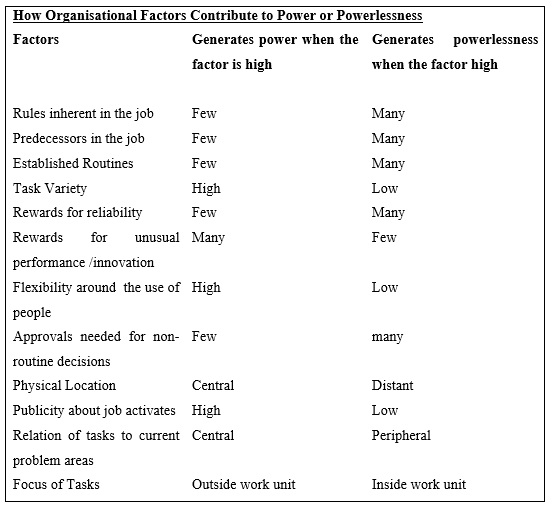
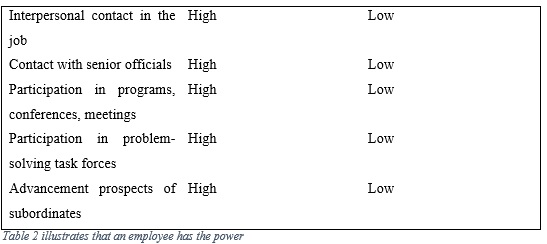
Figures 1 and 2 copied from my dissertation
Kanter’s argument is that when the factor is high employees have power or subjective well-being. My argument is when that when power is in the hand of employees that work for social enterprises. That power can be extended into the communities the social enterprise operates.
Conclusion
The purpose of this blog is to inform the reader of the process of the Human Rights Bill/Act. This bill has not yet reached the parliamentary stage. Therefore it is impossible to know how members of the Scottish Parliament (MSPs) will react to the bill at the first reading. If MSPs react in the same way as me, then expect a lively debate and a lot of amendments. Note debate and a lot of amendments are not to be discouraged. Debate and amendments are a sign of power. As I said above we cannot afford the Human rights bill to be empowered from the top down. Yes, we have the human rights lived experience board. My concern is what happens to the people on the lived experience board after the Scottish government decides it no longer needs the board. I say to the reader, the Scottish Government, and, The Human Rights Consortium Scotland I effusively welcome lived experienced boards. I add, however, lived experienced boards must be more than short-term talking shops.
I said above that my dissertation answered the question ‘why is there a subjective well-being premium in third-sector employment?’. My conclusion to that question is important for how social policy transitions from the third sector to the fourth sector. My conclusion to my dissertation question was; yes, there is a subjective well-being premium in third-sector employment but only when employment is sustainable and achieves an external improvement. For example, employees of the Scottish Human Rights Consortium have a well-being premium/power because their employment provides citizens of Scotland with human rights. Here is the catch well-being premium/power is provided by the Scottish Government or the city council, as it is these institutions which enable change via innovative policy change. I fundamentally believe there is a need for third-sector organisations that act as the second chamber of the Scottish Parliament. Perhaps a sounding board for the Scottish Government is a better way to look at it. I take the view though that the third sector is not sustainable. Therefore society must move toward the social enterprise fourth sector model. The Fourth Sector model is the only model that will provide subjective well-being to every employee in the sector while providing business growth indicators (BGI’s) and Key performance indicators (KIPs) that will monitor human rights from a well-being dignity lens and not access to justice lens.
Recommendations
I was planning to go into some detail on my social enterprise’s business model. How it focuses on the well-being economy while encapsulating the well-being economy in side the circular economy. My social enterprise will use BGI’s that are focused on corporate social responsibility and use KIPs that are directly linked to The UN Sustainable Development Goals. I feel, however, that splitting the more technical aspects into another blog or support document may be more useful to the reader.
I am hoping to have a zoom meeting in February/March regarding my social enterprise. I do recommend reader join that meeting. Details to follow.
 David M Howie