Human Rights Integration (Scotland) Act 2026: Not workable without a social contract?

Disclaimer. This blog post you are about to read is subjectively motivated. However, the intent is not to criticise the integration of the United Unitions Convention into Scottish Law. The blog intends to empower the reader with the knowledge required to understand why I believe the Human Rights Integration (Scotland) Act 2026 will be dead on arrival.

For clarity, I have no desire to see the Human Rights Integration (Scotland) Act 2026 fail. Upon completing my master’s in social Innovation, I attempted to set up a social enterprise to empower local communities and citizens by supporting and recommending improvements to the Scottish government’s social policy. I joined the Scottish government’s Human Rights Integration Lived Experience board to achieve my social enterprise’s outcome. The objective was to learn from citizens how best to empower citizens in local communities. On reflection, that objective was achieved. Why do I believe the Human Rights Integration (Scotland) Act 2026 will be dead on arrival? Firstly, I think the framework I designed to achieve A-LEAF’s outcome supports the Scottish government’s Human Rights Agenda. To be denied funding by the Scottish government’s social enterprise funders indicates departments are not communicating on a Human Rights agenda. To successfully implement the Human Rights Integration (Scotland) Act 2026, the Scottish government departments require a Human Rights inclusive communication policy; this policy must recognise the Scottish government lacks the capacity and resources to empower every citizen in Scotland with dignity. To provide dignity to every citizen in Scotland, there is a requirement to shift the Human Rights agenda from top-down to bottom-up- There is a requirement to support social enterprises that aim to be commercially sustainable whilst supporting the United Nations’ Sustainable Development Goals and the Scottish National Performance Framework.

The National Performance Framework states:

We [Scotland] have a thriving and innovative business, with quality jobs and fair work for everyone.

Scotland’s Natonal Perforance Framwork

As a Social Innovation graduate, I strongly suggest to the Scottish government that extensive work is required to achieve the standards for said performance.      

The Second reason I believe the Human Rights Integration (Scotland) Act 2026 will be dead on arrival is basic economics. Before completing my MSc in Social Innovation, I completed my second undergraduate degree in Politics, Philosophy, and economics. Therefore, I believe I have some legitimacy regarding my economic claims. The backlash to Scotland’s First Minsters Humza Yousaf’s announcement that council tax in Scotland will be frozen in Scotland in 2024 has been intensive. However, by applying a Human Rights approach, the question becomes, can Scotland afford not to have a council tax freeze? Not can Scotland’s councils afford a council tax freeze.

The limitations of Devolution, as it relates to short-run capitalism, dictate that a freeze in council tax results in a cut in public services. While this holds in the short term, it is my opinion that moving towards a well-being/circular economy which supports the principles of a shared economy could mitigate the cost-of-living crisis. In the long run, this could result in lower council tax as social enterprises could provide crucial services.      

For example, instead of charging Glasgow city residents £50 to pick up garden waste. Social Enterprises could pick up the waste for free and sell the biomass to companies looking into sustainable and renewable energy sources.

Sustainability is a goal for the national performance framework:

We [Scotland] have a globally competitive, entrepreneurial, inclusive, and sustainable economy.

SNPF

While the national performance framework provides keywords, it offers no hope. Scotland’s economy is not inclusive. Only 49.6 per cent of disabled people living in Scotland are in work. I am willing to bet it is not full-time work, which allows for the highest attainable standard of living. Scotland’s economy is not sustainable. Paying £50 for garden waste pick up when there is a cost-of-living crisis is anything but sustainable.

Scotland’s economy may be entrepreneurial. Scotland’s economy is not social entrepreneurial-friendly. If it was, the cost-of-living crises could be mitigated. Furthermore, because business tax is reserved for Westminster, the benefits from tax from any profit before people and planet business goes down south and does not stay in Scotland.

Given that Scotland’s economy is not social entrepreneurial-friendly, inclusive, or sustainable, can Scotland’s economy be competitive?  

The third reason why the Human Rights Integration (Scotland) Act 2026 will be dead on arrival is Scotland’s social enterprises are charities, not social enterprises. At least not the academic definition of a social enterprise. That is a significant issue that cannot be underestimated. I have volunteered in Scotland’s third sector since 2010. I fully support Scotland’s third sector. I am on record saying parts of Scotland’s third sector act as a second chamber to the Scottish government. Scotland has a strong third sector. Scotland does not need a more extensive state supporting more third-sector organisations. Scotland needs a robust social enterprise sector that reports to, answers and monitors the Scottish parliament. That is how we achieve a Human Rights Integration (Scotland) Act 2026 that is fit for purpose.

This brings me to the second part of the blog post. The social enterprise I tried to set up challenges the top-down social norm that exists in Scotland. There is too much of what the state can do for me and not enough of what I can do for my state. Or to put it another way.

Ask not what your country can do for you- ask what you can do for your country.

JFK, 1961

Scotland is not the USA. Scotland is, however, part of the UK, for worse or for better. In implementing the Human Rights Integration (Scotland) Act 2026, the Scottish government should remember the teachings of John Loke and Thomas Hobbes. Yes, citizens may need a government to run the state. Society in Scotland has come a long way since the English Civil War. Scotland requires a new social contract. Scotland requires a social contract that empowers social entrepreneurship. And social entrepreneurs must empower local communities.

Watch the attached video to learn more about A-LEAF and stay updated on my views on Scottish and UK politics.   

A-LEAF: should it say or go?

This video is not public on YouTube. If you do like this content, let me know, and I’ll see about updating my video and recording equipment.
Why identity matters.

A day after this website went live (second time) I had a meeting with my colleague to discuss the next stages for A-LEAF. This website/blog(s) is the launching site for A-LEAF- as well as my personal blog site. My colleague’s reaction was:

I like the website/blog, however, I did not get the ‘person’ vs human, philosophy on the landing page (paraphrased).

Matheson, 2022

After considering my colleague’s intervention I have concluded that there is a requirement for additional clarification on “person” vs human. Homing in on how I see ‘person’ as my identity and human as the physical body. Is any of this making sense? No? okay, let us try a different approach.

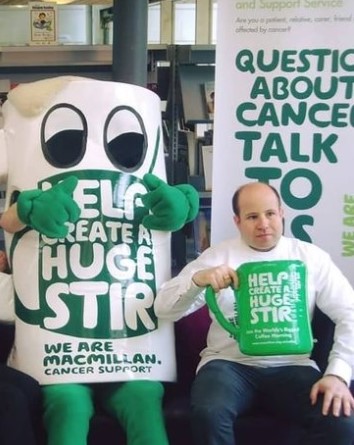
Objectively- what can be proven without a doubt. I am the child (human) that was diagnosed with a Medulloblastoma aged four. However, my lived experiences of growing up with the long-term side effects and the barriers to society the Medulloblastoma caused has shaped the ‘person’ I am today. To be clear what am saying is if it was not for the Medulloblastoma I would not have volunteered with Macmillan Glasgow Libraries in 2010.

This was where the journey started with the third sector in 2010. Never did I think in 2022 I would be weeks off registering my own company after completing my MSc in Social Innovation.   

I never would become involved with Cancer Support Scotland‘s child charity Youth Cancer Forum Scotland, I never would have taken an interest in charity law. More importantly, I never would have become a member of Health & Social care Alliance Scotland, Inclusion Scotland, Glasgow Disability Alliance, however, the utmost important connection to the Medulloblastoma childhood diagnosis which lead to volunteering with MacMillian; I would not have completed my MSc in social innovation and I would not be in a position to start a social enterprise today.

so let us consider the question again.

what makes a person the same person despite changes over time?

WARBURTON, 2011

A Medulloblastoma childhood diagnosis makes me the same person over time. I never did get that. I have Dr. Anne Smith for the enlightenment. I thanked Anne for providing me with this insight in my acknowledgments to my dissertation. My thanks are, now on record for the world to see.

Now I know I am the same ‘person’ today. As I was when I was four. The question remains if it was not for social norms and medical models. would I be the same ‘person’ today as I was when I was four? After all, no one in Locke’s time was living thirty-four years after a Medulloblastoma childhood diagnosis.

One last thought. A Ph.D. student once asked me:

“Does studying Social Innovation make you want to start a social enterprise”

Ph.D student, 2020

No, it is not the MSc in Social innovation that makes me want to start A-LEAF. it is the answer to the question:

would removing the inequalities social norms and medical models, result in me becoming a different person from the four-year-old me?

No, It is too late for me! The four-year-old I was in 1987 is the same ‘person’ I am today. The question remains if it was not for social norms and medical models. would I be the same ‘person’ today as I was when I was four?

The answer to this question is important for all childhood cancer patients today.

Diversity, Inclusion, and Belonging

 My initial blog post, “hello WordPress”, illustrated- to the best of my ability how the social model of disability is essential to building back better from COVID-19 and Brexit. This post will develop the foundations on which the previous post lay.  The fundamental point raised from the initial blog post; as a disabled person that has been living with sight and hearing difficulties since five years old, due to a childhood Medulloblastoma, I am best placed as an expert by experience to develop the policies required for me to live well in the future. Let me clarify. As a disabled person, I know what products and services I require to create inclusion for myself in society. However, 14 million disabled people are living in the UK. I am not, no one could be. An expert by experience, of 14 million long term conditions. An expert by experience, though, is the pedestal, citizens place the social security system.

Do not consider what am about to say, as an attack on our political institutions. As a Politics, philosophy and economics graduate, my view of the UK political institutions is they are dated, they are crumbling and they need a refit. Without improvements to political institutions, promptly, I am sceptical about how society can create inclusion for 14 million disabled citizens. At this point, I would like to remind readers it is not about inclusion. It is about belonging. My latest podcast discussed lived experiences, at 11:00 minutes in I talk about diversity, inclusion and belonging. I have said somewhere in the past I don’t feel I fully belong to any group in society. I have the privilege of having membership in several disabled peoples organisations. However, I have always perceived I don’t fully belong. I know the not belonging is a subjective perception. Perhaps it is just a barrier as a “person” I have placed on my-“self”.   

Am going to let the reader into a secret here. I have no idea what am going to write in regards to these blog posts before text appears on paper. Anyone that has written academic papers will know how good it feels just to have a blank page and have the ability to rabbit on. There is something to be said for academic writing style though. If using academic English, 364 words would not have been required to define what I mean by “person” and “self”.         

I have eventually got around to reading Joseph LeDoux book Synaptic Self: How Our Brains Become Who We Are. Get your copy here. I bought the book in 2015, I’ve just never found the time to read within my schedule. As LeDoux 2002, p 13 points out

Before we go looking for the essence of a person in the brain, it would help to have some conception of what we are seeking.     

LeDoux, 2002, p. 13

What we seek, is a definition of “person” and “self”. Luckily for me and the reader The Open University provided me with a copy of “The Self” written for A222 by Nigel Warburton. “Person” as I am using the term here is the same as John Locke used it in the Seventeenth-century.

You can be the same man as you were ten years ago without being the same person     

Warburton, 2011, p. 36

On my home page, I ask the question if I do not remember the child, I once was. Am I still him? Locke would say no. Me, I don’t know. Did I become active in the third sector because of the child I once was-  but have little to no memory of? Or because I think society is unethical. The Open University provided me with a book on Ethics too. Chapter 2 is on Bentham and Mill: maximising happiness. Perhaps I look at society as been unjust and that is why I strive to better myself and society via the third sector. 

Before returning to the idea of belonging, I am required to consider, if I am not the same “person” as the child with the Medulloblastoma. Who am I? Where can I find “the self”? The self, Hume thinks

[is] some kind of construction of the mind, not something which exists independently of our patterns of thought.    

Warburton, 2011, p.61

Hume’s thinking is not too far off from what LeDoux is saying in the Synaptic self, even if LeDoux’s methods and analysation of the data is a lot more scientific.  

Now the reader has an understanding of what I mean by “person” and “self”, let me explain why I do not feel I fully belong in disabled person’s organisations. Whilst studying professional practice- a module for my MSc. I had a light bulb moment- recognising my professional and personal identity is linked to my lived experience of growing up with the side effects of childhood Medulloblastoma. Despite the revelation, however, something subconsciously is preventing a full belonging to the group.            

Another group where I no longer perceive I fully belong is in political networks. Disengagement here is difficult to explain. I stood for vetting- candidate selection twice. The real reason why I have distanced myself from party politics, is, as I now see party politics as exclusion and alienating. As I said above I am not attacking our political institutions or any political party. Again I just perceive after several years of achieving nothing in politics, that I no longer belong in the political circle. I have friends in high positions in politics, I am grateful for my time spent campaigning for political candidates. From a professional and personal perspective, however,  having studied politics, philosophy and economics and then my MSc in social innovation the political system just is not working. The political systems, despite the UN conventions, sustainable development goals, European human rights – the international political systems cannot bring about diversity,  inclusion and belonging. When I came to that understanding, as a person, I have no place in society to belong.

Having a perception of not belonging is why I came up with the prospect of A-LEAF. If you are still reading, I do hope you will rally behind my call for diversity, inclusion and belonging (DIBs) alongside the social-platinum model.      

Our societies are diverse; to a point our societies have inclusion. Belonging is what we seek!    

If you enjoy these posts let me know by tweeting and voting.