Social Enterprise: A-LEAF

Society is structured to grow the gross domestic product (GDP). However, allocating available resources to grow GPD results in the most vulnerable citizens becoming an afterthought. The social enterprise/ framework Iain and I designed after completing our MSc in social innovation empowers citizens and communities by focusing on the diversity, inclusion, and belonging model.      

It is of utmost urgency that we address the critical issue of empowering disadvantaged citizens in Scotland. The evidence is stark: Disabled individuals confront substantial inequalities and are at a higher risk of living in poverty. This is a policy concern and a societal crisis that demands immediate action. I am deeply concerned that the Scottish Government may lack the capacity and resources to enact the required changes. The time for action is now.

While I acknowledge that the A-LEAF framework may not be a panacea for all the Scottish government’s challenges, I am confident it could be a significant step towards a more inclusive and equitable society for disabled people. This is not just a proposal. It’s a beacon of hope, a potential catalyst for positive change. Given the opportunity, this framework could not only enhance the well-being of countless disabled citizens in Scotland, but it could also transform their lives, offering them a brighter future. Let’s unite to envision this potential, understanding the profound impact it could have on the lives of our fellow citizens.

The A-LEAF framework I propose is more than just an abstract idea. It is a practical solution rooted in my personal experiences and the expertise of my graduate colleague, Iain. With over thirty years of collective experience, A-LEAF is based on the belief that citizens’ well-being is enhanced when they have a personal and professional identity, when social policy supports their right to live in the community, and when social norms allow them to do so. This is not just a theoretical concept but a tangible framework that can be implemented to bring about real change, instilling confidence in its practicality and effectiveness.

The A-LEAF framework is essentially the Iron Triangle on Sustainable Steroids. It aligns seamlessly with the Scottish Government’s well-being/ circular economy policy and advocates for a new fourth social enterprise sector. This framework is designed to bolster green growth and foster co-production in the three existing sectors – third, private, and public. Its implementation could significantly enhance the Scottish Government’s initiatives and policies, leading to a more inclusive and equitable society.  

Network theory is the idea that organisations within society collaborate to make society function. Each node does its job or the job it has a competitive advantage in—it can complete the job better and generate more profit than any other node/organisation. The A-LEAF framework enhances the network for the common good by placing it in a strategic action field. Every action field network node works towards the well-being/circular economy.        

In academic social enterprise theory, there are three typologies of social entrepreneurship. Schumpeter inspires social engineering thinkers to believe that a newer, more effective social system is designed to replace existing systems when systems are ill-suited to address significant social needs. As a social innovation graduate, a citizen of Scotland and someone disabled by the medical model, I have sympathy for this thought pattern. However, such political philosophy/ social enterprise typology needs to be revised. Such philosophy has no place in contemporary society.

The typology operating in society presently is social bricoleur. Social bricoleurs perceive and act upon opportunities to address local social needs. They are motivated by lived experiences and know how to address social problems. However, while Social bricoleurs have the lived experiences and knowledge to address social issues, the barriers consist of capacity and resources. Social bricoleurs are typically charities requiring financial capital and rely on top-down government support. Providing resources and capacity exists in the state. I have zero quarrels about this social policy/typology. Fundamentally, the resources and capacity do not exist. Levels of poverty and SCOPE’s call to action show evidence enough. Additionally, I would suggest two things. One. The current political framework of the Scottish political system is based on the Social bricoleur typology. Therefore, funding is allocated to charities/social enterprises that can mitigate social problems over the short term—providing the Scottish government with outcomes that support the national performance framework. Two. Social bricoleur thinking resulted in A-LEAF not receiving funding from the Scottish government’s social enterprise funding body.  The Scottish Government’s refusal to fund A-LEAF lowers my subjective well-being as funding refusal has resulted in my continuing quest for a professional identity.

For readers unaware, the Scottish national performance framework is effectively the United Nations sustainable development goals (UN SDGs) as applied to Scotland.  The nugatory differentials between the UN SDGs and the Scottish national performance framework are significant enough to propel A-LEAF into the typology of social constructionists – social constructionists build and operate alternative structures to provide goods and services addressing social needs that governments, agencies, and businesses cannot.  

Iain and I had not advocated for a dramatic system change with the A-LEAF framework. Our request was merely to empower citizens and support the Scottish government’s social policy. The chapter has attempted to inform the readers of my subjective understanding of the operation of the Scottish political system, how the political system results in disabled people facing vast inequalities, and how Social bricoleur thinking provides possible barriers to necessary required system changes. The remainder of the chapter will spotlight the A-LEAF framework.      

The fundamental theory of the A-LEAF framework is that a community’s collective well-being is empowered when citizens have a personal and professional identity that provides subjective well-being and simultaneously provides the person/self with good mental health. However, there is a direct correlation between personal and professional identity, social policy, and social norms. The workplace, the community, and government policy act as a tripod that supports citizens’ subjective well-being and provides good mental health. Absences of employment, paid or unpaid, reduces subjective well-being. Prohibition of the right to live in the community lowers subjective well-being. The perception that the government is not listening reduces citizens’ hope. As a society, we must ensure that citizens in our communities are provided opportunities to live well.

In the third sector, there is a focus on ‘self-management’. Self-management is an elongation that prolongs the required change. It is a mitigation method used to mitigate the effects of an ill-run society. I recognise that communities within communities can also empower citizens and foster the idea of citizenship. The problem, however, is that “a rising tide lifts all the boats” only when the focus is on the little boats.

Part one of the A-LEAF framework shows that citizens’ well-being correlates with each side of the tripod. The second part discusses what unites every citizen: waste. Rich, poor, disabled, and non-disabled, every citizen, every household, every institution, and every state produces waste.  How do you turn waste into a monetisation opportunity which empowers citizens? Run the four Rs of the circular economy in reverse. Instead of reducing, reuse, recycle, and remove. Society should focus on recycling, reusing, reducing, and removing. Waste has a value that can be monetised. Plastic, glass, metals, and fabrics can all be recycled. The fantastic part of recycling is that a community recycling project has the potential to unite and empower every citizen. Within every action field/network within a society, an organisation will have a competitive advantage in recycling. Providing people and the planet are prioritised over profits. The organisation offers the strategic action field/community with a common good.

Part one: step two envisioned the possible collaboration opportunities that could empower citizens with subjective well-being. To prevent repetition, I will forgo the literary details. The graphic is provided in the chapter notes.

The final framework Iain and I designed before dropping the idea of A-LEAF as a social enterprise in 2023 was the House of Well-being. The House of Well-being is based on the Health and Social Care Alliance Scotland’s House of Care. The graphic I used, however, looks more like the US House of Representatives. That was either due to studying American-Russian international relations or watching too many American political TV shows.     The House of Well-being/ A-LEAF framework for the well-being circular economy is as follows: The stairs metaphorically represent the circular economy but in reverse. The framework focuses on recycling as a monetary policy for community wealth building. From left to right, the four pillars are: (1) Build an online platform for keeping goods in the community longer, preventing goods within their life cycle from ending in landfills. (2) Within the community, there should be a focus on reducing polyester clothing for gym wear. Polyester, when washed, produces microplastics. The effects microplastics have on the environment are well known. The impact of microplastics on human life requires further investigation. (3)  The action field/network should prioritise action research with all stakeholders in the field/community. This would reduce the requirement for lived experience boards, which, from my experience, reduces well-being. (4) Network for the UN SDGs goals.  Every node/organisation with a network operating within the field should focus on achieving one or more of the seventeen sustainable development goals. The field the framework proposes is more robust than anything currently in place in Scotland. The nodes within the fields work towards the same strategy on a page (SOAP). Each field, of which there could be numerous in a geographical location, could adapt its SOAP to achieve the outcome of the field while working towards meeting the UN SDGs. The SOAP’s key performance and business growth indicators, designed to achieve the SDGs, can then be linked to the National Performance Framework. Directly connecting the strategic action fields back to the Scottish Government’s social policy agenda and simultaneously creating a database of community assets.  Implementing the A-LEAF framework would create a person-centred well-being economy.
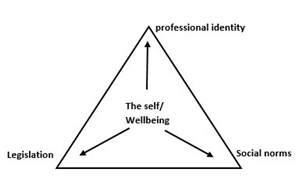
societal triangle

A-LEAF started with the idea that citizenship well-being is dependent on three areas. 1. Professional identity—without a sense of belonging and meaningful employment, well-being will remain low. 2. legislation. Government policy must support citizens in working on their own well-being. 3. Social norms of the community must support collaboration between citizens to develop a strong community.

Well-being circular economy.

To achieve the societal triangle, it was clear that the projects’ funding must be commercial. Removing community waste, upscaling, reusing, or recycling the community would generate a community wealth fund. Other commercial social enterprises could use the funds to develop projects that would empower citizen in their local community.

The circular image of well-being represents what Ian and I thought provided the best opportunities. Other projects are encouraged.
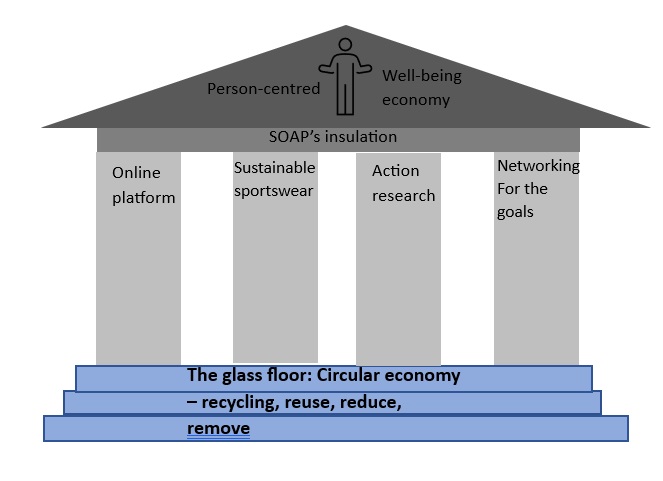
House of well-being

The House of Well-being was our last attempt to convince the funding bodies that A-LEAF, along with our Scottish government colleagues, had a solid plan for developing a well-being circular economy.
My Book: Chapter One (re-writing)

Chapter One: Why I don’t have a personal and professional identity.

The video above explains why I am re-writing my book. However, before doing so, I wanted to allow you to read what was written as a first draft of the chapters. See below for Chapter One.


Politics engulfs the life of every citizen on planet Earth. However, most Scottish citizens need to learn the difference between social policies devolved to the Scottish Parliament and those reserved for Westminster. Furthermore, most citizens have yet to care or have given up hope in both parliaments.

17 April 2007—the year the journey started. I don’t regret joining the SNP in 2007. My second undergraduate degree, MSc, volunteering with Globel Vision International, and numerous memberships with third-sector organisations are directly inherent to my SNP membership. However, SNP membership is the primary reason I lack a professional identity. I joined the SNP because I believed in 2007, which I think is true now. Scotland should be an independent country. However, over the past seventeen years, I have realised that independence is for nothing if citizens are not empowered. If citizens lack hope, communities become nothing more than industrial, capitalist ghost towns with the sole purpose of serving only shareholders, with no regard for stakeholders. Then why rock the boat?

2014 was the year I decided to return to education and find employment in social policy (see chapters three and four, respectively). I have ten years of experience in social policy, but I need help finding paid employment, which lowers my professional identity. In any other field of employment, ten years would demand legitimacy and respect. However, citizens who are experts by experience, including myself, are provided legitimacy only when the Scottish government wants to bring forward a new act of parliament or strengthen an act that has become outdated.  This process is unacceptable, unsustainable, and intolerable. The process of lived experience boards is a two-tier system—citizens who contribute to growth in society and citizens who are supported by growth in society. Note the oxymoron. Growth in the UK/Scottish economy has stalled. Cuts to vital services give that perception. Objectively, GDP growth has been steady. Steady growth results in budget cuts. Illogical?  Undebatable, budget cuts lower capacity and resources. I argue, therefore, that citizens cannot be supported in improving their well-being because the state lacks the capacity and resources (see Chapter Seven).  

Chapter four, Employment, outlines my contributions to lived experience boards since 2014. The pivot here is on two expected acts of the Scottish Government.  The Human Rights Integration (Scotland) Act 2026 and the Learning Disability, Autism, Neurodiversity (LDAN) (Scotland) Act 2026. The latter I have little experience. However, the LDAN bill is essential on a personal level for two reasons. Reason one: I am altruistic, more so than most citizens. I care greatly about the well-being of all citizens and how social policy correlates with citizenship well-being. The essential point is that evidence highlights that autistic citizens are more caring than neurotypical citizens. Additionally, autistic citizens talk more in statements. I am not suggesting I am autistic. However, I was diagnosed with a medulloblastoma – a cancerous brain tumour – at the age of four. A reasonable conclusion is that my brain is not neurotypical. Take this book for example. I am conveying my reasons for lacking a subjective well-being premium – I feel underemployed, undervalued, and not given the legitimacy I deserve. I have, however, chosen to convey a personal grievance through societal content, social policy, and the well-being of others. Furthermore, Chapters one to six are written in statements. I write in statements – as if my subjective opinion is a fact.

My opinions are not facts. What is a point other than an opinion that has been given legitimacy via an act of parliament or agreed upon as a social norm? My second reason for having a vested interest in the LDAN Bill/Act is that the Scottish Government will legitimise both the Human Rights and LDAN Act by 2026. But is legitimacy not subjective? What if both Acts fail to secure dignity for rights holders? What then? Because rights holders in question are some of the most vulnerable citizens in society. I strongly suggest that despite the legal guarantees set out in the Human Rights Integration (Scotland) Act 2026, the most vulnerable citizens don’t have civil liberties or the resources or capacity to set up a civil disobedience movement to gain their civil rights, better known as dignity.       

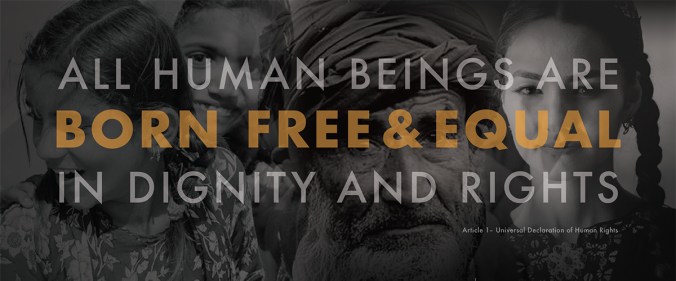
Article 1 of the Universal Declaration of Human Rights says:

“All human beings are born free and equal in dignity and rights. They are endowed with reason and conscience and should act towards one another in a spirit of brotherhood.”

Admirable sentiment but a work of fiction. In 2024, human beings are not born free and equal in dignity or rights. The Universal Declaration of Human Rights is a work of fictional political philosophy. In philosophy terminology, the premise of Article 1 is false. Philosophical essays start with a conclusion and attempt to prove the conclusion by demonstrating that each premise is correct. For example:

Socrates has two eyes.

Humans have two eyes.

Socrates has two feet.

Humans have two feet.

Socrates has two hands.

Humans have two hands.

Socrates must be human.

There is no evidence to prove Socrates was anything more than writings in Plato’s journals. Perhaps that is why the Open University teaches it to undergraduates. The maxim, however, is a matter of place and path dependency.  In Socrates’ time, the premises may have held. In contemporary Scotland, the assumption is as false as Article 1.

Despite my lack of enthusiasm for lived experience boards, I contribute to them for three reasons: 1. It keeps my skills ticking over. 2. I am networking for a purpose. 3. Peer-to-peer knowledge exchange can be a source of empowerment. When provided with the opportunity of sitting on the Scottish government’s human rights Lived experience board in 2022/23, I had to accept. However, I accepted because I wanted to listen and learn. If COVID-19 provided any valuable insight, the state failed the vulnerable rights holders not because of COVID-19 but because of an institutional design flaw. Chapter Five on the Social Enterprise/framework, Chapter Seven, discourse: What Society Missed, discusses possible mitigation methods.

Lived experience boards are designed to promote and develop acts of parliament or improve learning outcomes/frameworks. There is no debate. They achieve their desired outcome. Citizens/rights holders will have a subjective well-being premium for the board’s life cycle. The main reason for this subjective well-being premium is a sense of diversity, inclusion and belonging within the board. Rightsholders are placed on a pedestal, empowered by the belief of contributing to the government’s social policy. Concluding the board’s life cycle, however, the sense of belonging and empowerment has evaporated. Hope is replaced with anxiety. Altruism is replaced with egotistical thoughts. Thoughts like, was board membership the best opportunity cost? Can the board experience be used to find paid employment? The feeling of being back at the day job. The sense of being under-employed, under-valued, and unable to find a professional identity to satisfy a subjective void – the feeling of having zero legacies.

I dislike and admire lived experience boards equally, perhaps because I have too many expectations regarding my possible career prospects. Possibly, lived experience boards are a tool for achieving an outcome. Furthermore, citizens who are experts by experience are probably discarded as an afterthought on completion of the board, as citizens with lived experience were never endogenous to a system designed to produce an outcome. What gets measured gets done – that’s what they say in business schools. Well, I guess the well-being of rights holders is not measured.    

Readers, please don’t get the wrong idea. This chapter is not about any objective grievance relating to lived experience boards. What I have said is entirely subjective. However, a colleague who sat on the People Powered Health and Well-being reference group echoes my opinions (see chapter four). There is also academic evidence provided by ‘Cool Music: A Bottom-up ‘Music Intervention for Hard-to-reach Young People in Scotland’, which shows short-term projects can result in well-being issues for staff and clients. To prevent misreading, I believe lived experience boards must be phased out and replaced by community councils and reference groups taking a more active role in community and citizen empowerment. My view that lived experience boards should be phased out is not a grievance. It is an opinion. It is far from a social norm. And my views were dismissed by the Scottish government’s social enterprise funding body.

What I write now will split readers’ opinions. However, it is too important an issue for it to go undocumented. Like rights holders—citizens of Scotland—who don’t have the resources and capacity to challenge the inequalities that prohibit dignity, the Scottish Government doesn’t have the resources or capacity to provide every citizen in Scotland with human rights/dignity.  The objective evidence is clear and covered in detail in chapter seven. Subjectively, since 2014, I have worked directly and indirectly with the Scottish Government in some capacity. For the seven years before 2014, I was an active foot soldier for the SNP. I even went to vetting for candidacy for MSP. I am an idle supporter today because I became burnt out attempting to challenge/change the top-down institutional system from within a political system, a cornerstone of the institutional system itself. The focus of any society is on GDP growth. Goal eight of the UN SDGs is Decent Work and Economic Growth. GDP growth is an international aspiration. So economic growth should be. However, as Chapter Four shows, my paid employment lowers my subjective well-being/ dignity because I am unhappy with my professional identity.   Membership of the SNP provided false hope. I believed my SNP colleagues and I could bring about a fairer, healthier Scotland. Perhaps evidence exists to show inequality has reduced in Scotland since 2007. However, it has not been reduced to the point where the most vulnerable rights holders feel empowered and have dignity. Do I think the Human Rights Integration (Scotland) Act 2026 will enable rights holders and provide dignity for every Scottish citizen?  NO. No, I do not.    


Thank you for reading and watching the video. If you have any questions, ask them in the comments box.

Human Rights Integration (Scotland) Act 2026: Not workable without a social contract?

Disclaimer. This blog post you are about to read is subjectively motivated. However, the intent is not to criticise the integration of the United Unitions Convention into Scottish Law. The blog intends to empower the reader with the knowledge required to understand why I believe the Human Rights Integration (Scotland) Act 2026 will be dead on arrival.

For clarity, I have no desire to see the Human Rights Integration (Scotland) Act 2026 fail. Upon completing my master’s in social Innovation, I attempted to set up a social enterprise to empower local communities and citizens by supporting and recommending improvements to the Scottish government’s social policy. I joined the Scottish government’s Human Rights Integration Lived Experience board to achieve my social enterprise’s outcome. The objective was to learn from citizens how best to empower citizens in local communities. On reflection, that objective was achieved. Why do I believe the Human Rights Integration (Scotland) Act 2026 will be dead on arrival? Firstly, I think the framework I designed to achieve A-LEAF’s outcome supports the Scottish government’s Human Rights Agenda. To be denied funding by the Scottish government’s social enterprise funders indicates departments are not communicating on a Human Rights agenda. To successfully implement the Human Rights Integration (Scotland) Act 2026, the Scottish government departments require a Human Rights inclusive communication policy; this policy must recognise the Scottish government lacks the capacity and resources to empower every citizen in Scotland with dignity. To provide dignity to every citizen in Scotland, there is a requirement to shift the Human Rights agenda from top-down to bottom-up- There is a requirement to support social enterprises that aim to be commercially sustainable whilst supporting the United Nations’ Sustainable Development Goals and the Scottish National Performance Framework.

The National Performance Framework states:

We [Scotland] have a thriving and innovative business, with quality jobs and fair work for everyone.

Scotland’s Natonal Perforance Framwork

As a Social Innovation graduate, I strongly suggest to the Scottish government that extensive work is required to achieve the standards for said performance.      

The Second reason I believe the Human Rights Integration (Scotland) Act 2026 will be dead on arrival is basic economics. Before completing my MSc in Social Innovation, I completed my second undergraduate degree in Politics, Philosophy, and economics. Therefore, I believe I have some legitimacy regarding my economic claims. The backlash to Scotland’s First Minsters Humza Yousaf’s announcement that council tax in Scotland will be frozen in Scotland in 2024 has been intensive. However, by applying a Human Rights approach, the question becomes, can Scotland afford not to have a council tax freeze? Not can Scotland’s councils afford a council tax freeze.

The limitations of Devolution, as it relates to short-run capitalism, dictate that a freeze in council tax results in a cut in public services. While this holds in the short term, it is my opinion that moving towards a well-being/circular economy which supports the principles of a shared economy could mitigate the cost-of-living crisis. In the long run, this could result in lower council tax as social enterprises could provide crucial services.      

For example, instead of charging Glasgow city residents £50 to pick up garden waste. Social Enterprises could pick up the waste for free and sell the biomass to companies looking into sustainable and renewable energy sources.

Sustainability is a goal for the national performance framework:

We [Scotland] have a globally competitive, entrepreneurial, inclusive, and sustainable economy.

SNPF

While the national performance framework provides keywords, it offers no hope. Scotland’s economy is not inclusive. Only 49.6 per cent of disabled people living in Scotland are in work. I am willing to bet it is not full-time work, which allows for the highest attainable standard of living. Scotland’s economy is not sustainable. Paying £50 for garden waste pick up when there is a cost-of-living crisis is anything but sustainable.

Scotland’s economy may be entrepreneurial. Scotland’s economy is not social entrepreneurial-friendly. If it was, the cost-of-living crises could be mitigated. Furthermore, because business tax is reserved for Westminster, the benefits from tax from any profit before people and planet business goes down south and does not stay in Scotland.

Given that Scotland’s economy is not social entrepreneurial-friendly, inclusive, or sustainable, can Scotland’s economy be competitive?  

The third reason why the Human Rights Integration (Scotland) Act 2026 will be dead on arrival is Scotland’s social enterprises are charities, not social enterprises. At least not the academic definition of a social enterprise. That is a significant issue that cannot be underestimated. I have volunteered in Scotland’s third sector since 2010. I fully support Scotland’s third sector. I am on record saying parts of Scotland’s third sector act as a second chamber to the Scottish government. Scotland has a strong third sector. Scotland does not need a more extensive state supporting more third-sector organisations. Scotland needs a robust social enterprise sector that reports to, answers and monitors the Scottish parliament. That is how we achieve a Human Rights Integration (Scotland) Act 2026 that is fit for purpose.

This brings me to the second part of the blog post. The social enterprise I tried to set up challenges the top-down social norm that exists in Scotland. There is too much of what the state can do for me and not enough of what I can do for my state. Or to put it another way.

Ask not what your country can do for you- ask what you can do for your country.

JFK, 1961

Scotland is not the USA. Scotland is, however, part of the UK, for worse or for better. In implementing the Human Rights Integration (Scotland) Act 2026, the Scottish government should remember the teachings of John Loke and Thomas Hobbes. Yes, citizens may need a government to run the state. Society in Scotland has come a long way since the English Civil War. Scotland requires a new social contract. Scotland requires a social contract that empowers social entrepreneurship. And social entrepreneurs must empower local communities.

Watch the attached video to learn more about A-LEAF and stay updated on my views on Scottish and UK politics.   

A-LEAF: should it say or go?

This video is not public on YouTube. If you do like this content, let me know, and I’ll see about updating my video and recording equipment.

Human Rights (Scotland) Act [2026?]

The human rights lived-experience board meeting, taking place on Monday 21 November, shall focus on what key performance indicators to measure, to inform that the human rights act is achieving the desired outcome. This blog post will ask the readers three questions, question one will ask the reader how well you feel human rights are protected in Scotland right now. Question two will ask the reader what you think is the most important human rights issue in Scotland today. Question three will ask the reader how hopeful they are feeling that the new human rights bill will be successful in realising human rights for people in Scotland. After each question, there shall be a short discussion about the contemporary issues directly impacting the question.

What is the Human Rights (Scotland) act?

For international readers and national readers that do keep up to date with politics or the third sector, Human Rights (Scotland) Bill/Act is an act of the Scottish Parliament that will incorporate the UN Human Rights conventions into Scots law. Wait, it gets more interesting, the Scottish Government only has responsibility for devolved matters. Reserved matters are still the responsibility of the UK Government. What then does the devolved/reserved conflict as it relates to the power of Governments/Parliaments mean for the human rights of people living in Scotland? that is the question this blog will look to answer.       

How well do you feel human rights are protected in Scotland right now?

For international readers, this question and the two questions that follow will be hard or impossible to answer. While you- the international readers may have difficulties answering the questions, I would suggest that you continue reading. From an international relations lens, the Human Rights (Scotland) Bill/Act speaks volumes about the character of the Scottish Government/Parliament.

Turning attention to the question of how well you feel human rights are protected in Scotland right now. As a citizen of Scotland, I would conclude there is room for improvement. Poverty in Scotland 2021: Towards 2030 without poverty, tells you all you need to know about human rights violations in Scotland. While the case of Awaab Ishak, see here, is in England. Scotland’s housing situation is not much better. In Scotland today (2018)

2 per cent (51,000) of all households are overcrowded

19 per cent of homes have some level of urgent disrepair to a critical element and just 1 per cent had extensive disrepair

2 per cent (40,000) of homes (at the time of writing) do not meet the ‘Tolerable Standard  

0.7 per cent (18,000) have both condensation and some level of penetrating or rising dampness

(Cain, 2021, p. 212)

As the data above shows Scotland has to do much more to improve housing if the goal of the Scottish Government is to protect people living in Scotland from human rights violations.

What do you think is the most important human rights issue in Scotland today?

These questions that am putting to the readers are the questions the human rights lived experience board will answer on Monday. Therefore it is only fair to the reader, that the choices are made clear. Which options from the list are the most important human rights issue(s) in Scotland today?

  • Access to justice
  • Poverty
  • Disabled people’s rights
  • Women’s rights
  • Refugee and asylum seekers’ rights
  • Environmental rights
  • Older people’s rights
  • Children and young people’s rights
  • Something else
  • They’re all important- I can’t separate them all!

Readers may think, that because I referenced Poverty in Scotland 2021: towards 2030 without poverty. That I would say poverty is the most important human rights issue in Scotland today. If this is your thinking, I can inform you, you are completely incorrect. All choices above are equally important. To try to focus on one or two of the choices above without seeing the holistic picture is, hazardous to health.  

I have a seat on the Human Rights (Scotland) Bill lived-experience board because I am a member of the Health and Social Care Alliance Scotland. The third-sector organisations in Scotland know that a holistic co-produced model is required to achieve human rights in Scotland for all citizens.

What would human rights for all citizens look like? Given the political structure of Scottish society, only the Scottish Government and parliament can answer that question. In the decision section, I try and help the Scottish Government make the correct choice.     

How hopeful are you feeling that the new human rights bill will be successful in realising human rights for people in Scotland?

I recognise that this blog has not provided the reader with enough information to come to a balanced conclusion. I can, however, inform the reader that I am not hopeful, am probably more sceptical. Why sceptical you may ask. I said above that from an international relations lens, the human rights bill makes Scotland compliant with international policy. Therefore Scotland becomes viewed as open and outward-looking. Scotland should be viewed in this light. Scotland is a fantastic country with vast potential. With that said, If Scotland continues with the top-down approach to government, in which human rights are focused on access to justice and not on well-being and dignity then I see no outcome where the new human rights bill will be successful in realising human rights for people in Scotland.           

Discussion

Readers may or may not know of my background. If you do not, I was diagnosed with a brain tumour at the age of four. see the home page for more information. I have over ten years of experience in the third sector, I also have two undergraduate and one MSc degree. The reader must understand I conclude that the human rights (Scotland) bill will not have the outcome desired, based on 34 years of living with the side effects of a childhood brain tumour, 13 years as a member of the political party that governs Scotland, 10 years volunteering in the third sector- which includes Scottish government boards, and, three trimesters completing a masters degree in Social Innovation.

I would like to think my opinion carries some legitimacy. Yes am cynical, however, I hope am proven incorrect. I shall not hold my breath. The reason I am so pessimistic about the outcome is I believe the funding model for the third sector is unsustainable. Once the Human Rights (Scotland) Bill becomes the Human Rights (Scotland) Act [2026?] a lot of the burden is going to land on the table, not of civil servants but on the table of third-sector organisations. I have said this before the third sector in Scotland, at least third-sector organisations that are directly funded by the Scottish Government are civil servants by proxy. I believe these proxy civil servants act as a second chamber to the Scottish Parliament, and I would not change this framework. For the Human Rights (Scotland) Act [2026?] to have the desired outcome, there is a requirement to think outside the box. Bring forward the fourth sector.  

So there is no ambiguity, In Scottish policy farmwork and academia, there is no fourth sector.  Social Enterprise in practice and theory is defined as the third sector. Nicholls (2010) makes two observations about Social enterprises. (1) there is no definitive consensus about what the term means (2) the research agenda for the field is not yet clearly defined. Two points I want to make. The first point is academia and Scottish policy are wrong, Social enterprises are not operating in the third sector. The second point is Nicholls is also completely incorrect. Angela Constance when Cabinet Secretary for Communities, Social Security and Equalities has a foreword in Scotland’s Social Enterprise Strategy which makes direct reference to Robert Owen and New Lanark. My argument is simple New Lanark is the definitive consensus of what a social enterprise is. And, research agenda was set between 1785-1968. For readers that do not know the history of New Lanark click on the link here.  

I can hear the angry neo-liberal supporters, that’s in past. That is not how we do things in the contemporary UK, we like capitalism. Am sure Robert Owen would have considered himself a capitalist. It is said The Wealth Of Nations is simply the best book on political economy ever written (Butler, 2010, p.viii). The contemporary UK could have looked so different if Robert Owen had written The Wealth Of Citizens.

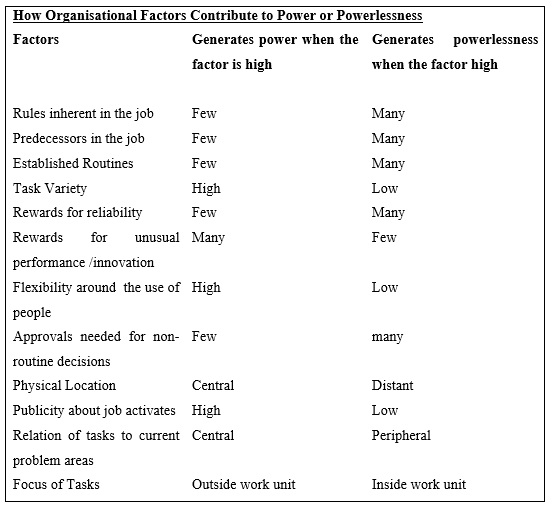
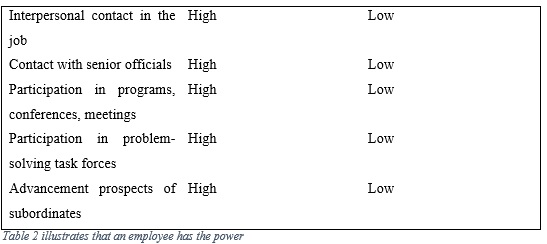
If readers require a more contemporary view of what a social enterprise is read The Social Entrepreneur: Making Communities work by Andrew Mawson. I’ll go on record and say Mawson is the only lord I would consider supporting based solely on the book. What though do Owen and Mawson have in common? They both understand the importance of stakeholdership. Ever since completing my MSc dissertation on the question: ‘why is there a subjective well-being premium in voluntary sector employment?’ I have become convinced that a stakeholdership model must Incorporate Rosabeth Moss Kanter’s thinking on power and powerlessness in the workplace. Figures 1 and 2 summaries Kanter’s thinking.

Figures 1 and 2 copied from my dissertation

Kanter’s argument is that when the factor is high employees have power or subjective well-being. My argument is when that when power is in the hand of employees that work for social enterprises. That power can be extended into the communities the social enterprise operates.  

Conclusion

The purpose of this blog is to inform the reader of the process of the Human Rights Bill/Act. This bill has not yet reached the parliamentary stage. Therefore it is impossible to know how members of the Scottish Parliament (MSPs) will react to the bill at the first reading. If MSPs react in the same way as me, then expect a lively debate and a lot of amendments. Note debate and a lot of amendments are not to be discouraged. Debate and amendments are a sign of power. As I said above we cannot afford the Human rights bill to be empowered from the top down. Yes, we have the human rights lived experience board. My concern is what happens to the people on the lived experience board after the Scottish government decides it no longer needs the board. I say to the reader, the Scottish Government, and, The Human Rights Consortium Scotland I effusively welcome lived experienced boards. I add, however, lived experienced boards must be more than short-term talking shops.

I said above that my dissertation answered the question ‘why is there a subjective well-being premium in third-sector employment?’. My conclusion to that question is important for how social policy transitions from the third sector to the fourth sector. My conclusion to my dissertation question was; yes, there is a subjective well-being premium in third-sector employment but only when employment is sustainable and achieves an external improvement. For example, employees of the Scottish Human Rights Consortium have a well-being premium/power because their employment provides citizens of Scotland with human rights. Here is the catch well-being premium/power is provided by the Scottish Government or the city council, as it is these institutions which enable change via innovative policy change. I fundamentally believe there is a need for third-sector organisations that act as the second chamber of the Scottish Parliament. Perhaps a sounding board for the Scottish Government is a better way to look at it. I take the view though that the third sector is not sustainable. Therefore society must move toward the social enterprise fourth sector model. The Fourth Sector model is the only model that will provide subjective well-being to every employee in the sector while providing business growth indicators (BGI’s) and Key performance indicators (KIPs) that will monitor human rights from a well-being dignity lens and not access to justice lens.

Recommendations

I was planning to go into some detail on my social enterprise’s business model. How it focuses on the well-being economy while encapsulating the well-being economy in side the circular economy.  My social enterprise will use BGI’s that are focused on corporate social responsibility and use KIPs that are directly linked to The UN Sustainable Development Goals. I feel, however, that splitting the more technical aspects into another blog or support document may be more useful to the reader.    

I am hoping to have a zoom meeting in February/March regarding my social enterprise. I do recommend reader join that meeting. Details to follow.  

Who is David M Howie?

Who is David M Howie? A question I have asked myself on several occasions. The answer has always evaded a conclusion. I became very interested in the notion of human being vs “person” while studying philosophy at the Open University. The idea that David M Howie could be the same human being as the five-year-old diagnosed with a brain tumour. However, could be a completely different person thirty-three years after diagnosis, is an intriguing concept. So who is David M Howie? Let us address the obvious. David M Howie is a son, a brother, an uncle, an MSc graduate and a citizen of the UK. Hence the dot UK of the URL. The list above is what I am. Not who I am. IF I cannot identify who I am. By what I am. It stands to reason that no other person can identify, who they are. By what they are.                

Nothing I have said above is intended to sound condescending. In philosophy when attempting to convince the reader of the legitimacy of the argument the premises which follow the conclusion must also be true. For example, Plato concluded Socrates is human. The argument went something like:

  • All human beings have two legs (in Plato’s time)
  • Socrates has two legs.
  • Socrates must be human.

They were simpler times.  That said, however, contemporary policy development follows the same basic principles. What I am about to say may sound a little condescending. All am doing is highlighting facts. More men than women sit on executive boards. The gender pay gap is still a major issue. Per head of population, more non-disabled people than disabled people will work. Those disabled people that do work are likely underemployed (like myself). Here is the controversial statement if you are white, male, non-disabled and privately educated you are more likely to be in a position of power. Again that is not intended to be controversial. It is a demographical and geographical fact.                   

 let me ask myself that question again. Who is David M Howie? He is a dreamer. I dream of a reduction in inequality. I dream of a society where “othering” is not a thing. And I dream of a society where my lived experience and education will be taken as legitimacy and provide an opportunity for a better tomorrow.

In previous blogs, I have quoted that inspirational speech from Rocky. In case you don’t know the one am referring to here is the link. 2 minutes and 45 seconds in rocky says

Until you start believing in yourself, you are not going to have a life.

Rocky Balloa 2006

My problem could be believing in myself a little too much. Perhaps in a society, that favours white, male, non-disabled and privately educated citizens people who are experts by experience and have the academic background to support their argument still are not supposed to dream. Perhaps my life is a struggle for equality. Perhaps that is who David M Howie is.

Legitimacy

In previous blog posts, readers will remind me saying: living with the long term conditions caused by a medulloblastoma diagnosis results in disillusion with society and the inability to identify the self within the social norms of society. I have tried to explain how having no sense of the self is like having no idea of who you are. I have without prevail tried to achieve acknowledgement of this feeling. The look of complete blankness on the faces of friends and family is soul-destroying. If my brain was nothing more than a biological machine I would possibly hit the reset button- full restart. One problem the human brain is not a biological machine (not only). Our brains, our memories, define who we are.

Eleanor Roosevelt once said

I am who I am today because of the choices I made yesterday.

Elenore Roosevelt

That quote is 100 per cent correct. Who we are as individuals is past dependent. I just want to say to anyone that has ever verbalised the words: “only you can change your life”. You have no idea how frustrating and condescending that sentence is. To anyone that has been on the receiving end of that sentence, I apologise, the person that muttered this sentence has no understanding of the impact it had.   

Yes, who we are as individuals have a past dependency, just like social policy and the environmental conundrum humanity finds itself. As individuals and as a society,  we have a choice. We can stay on the road to self-destruction or we get off and try another path. How though? If our paths are past dependent, how can we change the path?  

I will admit I don’t know how to get off the path. Sometimes I think it would be simpler to go back and apply for nine to five jobs. That is a path, however, that the brain just will not go. I know there is no self at the end of that path or anywhere in the discourse of it.

My younger brother runs a successful copy write company. His company tagline is Short, Sharp, Straight to the point. I guess  I would not make a good copywriter. My point is this. As humans, we want simple things in life. Things like a home, a job, a community, clothing and food. A simple list correct? All basic human rights?

I remember Zach Braff aka J.D in an episode of Scrubs saying something like

Your work colleagues truly do become your family.

J.D

I think the above conclusion only holds true when the following premises follow

  1. You have a sense of belonging in your workplace
  2. There are other persons like you in your workplace.

Remember that Short, Sharp, Straight to the point tagline? Yes, that one. That is how we want to run our lives, our work, our relationships. The problem is, for 14 million disabled people and everyone else that feels they do not belong. There is nothing Short, Sharp, Straight to the point about anything in life. Except for that verbalised statement

“Only you can change your life”.  

My point is this. Despite nothing being Short, Sharp, Straight to the point – the way society wants it. Everything I have said has lived experience behind it. In a sense when policymakers say they want people who have lived experience to inform policy. What I take away is: policymakers want experts by experience to inform social change. However, as experts by experience have no understanding of the path walked, this is where experts by experience, legitimacy must stop.  

Fundamentally I disagree. I strongly believe people who have lived experience are best placed to develop innovative solutions to complex problems. For clarification what I have said about policymakers, including policy networks is subjective, based on my lived experience. Perhaps I am a little frustrated that I have been volunteering in the third sector for ten years and am unable to find an employment position in the sector. Perhaps am more frustrated that I look at the Scottish third sector and see box-ticking shadow, civil servants. Nothing against civil servants. It is just when you have been in and around the third sector you tend to hold third sector employees to higher standards. Nothing against my political colleagues either. Essentially what I want the reader to take away here is I have a lifetime of lived experience. I am an expert by experience ten times over. I am also, however,  a PPE undergraduate and Social Innovation postgraduate graduate. I see myself not only as an expert by experience but also as an expert by academic experience. I have more lived experience than most disabled people. I also have more academic experience than most non-disabled people. You would therefore think. Would you not? Those expressions of no perception of the self or no idea who I am as a person would be received in good faith-“bona fides”. Giving the legitimacy my lived and academic experience should carry. Instead, my views are met with confusion, bewilderment and disbelief. I should be grateful After all, I have a dead-end job, am underemployed and I lived longer than the five years the medical model said I should.