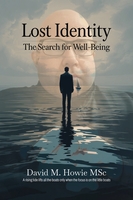
In the book ‘Lost Identity: The Search for Well-Being I talk about neurodiversity. I have come to the conclusion- after watching people talk about their neurodivergent minds – that I don’t understand neurodiversity- not even a little, not even at all.
If I don’t understand neurodiversity, when I self-diagnose as neurodivergent, post-childhood medulloblastoma, how can anyone who is neurotypical? I suppose they can’t, and I suppose they never will. That is, unless society starts to have a conversation about mental health.
As I say in the book, I have decent well-being; for the most part, I am happy with life. Of course, in an ideal world, I would be working in a profession focused on social policy and research, one that encompasses every citizen and fosters community development. Earth, however, is not a utopia. Earth is the island of necessity. On the island of necessity, no one gets what they want, and even fewer get what they require to live well.
For people who are neurodivergent, the WHO organisation suggests that it could be as high as 40%. We mask in plain sight. Not hiding, but also not having the strength to be ourselves.
I must admit, I find myself in a very unsettling situation. I thought that when I published the book, one of two things would happen. One. It would be the end of the project, and a new one would begin. Two. I would have achieved enough to move on with my life, so that I could perhaps now pursue a career on the neurotypical island of necessity. Something, though, is pulling me back. There are more chapters to be written. I alone can write them. I cannot explain it. There are many better writers than I. Why then must I be the writer of the next chapter? The only explanation available is that the book/project is not yet complete.
Someone on TikTok describes 24 hours in their life as a routine that they cannot complete, a never-ending cycle that never seems to end. Groundhog Day. Or a time loop, if you are a Sci-Fi fan. Lucky for me, my mind is not stuck in a time loop or doomed to repeat the same day over and over, like Bill Murray in Groundhog Day.
I don’t know how far down the rabbit hole the far end of the neurodivergent mind goes. From what I understand- from watching TikTok videos- it is disabling. What I do know is that I feel compelled to follow the white rabbit. Compelled. Yes. But in my own time. I am not free yet to leave the island of necessity and join the island of utopia.
I am not that far down the rabbit hole to qualify for free money from the state to do whatever I like all day. Not that that is what neurodivergent citizens at the dark end of the spectrum are doing. Remember, neurodivergent citizens are not a homogeneous group; it is not logical. It is more like a prison for the mind. I have a front row seat to the prison. Or at the movie theatre, if you prefer. The difference is I can leave and return. So many citizens don’t.
Physically disabled citizens
Subjectively, physically disabled people do not see the world in the same way as a neurotypical citizen. I don’t like the word damaged. That would be a neurotypical perspective. Without the lived experiences of a neurodegenerative citizen, it is impossible to understand how the neurotypical mind works.
That is why a one-size-fits-all approach to the integration of physically and neurotypical disabled citizens will not work.
What is next?
I start working on the second book: The Search for Well-being: Never Ends. It is a working title. It has no chapters, paragraphs, or words. The shape the next book will take shall depend a lot on what happens in 2026, after the Scottish parlament election. More importantly, though, the next book will depend on my subjective understanding of where my mind lies on the neurodivergent spectrum.
This blog post serves as a brief introduction to the steps that follow. As a neurodivergent person, self-diagnosed, my steps can change daily. What would it be like to live if your daily steps just repeated?
Given that Nature and Nurture are equal components of the Scottish government’s curriculum for excellence, it is essential not to forget my pre-medulloblastoma diagnosis years. Of which there were four. I was born on Saturday, May 7, 1983, at 23:00 in Glasgow Royal Maternity Hospital. Unknowing to me then, I would spend the majority of my childhood and most of my teen/early adulthood in a hospital, mainly as a day patient. By now, the reader should understand my medical history from reading chapter two. I did not say I buy from third parties regarding contemporary sensory issues in Chapter Two. That is, I purchase hearing aids and glasses from retail stores. My contact with the NHS is an annual phone call.
My parents and I lived on Walter Street in Glasgow. Walter Street is located in Glasgow’s East end in Haghill. The Scottish Index for Multiple Deprivation (SIMD) shows that Haghill is deprived of health, education, income, employment, and housing and is a high-crime area. What Haghill has got is access to public transport. At least citizens of Haghill have public transport to Merchant City East – known to locals as Dennistoun. My parents and I did not stay in Haghill long; we moved to Ballindalloch Drive, just off Alexandra Parade, when the local housing association offered to buy my parents and my first home.
Despite what the SIMD show about Haghill. It cannot remove the nurture of the community. My parents’ nature and the community’s nurture created the confident, outgoing child I was. The new flat at 28 Ballindalloch Drive was a top flat. It had a kitchen, bathroom, and separate bedrooms, unlike Walter Street at the time. However, there was no lift. I propose a motion. Every newly built multi-story flat above two floors must have an elevator (for my USA readers). The lack of a lift was why the family moved to 22 Ballindalloch Drive some years later. I’ll discuss that in chapter seven. The story about that can be found in the UK Parliament Library.
Despite resistance from the local school headteacher, I attended Alexandra Parade Primary School only months after the removal of the medulloblastoma, chemotherapy, radiotherapy, and stroke. Even as a four/five-year-old, I refused to take NO for an answer. From TikTok, I’ve learned that is a characteristic of people with Brain Tumours. No does not mean no—no means YES, but in my way. As expressed above, I was a bright child. The academic curriculum of primary 1 to 3 was not challenging. I strolled into primary four without difficulty. Well, there was one issue, not academic but physical. I could not tie my laces. I don’t know when I learned to tie my laces, but it was later than most of my classmates. In hindsight, this was when my primary school education was about to take a few bumps in the road.
Chapter six is titled “Do I consider myself disabled today?” I provide details on the nature of my physical limitations in that chapter. Those physical limitations contributed to my learning disabilities problems. At the time of writing, my education issues are not defined as learning disabilities. Hopefully, the learning disabilities, autism, and neurodiversity (Scotland) Act 2026 will correct a wrong and help support citizens with brain tumours.
As I reminisce back to my primary 4-7 years equipped with a BA (Hons) and an MSc as of 2024, blaming Chemo brain – as discussed in chapter two, would be too convenient to explain my poor academic performance. I propose that the educational system between 1992-95 was unequipped to educate a child recovering from a medulloblastoma. Is the educational system equipped to deal with an equivalent conundrum in 2024? I am not too sure in which primary I was tested for Dyslexia – difficulty reading due to problems identifying speech sounds and learning how they relate to letters and words. The outcome of the Dyslexia test was negative, as I could verbally spell the word. However, I could not write the word on paper.
Primary school is a blur. I have no vivid memory of those years. I remember silly things like finding a hedgehog while construction of the M8 Junction at Alexandra Park Street was in place. Or I was getting attacked by random cats for wearing a shell suit. It was the late 80s and early 90s. I still believed the World Wrestling Federation (WWF/WWE) was a combat sport. Apparently, I also let Sharon and Searha let me believe stray cats should be cradled like newborn babies. No judgments. That was the Nurture of my childhood.
I commenced secondary school in 1995 – Whitehill Secondary. Even then, I preferred my company to that of my classmates. It would not be inappropriate to say I prefer the company of animals over humans—even hedgehogs and cats.
Whitehill was more equipped to attend to my educational needs. I was provided with a laptop to help with spelling and grammar. I achieved acceptable standard grade results—grades 3 and 4 in all classes except French. I struggled with English. What chance did I have with French?
Above, I said I was tested for Dyslexia at primary school. There must have been a misconception from Whitehill’s English department that the results of the Dyslexia test were positive. I was discouraged from reading long books when writing a book review. Even at Whitehill, I was written off. I was written off not because teachers wanted me to fail but because there was no framework for teaching childhood medulloblastoma survivors. In 2024, I am not convinced Getting it Right for Every Child – the Scottish Government’s approach to supporting children and young people would have provided the support I required.
At Whitehill’s awards ceremony in 1998, I was awarded the leaps and bounds prize – for the student who had made the most progress. Take a second to process the date. I was diagnosed with a medulloblastoma in 1987. Either It took ten years for the brain to develop after the removal of the brain tumour, or the introduction of the internet into Scottish society provided the opportunity to learn in a way my brain required, i.e. for words to be verbally repeated back to me and corrected in real-time. Possibly both.
The following year, I had an attendance rate of 97 per cent. Perhaps there is something in peer-to-peer support and social capital, after all.
The 2000/01 year was a wasted year. I was accepted into Glasgow College of Building and Printing for my HND in March of 2001. I did not want to be a Whitehill in the last few months. Graduation on June 14, 2001, could not come quickly enough.
I enjoyed my time at the Glasgow building and printing. It is a shame to see that in 2024, the building is a shell of its former self. Hopefully, by the time this book is published, the building will operate as new flats and office space. I was in the building on September 11, 2001 – for Dugs Data Analysis and Database Design class. I remember Grant- a fellow student. Grant was one of the older guys, a grungy rocker who should have been studying music technology, not information and media technology. He must have been watching a news stream. Grant’s words evade me; I remember Dug running to the monitor to view images of the Twin Towers being hit.
I was in New York, attending Hole in the Wall Gang Camp – a children’s camp for seriously ill children and their families when I was 14 years old in 1997. I was only in Manhattan for three days. However, I must have walked past the Twin Towers. I am also sure our party of four or five seriously ill children and two adult social workers were admitted to Hard Rock café – in New York, with the only other customers being Michael Lee Aday, his wife, and their daughter.
Years later, in 2018, I was in South Africa, volunteering with Global Vision International. On one weekend off, I visited the District Six Museum. On the wall is this quote
“It struck me that our history is contained in the homes we live in, that we are shaped by the ability of these simple structures to resist being defiled.”
Achmat Dangor
Our history is not only contained in the homes we live in. It is also contained in the educational establishments we attend. That is why I get chills every time I walk past the Building and Printing structure where I once bought my first zip drive. Yes, I am that old.
After completing my HND, I attended Glasgow Caledonian University for a BSc in Multimedia Technology. I dropped out after one year, gaining a BSc in Multimedia Technology. At the time, I was more interested in hardware, or so I thought. Looking back, I was just a bad coder. I graduated in 2005 and did not return to higher education until 2014.
The return to higher education in 2014 was strategic. I joined the SNP in 2007, and as of 2014, I was still an active member. More about that in Chapter 3 – employment. The Open University (OU) allowed me to work and learn simultaneously. Politics, Philosophy, and Economics. What else would I have chosen to study? Reminiscing the OU provides students with the foundation to proceed in the higher educational journey. Each level and each course is designed to enable students to develop the skills required for incremental progression. For example, “Making Social Lives” and “Exploring Social Lives” were simplistic content for a ten-year experienced political campaigner and not academically challenging. With hindsight, the point of those modules was to instruct students in the academic writing process—a skill I was required to learn years later. The lesson learned was to learn to walk before you run.
I graduated from the OU in 2019 with a BA (Hons) PPE. Back to GCU, this time to study Social Innovation. Remember I said I had not learned to write academically in 2014? In 2021, I still had much to learn about academic writing. On reflection, I was accepted into the class because of my unpaid experience in Scotland’s third sector, not my academic achievements. After a resit or two, I was allowed to complete my dissertation. My dissertation question answered, “Why is there a subjective well-being premium in voluntary sector employment?”
I completed my dissertation thanks to my supervisor, Dr Tom Montgomery. I graduated from GCU in 2021 with an MSc in Social Innovation.
Social Innovation is business ethics. At least, that is how I view it.
Note that this is NOT a blog post. Like the other writings, it is a rough draft of the book I want to write.
What makes a person the same person over time? A British philosopher, Nigel Warburton, introduced me to personal identity via the “Ship of Theseus” thought experiment.
Now, let’s embark on a journey of contemplation. Imagine Theseus’s ship, lost at sea; its hull is the only remnant. A new vessel is painstakingly crafted from the salvaged wood, bearing the same name as the original. But is this new ship truly the same as the old one? I invite you to delve into this question, explore how you perceive personal identity in this context, and consider whether you can draw any parallels to your life experiences.
As we grapple with the ship’s enigma, let’s delve into a more profound question: Can a person remain the same over time? This is not just an abstract philosophical puzzle; it’s a question that each of us, in our unique ways, has to confront. Reflecting on my journey, I arrive at a resolute conclusion: I am the same person today as the four-year-old child who courageously faced a Medulloblastoma, a brain tumour. This personal insight, born from the depths of my experiences, underscores the profound depth and complexity of individual identity.
In philosophy, ‘personal identity’ refers to what makes a person the same person over time. It’s important to note that ‘personal identity’ is distinct from political ‘identity’ (which encompasses cultural and ethnic origins, sexual preferences, and so on). In my writing, I use ‘personal identity’ and ‘professional identity’ interchangeably in chapter five-Social Enterprise. Both these aspects, my personal and professional identity, contribute to defining the person I am, including the child diagnosed with Medulloblastoma in 1987.
I cannot say with certainty. Medical records were received after the time of writing. However, a small percentage of medulloblastomas related to gene changes can be passed down through families (Cancer.gov). I am 90 per cent sure my medulloblastoma was genetic. The person I am today was preconditioned before birth.
Philosophy, however, is not written with childhood medulloblastoma survivors in mind. Therefore, when philosophers argue their conclusions supported by true premises, they do so based on undeniably correct objectivity. My argument here is subjective, remaining so until the completion of chapter six: Do I consider myself disabled today? In philosophical terminology, my conclusion, my subjective conclusion, is that I am the same person through time because of a traumatic event—a childhood medulloblastoma diagnosis.
Hopefully, the reader is beginning to grasp who I am. Ponder this question: Can the person I am today with, 36 years of navigating a society, a society based on institutional objectivity, have subjective happiness/ well-being? Shawn Achor, writing in The Happiness Advantage, points out that ‘the most enjoyable part of an activity is the anticipation’. What if the anticipation of a career change, system change, or recognition never comes? How is happiness/well-being affected?
The remainder of this chapter focuses on my childhood medulloblastoma diagnosis and the side effects of chemotherapy, radiotherapy, and stroke. As mentioned above, I have not received my medical records at the time of writing. I write this chapter from memory using published documentation to provide legitimacy to my degrading memory.
In the UK, 52 children are diagnosed with medulloblastoma each year. In 1987, I was unlucky enough to be one of the 52. Medulloblastoma is the most common childhood malignant (high-grade) children’s brain tumour. Malignant means the tumour is cancerous. A high-grade malignant medulloblastoma means it is a miracle I am here to write this book 36 years after the diagnosis.
On social media, I was asked what type and sub-type of medulloblastoma I had. Honestly, that information evades me. Once I receive my medical history, I shall insert that information into the chapter notes.
As a child, my favourite cartoon was ‘He-Man and the Masters of the Universe’. I had all of the figures, including Orko. Orko is the comedic character who comes across as a clumsy oaf. The silly little sorcerer provided many laugh-out-loud moments for the three-year-old I was. On reflection, when my parents started to call me Orko. Alarm bells should have gone off. No parent wants to call their child a clumsy oaf. No parent wants to find out their child has a medulloblastoma. The reality is that children who become clumsy oafs over a short period could have a brain tumour. If you see this change in your child, I urge readers to go to the doctor and demand a referral for a scan.
Cancer Research UK lists the following as symptoms of a medulloblastoma: headaches, sickness, double vision, standing or sitting unsupported, loss of appetite, and behavioural changes.
Double vision and standing or sitting unsupported. I dub this Orko syndrome. If your child has Orko Syndrome, get to the doctor for a referral for a scan, and don’t take no for an answer. I don’t think I ever lost my appetite. My issue was that I could not keep any food down concerning the behavioural changes. I spent most of my pre-diagnosis days in a dark room to stop the headaches. That is a massive behavioural change for a child who just turned four.
Above, I mentioned that only 52 children in the UK will be diagnosed with a medulloblastoma each year. Therefore, at least today, I hold no animosity towards the general practitioners (GPs) who misdiagnosed my condition as jealousy of my younger brother and play-acting. Fiercely, I condemn the GPs, who in their right mind think a four-year-old is voluntarily making himself vomit to the point of death out of jealousy of a younger sibling? The thought alone is outrageous. Outrageous, disgraceful, bordering on eccentric.
Eccentricity is supported by objectivity. Society supports institutional objectivity, and social norms reinforce it. Therefore, I cannot condemn GPs because they are part of a system of governance built on institutional objectivity. As a social science graduate, I am tasked with understanding society, not asking for a system change. Sorry, I cannot do that. At this point, the readers should understand I am the same person today, not because of the medulloblastoma. I am the same person today because of society’s inability to support adults who had brain tumours as children.
Cognitive awareness of the months/years directly following my medulloblastoma diagnosis is absent. Perhaps it is for the best, as it allowed me to move past that experience quickly. By the time I was eighteen, I wanted nothing to do with my medulloblastoma diagnosis. That is getting ahead of the story. Not having my medical records on hand prevents me from providing you, the reader, with the technical details of my brain tumour. A friend on social media had a non-malignant brain tumour the size of a cream egg. Sorry, @Tumourkilller, my malignant brain tumour dwarfed your non-malignant brain tumour. I am a survivor. I have bragging rights. I am attempting to tell the reader that not having my medical records on hand is a blessing, making writing this chapter more authentic. I hope the authenticity I give the reader will be returned with legitimacy.
Objectively, surviving a high-grade malignant medulloblastoma is more impressive than surviving a non-malignant brain tumour the size of a cream egg. That’s how an institutional system with objective evidence would view it. However, I am too altruistic and understand the importance of viewing the situation holistically to take that view. @Tumourkiller is authentically telling his story to empower himself and inform his viewers. Tumour killer (Ryan) deserves legitimacy. Legitimacy, I argue, provides the speaker with dignity. What the GPs did, what society did, removed my parent’s dignity. Only 52 children are diagnosed with high-grade malignant medulloblastoma each year in the UK. I understand the objective view of the GP. I also understand that place and past dependency matter. The GP would have lacked the knowledge and understanding to diagnose a child with high-grade malignant medulloblastoma. Understand, yes; forgive, no. What the GP did was remove any legitimacy my parents had. Therefore removing their dignity. That objectively is a breach of human rights. My views on human rights in Scotland were covered in chapter one.
In 1987, I was diagnosed with high-grade malignant medulloblastoma—a childhood brain tumour.
“Medulloblastoma is likely to grow quickly and can spread to other areas of the brain and spinal cord. Around 30 out of 100 children (around 30%) have medulloblastoma that has spread when they are first diagnosed.”
(Cancer Research UK, n/a)
I was one of the 70 per cent of diagnoses where the cancer had not spread to other parts of my body—no secondary cancer – the name given to cancer that spreads. Additionally, to date no recurrence. I do not know the type of chemotherapy or dosages I received. I also don’t know anything about the radiotherapy I was given. I remember having to be held still in a mask attached to a table—readers who have watched The Man in the Iron Mask, like that, only shackled to a table with radiation being fired at me. Today, my spinal cord is shunted due to the radiotherapy. Though better to be a few inches shorter than biologically expected than dead.
I cannot be too sure about the side effects of the chemotherapy. Today, from what I know about neurodivergent individuals, I think my brain works similarly. However, that could be due to removing the tumour damaging surrounding parts of the brain, not the chemotherapy. I believe I had some form of learning disability in primary school caused by the chemotherapy. More realistically, however, is a sensory loss – hearing and sight were an issue as far back as the late 80s. I refused to acknowledge it. The education system, NHS, social workers, and even my parents failed to see it.
As far as the stroke is concerned, I have a slight speech impediment, cannot walk in a straight line, and have constant double vision. Today, I am considering asking for a symbol cane. To stop the double vision, I have to blind my left eye, and as I am sure you can imagine, walking with only one eye while not being able to walk in a straight line has its difficulties. A symbol cane would inform the public that I have sight issues.
In the fictional case of Howie vs. Scotland, the judge had no choice but to find in my favour. Scotland failed Howie by not delivering on getting it right for every child (GIRFEC). Scotland could not protect my human rights—mainly rehabilitation and the right to live in the community. Scotland failed to transition Howie from GIRFEC to Getting It Right for Everyone (GIRFE).
Chapter One: Why I don’t have a personal and professional identity.
The video above explains why I am re-writing my book. However, before doing so, I wanted to allow you to read what was written as a first draft of the chapters. See below for Chapter One.
Politics engulfs the life of every citizen on planet Earth. However, most Scottish citizens need to learn the difference between social policies devolved to the Scottish Parliament and those reserved for Westminster. Furthermore, most citizens have yet to care or have given up hope in both parliaments.
17 April 2007—the year the journey started. I don’t regret joining the SNP in 2007. My second undergraduate degree, MSc, volunteering with Globel Vision International, and numerous memberships with third-sector organisations are directly inherent to my SNP membership. However, SNP membership is the primary reason I lack a professional identity. I joined the SNP because I believed in 2007, which I think is true now. Scotland should be an independent country. However, over the past seventeen years, I have realised that independence is for nothing if citizens are not empowered. If citizens lack hope, communities become nothing more than industrial, capitalist ghost towns with the sole purpose of serving only shareholders, with no regard for stakeholders. Then why rock the boat?
2014 was the year I decided to return to education and find employment in social policy (see chapters three and four, respectively). I have ten years of experience in social policy, but I need help finding paid employment, which lowers my professional identity. In any other field of employment, ten years would demand legitimacy and respect. However, citizens who are experts by experience, including myself, are provided legitimacy only when the Scottish government wants to bring forward a new act of parliament or strengthen an act that has become outdated. This process is unacceptable, unsustainable, and intolerable. The process of lived experience boards is a two-tier system—citizens who contribute to growth in society and citizens who are supported by growth in society. Note the oxymoron. Growth in the UK/Scottish economy has stalled. Cuts to vital services give that perception. Objectively, GDP growth has been steady. Steady growth results in budget cuts. Illogical? Undebatable, budget cuts lower capacity and resources. I argue, therefore, that citizens cannot be supported in improving their well-being because the state lacks the capacity and resources (see Chapter Seven).
Chapter four, Employment, outlines my contributions to lived experience boards since 2014. The pivot here is on two expected acts of the Scottish Government. The Human Rights Integration (Scotland) Act 2026 and the Learning Disability, Autism, Neurodiversity (LDAN) (Scotland) Act 2026. The latter I have little experience. However, the LDAN bill is essential on a personal level for two reasons. Reason one: I am altruistic, more so than most citizens. I care greatly about the well-being of all citizens and how social policy correlates with citizenship well-being. The essential point is that evidence highlights that autistic citizens are more caring than neurotypical citizens. Additionally, autistic citizens talk more in statements. I am not suggesting I am autistic. However, I was diagnosed with a medulloblastoma – a cancerous brain tumour – at the age of four. A reasonable conclusion is that my brain is not neurotypical. Take this book for example. I am conveying my reasons for lacking a subjective well-being premium – I feel underemployed, undervalued, and not given the legitimacy I deserve. I have, however, chosen to convey a personal grievance through societal content, social policy, and the well-being of others. Furthermore, Chapters one to six are written in statements. I write in statements – as if my subjective opinion is a fact.
My opinions are not facts. What is a point other than an opinion that has been given legitimacy via an act of parliament or agreed upon as a social norm? My second reason for having a vested interest in the LDAN Bill/Act is that the Scottish Government will legitimise both the Human Rights and LDAN Act by 2026. But is legitimacy not subjective? What if both Acts fail to secure dignity for rights holders? What then? Because rights holders in question are some of the most vulnerable citizens in society. I strongly suggest that despite the legal guarantees set out in the Human Rights Integration (Scotland) Act 2026, the most vulnerable citizens don’t have civil liberties or the resources or capacity to set up a civil disobedience movement to gain their civil rights, better known as dignity.
Article 1 of the Universal Declaration of Human Rights says:
“All human beings are born free and equal in dignity and rights. They are endowed with reason and conscience and should act towards one another in a spirit of brotherhood.”
Admirable sentiment but a work of fiction. In 2024, human beings are not born free and equal in dignity or rights. The Universal Declaration of Human Rights is a work of fictional political philosophy. In philosophy terminology, the premise of Article 1 is false. Philosophical essays start with a conclusion and attempt to prove the conclusion by demonstrating that each premise is correct. For example:
Socrates has two eyes.
Humans have two eyes.
Socrates has two feet.
Humans have two feet.
Socrates has two hands.
Humans have two hands.
Socrates must be human.
There is no evidence to prove Socrates was anything more than writings in Plato’s journals. Perhaps that is why the Open University teaches it to undergraduates. The maxim, however, is a matter of place and path dependency. In Socrates’ time, the premises may have held. In contemporary Scotland, the assumption is as false as Article 1.
Despite my lack of enthusiasm for lived experience boards, I contribute to them for three reasons: 1. It keeps my skills ticking over. 2. I am networking for a purpose. 3. Peer-to-peer knowledge exchange can be a source of empowerment. When provided with the opportunity of sitting on the Scottish government’s human rights Lived experience board in 2022/23, I had to accept. However, I accepted because I wanted to listen and learn. If COVID-19 provided any valuable insight, the state failed the vulnerable rights holders not because of COVID-19 but because of an institutional design flaw. Chapter Five on the Social Enterprise/framework, Chapter Seven, discourse: What Society Missed, discusses possible mitigation methods.
Lived experience boards are designed to promote and develop acts of parliament or improve learning outcomes/frameworks. There is no debate. They achieve their desired outcome. Citizens/rights holders will have a subjective well-being premium for the board’s life cycle. The main reason for this subjective well-being premium is a sense of diversity, inclusion and belonging within the board. Rightsholders are placed on a pedestal, empowered by the belief of contributing to the government’s social policy. Concluding the board’s life cycle, however, the sense of belonging and empowerment has evaporated. Hope is replaced with anxiety. Altruism is replaced with egotistical thoughts. Thoughts like, was board membership the best opportunity cost? Can the board experience be used to find paid employment? The feeling of being back at the day job. The sense of being under-employed, under-valued, and unable to find a professional identity to satisfy a subjective void – the feeling of having zero legacies.
I dislike and admire lived experience boards equally, perhaps because I have too many expectations regarding my possible career prospects. Possibly, lived experience boards are a tool for achieving an outcome. Furthermore, citizens who are experts by experience are probably discarded as an afterthought on completion of the board, as citizens with lived experience were never endogenous to a system designed to produce an outcome. What gets measured gets done – that’s what they say in business schools. Well, I guess the well-being of rights holders is not measured.
Readers, please don’t get the wrong idea. This chapter is not about any objective grievance relating to lived experience boards. What I have said is entirely subjective. However, a colleague who sat on the People Powered Health and Well-being reference group echoes my opinions (see chapter four). There is also academic evidence provided by ‘Cool Music: A Bottom-up ‘Music Intervention for Hard-to-reach Young People in Scotland’, which shows short-term projects can result in well-being issues for staff and clients. To prevent misreading, I believe lived experience boards must be phased out and replaced by community councils and reference groups taking a more active role in community and citizen empowerment. My view that lived experience boards should be phased out is not a grievance. It is an opinion. It is far from a social norm. And my views were dismissed by the Scottish government’s social enterprise funding body.
What I write now will split readers’ opinions. However, it is too important an issue for it to go undocumented. Like rights holders—citizens of Scotland—who don’t have the resources and capacity to challenge the inequalities that prohibit dignity, the Scottish Government doesn’t have the resources or capacity to provide every citizen in Scotland with human rights/dignity. The objective evidence is clear and covered in detail in chapter seven. Subjectively, since 2014, I have worked directly and indirectly with the Scottish Government in some capacity. For the seven years before 2014, I was an active foot soldier for the SNP. I even went to vetting for candidacy for MSP. I am an idle supporter today because I became burnt out attempting to challenge/change the top-down institutional system from within a political system, a cornerstone of the institutional system itself. The focus of any society is on GDP growth. Goal eight of the UN SDGs is Decent Work and Economic Growth. GDP growth is an international aspiration. So economic growth should be. However, as Chapter Four shows, my paid employment lowers my subjective well-being/ dignity because I am unhappy with my professional identity. Membership of the SNP provided false hope. I believed my SNP colleagues and I could bring about a fairer, healthier Scotland. Perhaps evidence exists to show inequality has reduced in Scotland since 2007. However, it has not been reduced to the point where the most vulnerable rights holders feel empowered and have dignity. Do I think the Human Rights Integration (Scotland) Act 2026 will enable rights holders and provide dignity for every Scottish citizen? NO. No, I do not.
Thank you for reading and watching the video. If you have any questions, ask them in the comments box.
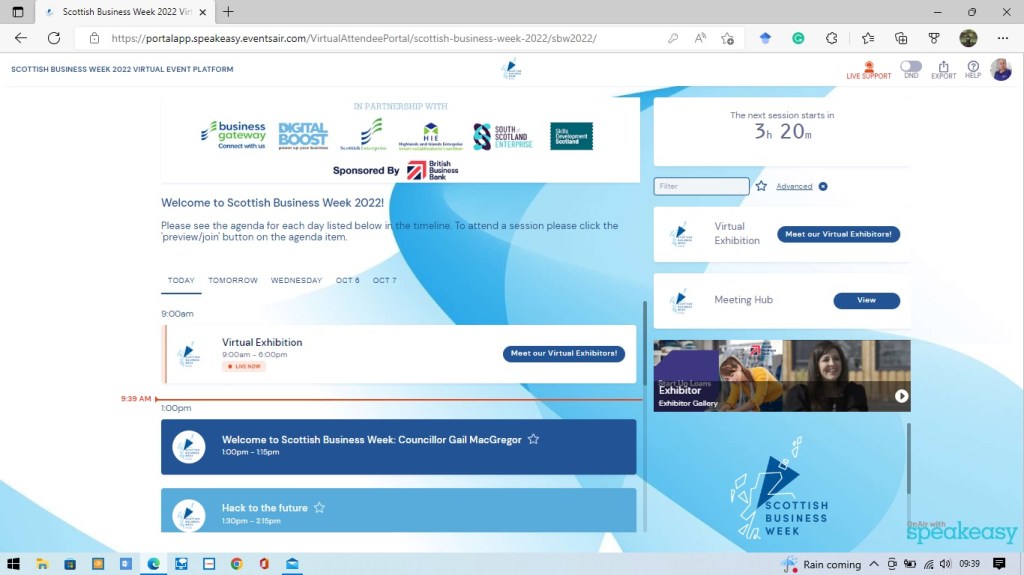
This month shall be paramount in developing A-LEAF going forward. It all starts today with Scottish Business Week 2022. Business, What Business? What am I in Business to do? Well, it is not to build up the funds in my bank account. If increasing my account balance was the goal. I could have continued my hunt for employment with the Scottish Government or Glasgow City Council. No. am in business to build a better me. And, to build resistance in Scottish Communities.
Earlier this morning I found out Rule_ette_out (Darren) win the Alliance Scotland self-management award. Darren offers peer-to-peer support for people struggling with gambling addictions. Darren’s story got me thinking about A-LEAF’s Purpose, Values, and, Vision. Not only A-LEAF’s Purpose, Values, and, Vision but also my own. What makes me the person I am today. What makes me have the Purpose, Values, and, Vision I have today? In another blog post, I concluded that my childhood Medulloblastoma was the reason I am the same person today as the child I once was. Nigel Warburton- writing the textbook ‘The Self for the Open University module A222 Exploring Philosophy, would be so proud of me. I have to amend that conclusion. You see the Entrepreneur genius test says am a Dynamo Genius. What is a Dynamo Genius? It’s me, I just told you that. Dynamo Genius, such as myself, use your Frontal lobe more than other parts of the brain. When the location of the Medulloblastoma in the brain. Being a Dynamo Genius completely makes sense.
Am a dreamer, I have my head in the clouds. I want to save the world one community at a time. Yes, that sounds about right. When Ben Freedman & Craig Carey- authors of 4th Sector Entrepreneurship say fourth sector organisations take on the Purpose, Values, and, Vision of their owners. That is also true. I have still to define A-LEAf’s PVVs. They will be up on the A-LEAF page of the website later today. With the A-LEAF website up ASAP.
On Wednesday I have a meeting with the Scottish Government’s Human rights lived experience board. What I am about to suggest is that Human Rights are the writings of Dynamo Genius. Or you could look at it another way. After World War Two the Frontal lobe of world leaders took over their brains- all world leaders became Dynamo Geniuses.
The fact that everyone can think with their Frontal lobe after a major life-changing event. Opens up the question. Why as societies as Human beings, can we not Upstream?
To stop the cats from drowning in the river, find out why there are so many cats in the river in the first place.
paraphrased from Upstream by Dan Heath
I started this blog off by pointing out it Is Scottish Business week. As a Business leader, to be. I want to put to my colleagues at the Scottish Business week. Should we not be in the business of adding more people to our boards that think with their Frontal lobes?
Scottish Business week portal view.
This would be a good place to end this blog post. However, am not going to do that. Am going to ask a question. Two questions. Question one of two. Given Darren’s exigency to support others. And given we all know someone like Darren. Why is it not all our Business to support the Darren’s in our Scottish communities?
Final question. Wednesday’s Scottish Government’s Human rights lived experience board meeting is on the cost of living. And, given that it is widely known that people who require access to self-directed support have the highest cost of living. Why is it not all our business to reduce the cost of living for everyone in our Scottish societies?
A day after this website went live (second time) I had a meeting with my colleague to discuss the next stages for A-LEAF. This website/blog(s) is the launching site for A-LEAF- as well as my personal blog site. My colleague’s reaction was:
I like the website/blog, however, I did not get the ‘person’ vs human, philosophy on the landing page (paraphrased).
Matheson, 2022
After considering my colleague’s intervention I have concluded that there is a requirement for additional clarification on “person” vs human. Homing in on how I see ‘person’ as my identity and human as the physical body. Is any of this making sense? No? okay, let us try a different approach.
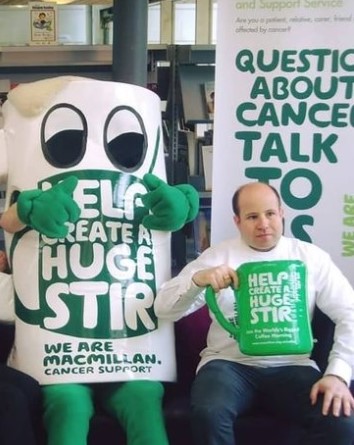
Objectively- what can be proven without a doubt. I am the child (human) that was diagnosed with a Medulloblastoma aged four. However, my lived experiences of growing up with the long-term side effects and the barriers to society the Medulloblastoma caused has shaped the ‘person’ I am today. To be clear what am saying is if it was not for the Medulloblastoma I would not have volunteered with Macmillan Glasgow Libraries in 2010.
This was where the journey started with the third sector in 2010. Never did I think in 2022 I would be weeks off registering my own company after completing my MSc in Social Innovation.
I never would become involved with Cancer Support Scotland‘s child charity Youth Cancer Forum Scotland, I never would have taken an interest in charity law. More importantly, I never would have become a member of Health & Social care Alliance Scotland, Inclusion Scotland, Glasgow Disability Alliance, however, the utmost important connection to the Medulloblastoma childhood diagnosis which lead to volunteering with MacMillian; I would not have completed my MSc in social innovation and I would not be in a position to start a social enterprise today.
so let us consider the question again.
what makes a person the same person despite changes over time?
WARBURTON, 2011
A Medulloblastoma childhood diagnosis makes me the same person over time. I never did get that. I have Dr. Anne Smith for the enlightenment. I thanked Anne for providing me with this insight in my acknowledgments to my dissertation. My thanks are, now on record for the world to see.
Now I know I am the same ‘person’ today. As I was when I was four. The question remains if it was not for social norms and medical models. would I be the same ‘person’ today as I was when I was four? After all, no one in Locke’s time was living thirty-four years after a Medulloblastoma childhood diagnosis.
One last thought. A Ph.D. student once asked me:
“Does studying Social Innovation make you want to start a social enterprise”
Ph.D student, 2020
No, it is not the MSc in Social innovation that makes me want to start A-LEAF. it is the answer to the question:
would removing the inequalities social norms and medical models, result in me becoming a different person from the four-year-old me?
No, It is too late for me! The four-year-old I was in 1987 is the same ‘person’ I am today. The question remains if it was not for social norms and medical models. would I be the same ‘person’ today as I was when I was four?
The answer to this question is important for all childhood cancer patients today.
Who is David M Howie? A question I have asked myself on several occasions. The answer has always evaded a conclusion. I became very interested in the notion of human being vs “person” while studying philosophy at the Open University. The idea that David M Howie could be the same human being as the five-year-old diagnosed with a brain tumour. However, could be a completely different person thirty-three years after diagnosis, is an intriguing concept. So who is David M Howie? Let us address the obvious. David M Howie is a son, a brother, an uncle, an MSc graduate and a citizen of the UK. Hence the dot UK of the URL. The list above is what I am. Not who I am. IF I cannot identify who I am. By what I am. It stands to reason that no other person can identify, who they are. By what they are.
Nothing I have said above is intended to sound condescending. In philosophy when attempting to convince the reader of the legitimacy of the argument the premises which follow the conclusion must also be true. For example, Plato concluded Socrates is human. The argument went something like:
All human beings have two legs (in Plato’s time)
Socrates has two legs.
Socrates must be human.
They were simpler times. That said, however, contemporary policy development follows the same basic principles. What I am about to say may sound a little condescending. All am doing is highlighting facts. More men than women sit on executive boards. The gender pay gap is still a major issue. Per head of population, more non-disabled people than disabled people will work. Those disabled people that do work are likely underemployed (like myself). Here is the controversial statement if you are white, male, non-disabled and privately educated you are more likely to be in a position of power. Again that is not intended to be controversial. It is a demographical and geographical fact.
let me ask myself that question again. Who is David M Howie? He is a dreamer. I dream of a reduction in inequality. I dream of a society where “othering” is not a thing. And I dream of a society where my lived experience and education will be taken as legitimacy and provide an opportunity for a better tomorrow.
In previous blogs, I have quoted that inspirational speech from Rocky. In case you don’t know the one am referring to here is the link. 2 minutes and 45 seconds in rocky says
Until you start believing in yourself, you are not going to have a life.
Rocky Balloa 2006
My problem could be believing in myself a little too much. Perhaps in a society, that favours white, male, non-disabled and privately educated citizens people who are experts by experience and have the academic background to support their argument still are not supposed to dream. Perhaps my life is a struggle for equality. Perhaps that is who David M Howie is.
Have you stumbled on my website or blog for the first time? Have you found my landing page by mistake? If so, you presently could be a little bewildered. You could and should be asking questions. The foremost question on your mind should be why? Not necessary why you have never questioned your “personal identity” before. The why question you should be asking is why it is important to ask how “personal identity” is shaped via geographic locations and lived experiences.
Hello WordPress, I am David M Howie. Fasten your seatbelts. You are about to go on a rollercoaster ride. This rollercoaster will make you feel happy, sad, upset and even a little angry. Predominantly, though this rollercoaster will leave you asking what. What was society thinking? What was my role in all of this?
Mark Athinson chief executive of the disability charity Scope told the Huffington post there are almost 14 million people in the UK living with a disability. To put that in perspective the population of Scotland is 5.47 Million. The population of Wales is 3.25 Million and the population of Northern Ireland is 1.9 million. If like me you identify as disabled, you are probably hitting a downwards dip on the rollercoaster, you may even feel a little sick. If you do not identify as disabled. If this is all new to you. Tighten your seatbelt. The rollercoaster is about to go down the rabbit hole.
As a four-year-old child, I was diagnosed with a Medulloblastoma. As a result of the Medulloblastoma, I have grown up with long term conditions which include but are not limited to visual and hearing issues. Are my readers in the know about the social model of disability? If not see the definition provided by Scope here. Why is the social model of disability important to me? As I said above I have sight issues caused by the Medulloblastoma. This statement is not one hundred per cent correct. It is correct to say I have sight issues – constant double vision. Wearing glasses that prevents vision in my right eye (any eye) removes my double vision. Personally, the opportunity cost of buying glasses that limits my vision to one eye is better than not been able to see an LCD computer screen at all. I say LCD computer screen because while completing my first undergraduate degree back in 2001-2005 using Cathode-ray tube (CRT) monitors I had no issues seeing the monitors at all. My story is just one example of how society has disabled an individual. There are another 14 million stories in society. So why is it important for me to have the reader understand the social model? I have to buy glasses- not covered by the NHS- so I can be part of the community. So I can go to work. So I can go to University and so I can start my social enterprise. In a sense, I am lucky, I can pay to disable myself to fit in with the social norms of society. Go me – joking! How many of the 14 million disabled people in the UK cannot?
On the off chance, you missed my camouflaged attempt at humour, I choose to disable myself not because of my childhood Medulloblastoma but because society has made technological advances. Here is where it gets more ironic, whilst completing my MSc I used Grammarly to aid with grammar and spelling. Capitalism 101. Society disables citizens because the policy used to measure how well a society is performing is based on GDP growth, not citizen well-being. Let me untangle my thinking and prevent any confusion.
21-year-old me graduates university, ready to take on the world. One problem the world is not a nice place. To quote Rocky Balboa
“It will, beat you to your knees and keep you there if you let it…nobody will hit as hard as life”
Balboa, 2006
The rollercoaster is about to do a 360. You may virtually want to find something to break.
I have been involved in the Scottish third sector for over ten years. In these ten years, I have tried to improve my life and the lives of the other 14 million disabled people in society. Here is the problem. Society does not want citizens with high subjective well-being. If citizens are happy, citizens are not spending. Think about it. The reason you buy a product or purchase a good is to solve a problem. I have a problem in that I cannot see the new computer monitors. Therefore, I have to become a consumer of glasses that allow me to see LCD and other new computer monitors. Additionally, due to problems retaining information in early education, I am now required to use Grammarly and read aloud word functions at additional personal cost. Like the rollercoaster, my academic career is almost at the tipping point. I have my MSc and I have no plans to pursue a PhD. Therefore I need to get a paid career and make my way in society. Like the rollercoaster the final destination is clear. What is not clear is will the outcome follow incremental milestone achievements or be a steep drop off the Clift.
The end will come
Life, like the rollercoaster, will end. In life as in the ride, the final destination is unavoidable. Unlike the rollercoaster which is fixed as it is- if not replaced. In life, human well-being can be shaped by policy. A policy implemented that is designed to include all (as many) citizens, is in the best interest of society overall. Perhaps am been egotistical here, I do not care. I have been living with the side effects of Medulloblastoma since the age of four- I believe rather well. I have two undergraduate degrees (paid for by the Scottish government) and an MSc in social innovation. I have achieved this despite typing this with only sight in one eye- because the technology behind my laptop, prevents me from seeing the laptop screen. Additionally, I purchased private hearing aids- I don’t hear high pitched sounds. There is that “why” question again. Why did I purchase private hearing aids? Because it is simpler to receive good customer service at Specsavers than it is to receive an appointment with the NHS.
And there you have it. “What” disables citizens? Money! You are having the privilege of reading this blog post because I had savings and could pay for glasses that blind me in one eye. I had £4k+ to pay for my MSc. I had £1k to pay for private hearing aids and I had £24 a month (something like that) to pay for Grammarly. You are at the end. Not of the journey, that is just starting. You have reached the end of seeing disabled people as others but only if you take off your blinders. Unfortunately, I cannot.


 David M Howie