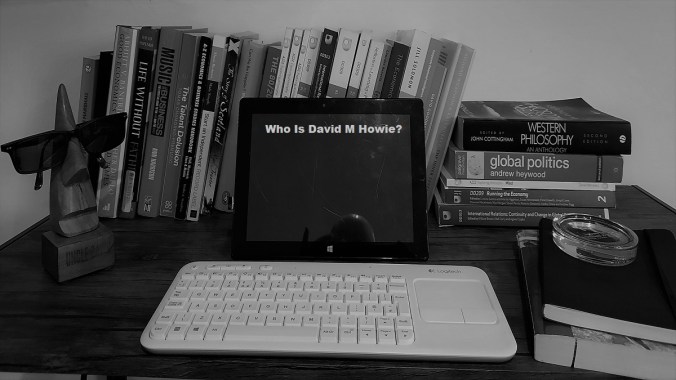
Who is David M Howie?

Who is David M Howie? A question I have asked myself on several occasions. The answer has always evaded a conclusion. I became very interested in the notion of human being vs “person” while studying philosophy at the Open University. The idea that David M Howie could be the same human being as the five-year-old diagnosed with a brain tumour. However, could be a completely different person thirty-three years after diagnosis, is an intriguing concept. So who is David M Howie? Let us address the obvious. David M Howie is a son, a brother, an uncle, an MSc graduate and a citizen of the UK. Hence the dot UK of the URL. The list above is what I am. Not who I am. IF I cannot identify who I am. By what I am. It stands to reason that no other person can identify, who they are. By what they are.                

Nothing I have said above is intended to sound condescending. In philosophy when attempting to convince the reader of the legitimacy of the argument the premises which follow the conclusion must also be true. For example, Plato concluded Socrates is human. The argument went something like:

  • All human beings have two legs (in Plato’s time)
  • Socrates has two legs.
  • Socrates must be human.

They were simpler times.  That said, however, contemporary policy development follows the same basic principles. What I am about to say may sound a little condescending. All am doing is highlighting facts. More men than women sit on executive boards. The gender pay gap is still a major issue. Per head of population, more non-disabled people than disabled people will work. Those disabled people that do work are likely underemployed (like myself). Here is the controversial statement if you are white, male, non-disabled and privately educated you are more likely to be in a position of power. Again that is not intended to be controversial. It is a demographical and geographical fact.                   

 let me ask myself that question again. Who is David M Howie? He is a dreamer. I dream of a reduction in inequality. I dream of a society where “othering” is not a thing. And I dream of a society where my lived experience and education will be taken as legitimacy and provide an opportunity for a better tomorrow.

In previous blogs, I have quoted that inspirational speech from Rocky. In case you don’t know the one am referring to here is the link. 2 minutes and 45 seconds in rocky says

Until you start believing in yourself, you are not going to have a life.

Rocky Balloa 2006

My problem could be believing in myself a little too much. Perhaps in a society, that favours white, male, non-disabled and privately educated citizens people who are experts by experience and have the academic background to support their argument still are not supposed to dream. Perhaps my life is a struggle for equality. Perhaps that is who David M Howie is.

Legitimacy

In previous blog posts, readers will remind me saying: living with the long term conditions caused by a medulloblastoma diagnosis results in disillusion with society and the inability to identify the self within the social norms of society. I have tried to explain how having no sense of the self is like having no idea of who you are. I have without prevail tried to achieve acknowledgement of this feeling. The look of complete blankness on the faces of friends and family is soul-destroying. If my brain was nothing more than a biological machine I would possibly hit the reset button- full restart. One problem the human brain is not a biological machine (not only). Our brains, our memories, define who we are.

Eleanor Roosevelt once said

I am who I am today because of the choices I made yesterday.

Elenore Roosevelt

That quote is 100 per cent correct. Who we are as individuals is past dependent. I just want to say to anyone that has ever verbalised the words: “only you can change your life”. You have no idea how frustrating and condescending that sentence is. To anyone that has been on the receiving end of that sentence, I apologise, the person that muttered this sentence has no understanding of the impact it had.   

Yes, who we are as individuals have a past dependency, just like social policy and the environmental conundrum humanity finds itself. As individuals and as a society,  we have a choice. We can stay on the road to self-destruction or we get off and try another path. How though? If our paths are past dependent, how can we change the path?  

I will admit I don’t know how to get off the path. Sometimes I think it would be simpler to go back and apply for nine to five jobs. That is a path, however, that the brain just will not go. I know there is no self at the end of that path or anywhere in the discourse of it.

My younger brother runs a successful copy write company. His company tagline is Short, Sharp, Straight to the point. I guess  I would not make a good copywriter. My point is this. As humans, we want simple things in life. Things like a home, a job, a community, clothing and food. A simple list correct? All basic human rights?

I remember Zach Braff aka J.D in an episode of Scrubs saying something like

Your work colleagues truly do become your family.

J.D

I think the above conclusion only holds true when the following premises follow

  1. You have a sense of belonging in your workplace
  2. There are other persons like you in your workplace.

Remember that Short, Sharp, Straight to the point tagline? Yes, that one. That is how we want to run our lives, our work, our relationships. The problem is, for 14 million disabled people and everyone else that feels they do not belong. There is nothing Short, Sharp, Straight to the point about anything in life. Except for that verbalised statement

“Only you can change your life”.  

My point is this. Despite nothing being Short, Sharp, Straight to the point – the way society wants it. Everything I have said has lived experience behind it. In a sense when policymakers say they want people who have lived experience to inform policy. What I take away is: policymakers want experts by experience to inform social change. However, as experts by experience have no understanding of the path walked, this is where experts by experience, legitimacy must stop.  

Fundamentally I disagree. I strongly believe people who have lived experience are best placed to develop innovative solutions to complex problems. For clarification what I have said about policymakers, including policy networks is subjective, based on my lived experience. Perhaps I am a little frustrated that I have been volunteering in the third sector for ten years and am unable to find an employment position in the sector. Perhaps am more frustrated that I look at the Scottish third sector and see box-ticking shadow, civil servants. Nothing against civil servants. It is just when you have been in and around the third sector you tend to hold third sector employees to higher standards. Nothing against my political colleagues either. Essentially what I want the reader to take away here is I have a lifetime of lived experience. I am an expert by experience ten times over. I am also, however,  a PPE undergraduate and Social Innovation postgraduate graduate. I see myself not only as an expert by experience but also as an expert by academic experience. I have more lived experience than most disabled people. I also have more academic experience than most non-disabled people. You would therefore think. Would you not? Those expressions of no perception of the self or no idea who I am as a person would be received in good faith-“bona fides”. Giving the legitimacy my lived and academic experience should carry. Instead, my views are met with confusion, bewilderment and disbelief. I should be grateful After all, I have a dead-end job, am underemployed and I lived longer than the five years the medical model said I should.