Social Enterprise: A-LEAF

Society is structured to grow the gross domestic product (GDP). However, allocating available resources to grow GPD results in the most vulnerable citizens becoming an afterthought. The social enterprise/ framework Iain and I designed after completing our MSc in social innovation empowers citizens and communities by focusing on the diversity, inclusion, and belonging model.      

It is of utmost urgency that we address the critical issue of empowering disadvantaged citizens in Scotland. The evidence is stark: Disabled individuals confront substantial inequalities and are at a higher risk of living in poverty. This is a policy concern and a societal crisis that demands immediate action. I am deeply concerned that the Scottish Government may lack the capacity and resources to enact the required changes. The time for action is now.

While I acknowledge that the A-LEAF framework may not be a panacea for all the Scottish government’s challenges, I am confident it could be a significant step towards a more inclusive and equitable society for disabled people. This is not just a proposal. It’s a beacon of hope, a potential catalyst for positive change. Given the opportunity, this framework could not only enhance the well-being of countless disabled citizens in Scotland, but it could also transform their lives, offering them a brighter future. Let’s unite to envision this potential, understanding the profound impact it could have on the lives of our fellow citizens.

The A-LEAF framework I propose is more than just an abstract idea. It is a practical solution rooted in my personal experiences and the expertise of my graduate colleague, Iain. With over thirty years of collective experience, A-LEAF is based on the belief that citizens’ well-being is enhanced when they have a personal and professional identity, when social policy supports their right to live in the community, and when social norms allow them to do so. This is not just a theoretical concept but a tangible framework that can be implemented to bring about real change, instilling confidence in its practicality and effectiveness.

The A-LEAF framework is essentially the Iron Triangle on Sustainable Steroids. It aligns seamlessly with the Scottish Government’s well-being/ circular economy policy and advocates for a new fourth social enterprise sector. This framework is designed to bolster green growth and foster co-production in the three existing sectors – third, private, and public. Its implementation could significantly enhance the Scottish Government’s initiatives and policies, leading to a more inclusive and equitable society.  

Network theory is the idea that organisations within society collaborate to make society function. Each node does its job or the job it has a competitive advantage in—it can complete the job better and generate more profit than any other node/organisation. The A-LEAF framework enhances the network for the common good by placing it in a strategic action field. Every action field network node works towards the well-being/circular economy.        

In academic social enterprise theory, there are three typologies of social entrepreneurship. Schumpeter inspires social engineering thinkers to believe that a newer, more effective social system is designed to replace existing systems when systems are ill-suited to address significant social needs. As a social innovation graduate, a citizen of Scotland and someone disabled by the medical model, I have sympathy for this thought pattern. However, such political philosophy/ social enterprise typology needs to be revised. Such philosophy has no place in contemporary society.

The typology operating in society presently is social bricoleur. Social bricoleurs perceive and act upon opportunities to address local social needs. They are motivated by lived experiences and know how to address social problems. However, while Social bricoleurs have the lived experiences and knowledge to address social issues, the barriers consist of capacity and resources. Social bricoleurs are typically charities requiring financial capital and rely on top-down government support. Providing resources and capacity exists in the state. I have zero quarrels about this social policy/typology. Fundamentally, the resources and capacity do not exist. Levels of poverty and SCOPE’s call to action show evidence enough. Additionally, I would suggest two things. One. The current political framework of the Scottish political system is based on the Social bricoleur typology. Therefore, funding is allocated to charities/social enterprises that can mitigate social problems over the short term—providing the Scottish government with outcomes that support the national performance framework. Two. Social bricoleur thinking resulted in A-LEAF not receiving funding from the Scottish government’s social enterprise funding body.  The Scottish Government’s refusal to fund A-LEAF lowers my subjective well-being as funding refusal has resulted in my continuing quest for a professional identity.

For readers unaware, the Scottish national performance framework is effectively the United Nations sustainable development goals (UN SDGs) as applied to Scotland.  The nugatory differentials between the UN SDGs and the Scottish national performance framework are significant enough to propel A-LEAF into the typology of social constructionists – social constructionists build and operate alternative structures to provide goods and services addressing social needs that governments, agencies, and businesses cannot.  

Iain and I had not advocated for a dramatic system change with the A-LEAF framework. Our request was merely to empower citizens and support the Scottish government’s social policy. The chapter has attempted to inform the readers of my subjective understanding of the operation of the Scottish political system, how the political system results in disabled people facing vast inequalities, and how Social bricoleur thinking provides possible barriers to necessary required system changes. The remainder of the chapter will spotlight the A-LEAF framework.      

The fundamental theory of the A-LEAF framework is that a community’s collective well-being is empowered when citizens have a personal and professional identity that provides subjective well-being and simultaneously provides the person/self with good mental health. However, there is a direct correlation between personal and professional identity, social policy, and social norms. The workplace, the community, and government policy act as a tripod that supports citizens’ subjective well-being and provides good mental health. Absences of employment, paid or unpaid, reduces subjective well-being. Prohibition of the right to live in the community lowers subjective well-being. The perception that the government is not listening reduces citizens’ hope. As a society, we must ensure that citizens in our communities are provided opportunities to live well.

In the third sector, there is a focus on ‘self-management’. Self-management is an elongation that prolongs the required change. It is a mitigation method used to mitigate the effects of an ill-run society. I recognise that communities within communities can also empower citizens and foster the idea of citizenship. The problem, however, is that “a rising tide lifts all the boats” only when the focus is on the little boats.

Part one of the A-LEAF framework shows that citizens’ well-being correlates with each side of the tripod. The second part discusses what unites every citizen: waste. Rich, poor, disabled, and non-disabled, every citizen, every household, every institution, and every state produces waste.  How do you turn waste into a monetisation opportunity which empowers citizens? Run the four Rs of the circular economy in reverse. Instead of reducing, reuse, recycle, and remove. Society should focus on recycling, reusing, reducing, and removing. Waste has a value that can be monetised. Plastic, glass, metals, and fabrics can all be recycled. The fantastic part of recycling is that a community recycling project has the potential to unite and empower every citizen. Within every action field/network within a society, an organisation will have a competitive advantage in recycling. Providing people and the planet are prioritised over profits. The organisation offers the strategic action field/community with a common good.

Part one: step two envisioned the possible collaboration opportunities that could empower citizens with subjective well-being. To prevent repetition, I will forgo the literary details. The graphic is provided in the chapter notes.

The final framework Iain and I designed before dropping the idea of A-LEAF as a social enterprise in 2023 was the House of Well-being. The House of Well-being is based on the Health and Social Care Alliance Scotland’s House of Care. The graphic I used, however, looks more like the US House of Representatives. That was either due to studying American-Russian international relations or watching too many American political TV shows.     The House of Well-being/ A-LEAF framework for the well-being circular economy is as follows: The stairs metaphorically represent the circular economy but in reverse. The framework focuses on recycling as a monetary policy for community wealth building. From left to right, the four pillars are: (1) Build an online platform for keeping goods in the community longer, preventing goods within their life cycle from ending in landfills. (2) Within the community, there should be a focus on reducing polyester clothing for gym wear. Polyester, when washed, produces microplastics. The effects microplastics have on the environment are well known. The impact of microplastics on human life requires further investigation. (3)  The action field/network should prioritise action research with all stakeholders in the field/community. This would reduce the requirement for lived experience boards, which, from my experience, reduces well-being. (4) Network for the UN SDGs goals.  Every node/organisation with a network operating within the field should focus on achieving one or more of the seventeen sustainable development goals. The field the framework proposes is more robust than anything currently in place in Scotland. The nodes within the fields work towards the same strategy on a page (SOAP). Each field, of which there could be numerous in a geographical location, could adapt its SOAP to achieve the outcome of the field while working towards meeting the UN SDGs. The SOAP’s key performance and business growth indicators, designed to achieve the SDGs, can then be linked to the National Performance Framework. Directly connecting the strategic action fields back to the Scottish Government’s social policy agenda and simultaneously creating a database of community assets.  Implementing the A-LEAF framework would create a person-centred well-being economy.
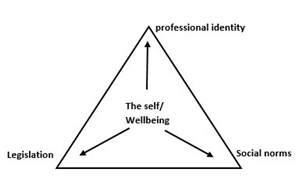
societal triangle

A-LEAF started with the idea that citizenship well-being is dependent on three areas. 1. Professional identity—without a sense of belonging and meaningful employment, well-being will remain low. 2. legislation. Government policy must support citizens in working on their own well-being. 3. Social norms of the community must support collaboration between citizens to develop a strong community.

Well-being circular economy.

To achieve the societal triangle, it was clear that the projects’ funding must be commercial. Removing community waste, upscaling, reusing, or recycling the community would generate a community wealth fund. Other commercial social enterprises could use the funds to develop projects that would empower citizen in their local community.

The circular image of well-being represents what Ian and I thought provided the best opportunities. Other projects are encouraged.
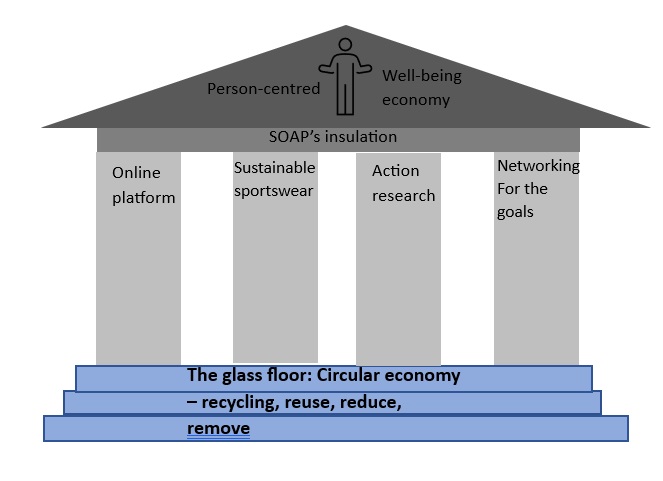
House of well-being

The House of Well-being was our last attempt to convince the funding bodies that A-LEAF, along with our Scottish government colleagues, had a solid plan for developing a well-being circular economy.
Human Rights (Scotland) Act [2026?]

The human rights lived-experience board meeting, taking place on Monday 21 November, shall focus on what key performance indicators to measure, to inform that the human rights act is achieving the desired outcome. This blog post will ask the readers three questions, question one will ask the reader how well you feel human rights are protected in Scotland right now. Question two will ask the reader what you think is the most important human rights issue in Scotland today. Question three will ask the reader how hopeful they are feeling that the new human rights bill will be successful in realising human rights for people in Scotland. After each question, there shall be a short discussion about the contemporary issues directly impacting the question.

What is the Human Rights (Scotland) act?

For international readers and national readers that do keep up to date with politics or the third sector, Human Rights (Scotland) Bill/Act is an act of the Scottish Parliament that will incorporate the UN Human Rights conventions into Scots law. Wait, it gets more interesting, the Scottish Government only has responsibility for devolved matters. Reserved matters are still the responsibility of the UK Government. What then does the devolved/reserved conflict as it relates to the power of Governments/Parliaments mean for the human rights of people living in Scotland? that is the question this blog will look to answer.       

How well do you feel human rights are protected in Scotland right now?

For international readers, this question and the two questions that follow will be hard or impossible to answer. While you- the international readers may have difficulties answering the questions, I would suggest that you continue reading. From an international relations lens, the Human Rights (Scotland) Bill/Act speaks volumes about the character of the Scottish Government/Parliament.

Turning attention to the question of how well you feel human rights are protected in Scotland right now. As a citizen of Scotland, I would conclude there is room for improvement. Poverty in Scotland 2021: Towards 2030 without poverty, tells you all you need to know about human rights violations in Scotland. While the case of Awaab Ishak, see here, is in England. Scotland’s housing situation is not much better. In Scotland today (2018)

2 per cent (51,000) of all households are overcrowded

19 per cent of homes have some level of urgent disrepair to a critical element and just 1 per cent had extensive disrepair

2 per cent (40,000) of homes (at the time of writing) do not meet the ‘Tolerable Standard  

0.7 per cent (18,000) have both condensation and some level of penetrating or rising dampness

(Cain, 2021, p. 212)

As the data above shows Scotland has to do much more to improve housing if the goal of the Scottish Government is to protect people living in Scotland from human rights violations.

What do you think is the most important human rights issue in Scotland today?

These questions that am putting to the readers are the questions the human rights lived experience board will answer on Monday. Therefore it is only fair to the reader, that the choices are made clear. Which options from the list are the most important human rights issue(s) in Scotland today?

  • Access to justice
  • Poverty
  • Disabled people’s rights
  • Women’s rights
  • Refugee and asylum seekers’ rights
  • Environmental rights
  • Older people’s rights
  • Children and young people’s rights
  • Something else
  • They’re all important- I can’t separate them all!

Readers may think, that because I referenced Poverty in Scotland 2021: towards 2030 without poverty. That I would say poverty is the most important human rights issue in Scotland today. If this is your thinking, I can inform you, you are completely incorrect. All choices above are equally important. To try to focus on one or two of the choices above without seeing the holistic picture is, hazardous to health.  

I have a seat on the Human Rights (Scotland) Bill lived-experience board because I am a member of the Health and Social Care Alliance Scotland. The third-sector organisations in Scotland know that a holistic co-produced model is required to achieve human rights in Scotland for all citizens.

What would human rights for all citizens look like? Given the political structure of Scottish society, only the Scottish Government and parliament can answer that question. In the decision section, I try and help the Scottish Government make the correct choice.     

How hopeful are you feeling that the new human rights bill will be successful in realising human rights for people in Scotland?

I recognise that this blog has not provided the reader with enough information to come to a balanced conclusion. I can, however, inform the reader that I am not hopeful, am probably more sceptical. Why sceptical you may ask. I said above that from an international relations lens, the human rights bill makes Scotland compliant with international policy. Therefore Scotland becomes viewed as open and outward-looking. Scotland should be viewed in this light. Scotland is a fantastic country with vast potential. With that said, If Scotland continues with the top-down approach to government, in which human rights are focused on access to justice and not on well-being and dignity then I see no outcome where the new human rights bill will be successful in realising human rights for people in Scotland.           

Discussion

Readers may or may not know of my background. If you do not, I was diagnosed with a brain tumour at the age of four. see the home page for more information. I have over ten years of experience in the third sector, I also have two undergraduate and one MSc degree. The reader must understand I conclude that the human rights (Scotland) bill will not have the outcome desired, based on 34 years of living with the side effects of a childhood brain tumour, 13 years as a member of the political party that governs Scotland, 10 years volunteering in the third sector- which includes Scottish government boards, and, three trimesters completing a masters degree in Social Innovation.

I would like to think my opinion carries some legitimacy. Yes am cynical, however, I hope am proven incorrect. I shall not hold my breath. The reason I am so pessimistic about the outcome is I believe the funding model for the third sector is unsustainable. Once the Human Rights (Scotland) Bill becomes the Human Rights (Scotland) Act [2026?] a lot of the burden is going to land on the table, not of civil servants but on the table of third-sector organisations. I have said this before the third sector in Scotland, at least third-sector organisations that are directly funded by the Scottish Government are civil servants by proxy. I believe these proxy civil servants act as a second chamber to the Scottish Parliament, and I would not change this framework. For the Human Rights (Scotland) Act [2026?] to have the desired outcome, there is a requirement to think outside the box. Bring forward the fourth sector.  

So there is no ambiguity, In Scottish policy farmwork and academia, there is no fourth sector.  Social Enterprise in practice and theory is defined as the third sector. Nicholls (2010) makes two observations about Social enterprises. (1) there is no definitive consensus about what the term means (2) the research agenda for the field is not yet clearly defined. Two points I want to make. The first point is academia and Scottish policy are wrong, Social enterprises are not operating in the third sector. The second point is Nicholls is also completely incorrect. Angela Constance when Cabinet Secretary for Communities, Social Security and Equalities has a foreword in Scotland’s Social Enterprise Strategy which makes direct reference to Robert Owen and New Lanark. My argument is simple New Lanark is the definitive consensus of what a social enterprise is. And, research agenda was set between 1785-1968. For readers that do not know the history of New Lanark click on the link here.  

I can hear the angry neo-liberal supporters, that’s in past. That is not how we do things in the contemporary UK, we like capitalism. Am sure Robert Owen would have considered himself a capitalist. It is said The Wealth Of Nations is simply the best book on political economy ever written (Butler, 2010, p.viii). The contemporary UK could have looked so different if Robert Owen had written The Wealth Of Citizens.

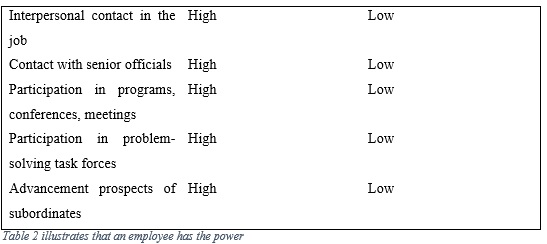
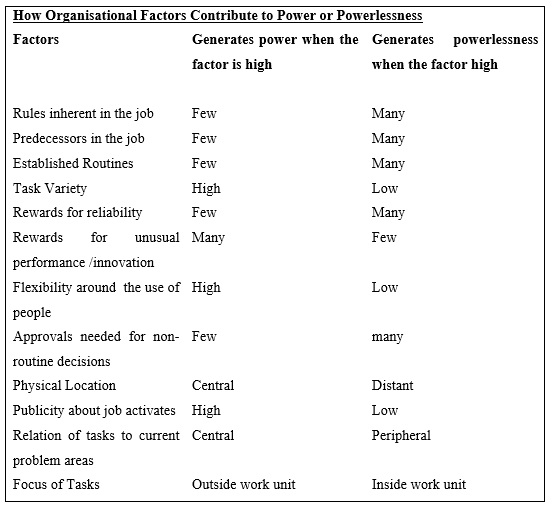
If readers require a more contemporary view of what a social enterprise is read The Social Entrepreneur: Making Communities work by Andrew Mawson. I’ll go on record and say Mawson is the only lord I would consider supporting based solely on the book. What though do Owen and Mawson have in common? They both understand the importance of stakeholdership. Ever since completing my MSc dissertation on the question: ‘why is there a subjective well-being premium in voluntary sector employment?’ I have become convinced that a stakeholdership model must Incorporate Rosabeth Moss Kanter’s thinking on power and powerlessness in the workplace. Figures 1 and 2 summaries Kanter’s thinking.

Figures 1 and 2 copied from my dissertation

Kanter’s argument is that when the factor is high employees have power or subjective well-being. My argument is when that when power is in the hand of employees that work for social enterprises. That power can be extended into the communities the social enterprise operates.  

Conclusion

The purpose of this blog is to inform the reader of the process of the Human Rights Bill/Act. This bill has not yet reached the parliamentary stage. Therefore it is impossible to know how members of the Scottish Parliament (MSPs) will react to the bill at the first reading. If MSPs react in the same way as me, then expect a lively debate and a lot of amendments. Note debate and a lot of amendments are not to be discouraged. Debate and amendments are a sign of power. As I said above we cannot afford the Human rights bill to be empowered from the top down. Yes, we have the human rights lived experience board. My concern is what happens to the people on the lived experience board after the Scottish government decides it no longer needs the board. I say to the reader, the Scottish Government, and, The Human Rights Consortium Scotland I effusively welcome lived experienced boards. I add, however, lived experienced boards must be more than short-term talking shops.

I said above that my dissertation answered the question ‘why is there a subjective well-being premium in third-sector employment?’. My conclusion to that question is important for how social policy transitions from the third sector to the fourth sector. My conclusion to my dissertation question was; yes, there is a subjective well-being premium in third-sector employment but only when employment is sustainable and achieves an external improvement. For example, employees of the Scottish Human Rights Consortium have a well-being premium/power because their employment provides citizens of Scotland with human rights. Here is the catch well-being premium/power is provided by the Scottish Government or the city council, as it is these institutions which enable change via innovative policy change. I fundamentally believe there is a need for third-sector organisations that act as the second chamber of the Scottish Parliament. Perhaps a sounding board for the Scottish Government is a better way to look at it. I take the view though that the third sector is not sustainable. Therefore society must move toward the social enterprise fourth sector model. The Fourth Sector model is the only model that will provide subjective well-being to every employee in the sector while providing business growth indicators (BGI’s) and Key performance indicators (KIPs) that will monitor human rights from a well-being dignity lens and not access to justice lens.

Recommendations

I was planning to go into some detail on my social enterprise’s business model. How it focuses on the well-being economy while encapsulating the well-being economy in side the circular economy.  My social enterprise will use BGI’s that are focused on corporate social responsibility and use KIPs that are directly linked to The UN Sustainable Development Goals. I feel, however, that splitting the more technical aspects into another blog or support document may be more useful to the reader.    

I am hoping to have a zoom meeting in February/March regarding my social enterprise. I do recommend reader join that meeting. Details to follow.  

A-LEAF: Is my personality?

Ben Freedman & Craig Carey in the book 4th Sector Entrepreneurship. Suggest Social enterprises take on the values of their owner(s). Given I follow good social science procedures (not so much). And, according to Jennifer A Moon’s book Reflection: in Learning Professional Development. I now have to reflect on how my personality has shaped A-LEAF to date. As I said to David Lyon- jobs and Business Glasgow, last night I once considered that Third Sector organisations would step up and fill the void resulting from spending cuts. However, “understandings of the world [lived experience] that people bring to a learning situation” (Moon, 1999, p. 3) are immensely overlooked. For example, David still refers to Social Enterprise organisations as the third sector. As does Caledoinain Business School I should add. I, however, take the view that Social Enterprises are in a sector of their own.

Am I correct? Is David Lyon and Glasgow Caledonian Business School wrong? No, it is the other way around. According to social norms. Am wrong. If am wrong then Ben Freedman & Craig Carey are also wrong. Here is the perfect opportunity to remind the reader the name of the blog and podcast is ‘so wrong, it is write (right)’- meaning if it is written into law or has become a social norm. No matter how wrong it is or how unethical it is viewed to be right in the eyes of the beholder.    

What does all the talk about Third Sector/ Fourth Sector mean for the Social Enterprise A-LEAF? As Moon rightly points out lived experience is paramount. A-LEAF is shaped a lot by how I am. The values and the goals of the company are shaped by who I am both professionally and personally.

Here though is where I think Ben Freedman & Craig Carey are as far down the echo chamber as everyone that follows social norms. I am reminded of the book “that’s not how we do it here! By John Kotter. The world is neither black- all social enterprises must be in the fourth sector. And, the value systems of social enterprises must be shaped by their owner’s lived experiences. The world is also not white as the policy farmwork or social norms would have citizens believe. The world is grayscale. The world has many different voices. I believe the values and the mission goals A-LEAF will have moving forward will be shaped by listening and hearing all the voices in our grayscale world.          

What I originally wanted to do with this blog was to show how in part how A-LEAF is shaped by my lived experiences. Hopefully, the reader did not miss that point. My colleague Iain also played a significant part in shaping A-LEAF. As did Mairi Lowe and Liisa Lehtinen of Sustainable Fashion Scotland all be it indirectly. Here is the fundamental point, I hope the reader takes this away. If you do not do any reflection on it. at least think about it. A-LEAF’s tagline is:

A rising tide lifts all the boats; only when the original focus is on rising the little boats.  

If the only thing, you take away after reading this is anything. I want it to be this. In society there are many little boats, make sure you hear their voice.