My education: P1 to MSc graduate.

Given that Nature and Nurture are equal components of the Scottish government’s curriculum for excellence, it is essential not to forget my pre-medulloblastoma diagnosis years. Of which there were four. I was born on Saturday, May 7, 1983, at 23:00 in Glasgow Royal Maternity Hospital. Unknowing to me then, I would spend the majority of my childhood and most of my teen/early adulthood in a hospital, mainly as a day patient. By now, the reader should understand my medical history from reading chapter two. I did not say I buy from third parties regarding contemporary sensory issues in Chapter Two. That is, I purchase hearing aids and glasses from retail stores. My contact with the NHS is an annual phone call.

My parents and I lived on Walter Street in Glasgow. Walter Street is located in Glasgow’s East end in Haghill. The Scottish Index for Multiple Deprivation (SIMD) shows that Haghill is deprived of health, education, income, employment, and housing and is a high-crime area. What Haghill has got is access to public transport. At least citizens of Haghill have public transport to Merchant City East – known to locals as Dennistoun. My parents and I did not stay in Haghill long; we moved to Ballindalloch Drive, just off Alexandra Parade, when the local housing association offered to buy my parents and my first home.

Despite what the SIMD show about Haghill. It cannot remove the nurture of the community. My parents’ nature and the community’s nurture created the confident, outgoing child I was. The new flat at 28 Ballindalloch Drive was a top flat. It had a kitchen, bathroom, and separate bedrooms, unlike Walter Street at the time. However, there was no lift. I propose a motion. Every newly built multi-story flat above two floors must have an elevator (for my USA readers). The lack of a lift was why the family moved to 22 Ballindalloch Drive some years later. I’ll discuss that in chapter seven. The story about that can be found in the UK Parliament Library.

Despite resistance from the local school headteacher, I attended Alexandra Parade Primary School only months after the removal of the medulloblastoma, chemotherapy, radiotherapy, and stroke. Even as a four/five-year-old, I refused to take NO for an answer. From TikTok, I’ve learned that is a characteristic of people with Brain Tumours. No does not mean no—no means YES, but in my way. As expressed above, I was a bright child. The academic curriculum of primary 1 to 3 was not challenging. I strolled into primary four without difficulty. Well, there was one issue, not academic but physical. I could not tie my laces. I don’t know when I learned to tie my laces, but it was later than most of my classmates. In hindsight, this was when my primary school education was about to take a few bumps in the road.

Chapter six is titled “Do I consider myself disabled today?” I provide details on the nature of my physical limitations in that chapter. Those physical limitations contributed to my learning disabilities problems. At the time of writing, my education issues are not defined as learning disabilities. Hopefully, the learning disabilities, autism, and neurodiversity (Scotland) Act 2026 will correct a wrong and help support citizens with brain tumours.

As I reminisce back to my primary 4-7 years equipped with a BA (Hons) and an MSc as of 2024, blaming Chemo brain – as discussed in chapter two, would be too convenient to explain my poor academic performance. I propose that the educational system between 1992-95 was unequipped to educate a child recovering from a medulloblastoma. Is the educational system equipped to deal with an equivalent conundrum in 2024? I am not too sure in which primary I was tested for Dyslexia – difficulty reading due to problems identifying speech sounds and learning how they relate to letters and words. The outcome of the Dyslexia test was negative, as I could verbally spell the word. However, I could not write the word on paper.

Primary school is a blur. I have no vivid memory of those years. I remember silly things like finding a hedgehog while construction of the M8 Junction at Alexandra Park Street was in place. Or I was getting attacked by random cats for wearing a shell suit. It was the late 80s and early 90s. I still believed the World Wrestling Federation (WWF/WWE) was a combat sport. Apparently, I also let Sharon and Searha let me believe stray cats should be cradled like newborn babies. No judgments. That was the Nurture of my childhood.

I commenced secondary school in 1995 – Whitehill Secondary. Even then, I preferred my company to that of my classmates. It would not be inappropriate to say I prefer the company of animals over humans—even hedgehogs and cats.

Whitehill was more equipped to attend to my educational needs. I was provided with a laptop to help with spelling and grammar. I achieved acceptable standard grade results—grades 3 and 4 in all classes except French.  I struggled with English. What chance did I have with French?  

Above, I said I was tested for Dyslexia at primary school. There must have been a misconception from Whitehill’s English department that the results of the Dyslexia test were positive. I was discouraged from reading long books when writing a book review. Even at Whitehill, I was written off. I was written off not because teachers wanted me to fail but because there was no framework for teaching childhood medulloblastoma survivors. In 2024, I am not convinced Getting it Right for Every Child – the Scottish Government’s approach to supporting children and young people would have provided the support I required.

At Whitehill’s awards ceremony in 1998, I was awarded the leaps and bounds prize – for the student who had made the most progress. Take a second to process the date. I was diagnosed with a medulloblastoma in 1987. Either It took ten years for the brain to develop after the removal of the brain tumour, or the introduction of the internet into Scottish society provided the opportunity to learn in a way my brain required, i.e. for words to be verbally repeated back to me and corrected in real-time. Possibly both.

The following year, I had an attendance rate of 97 per cent. Perhaps there is something in peer-to-peer support and social capital, after all.   

The 2000/01 year was a wasted year. I was accepted into Glasgow College of Building and Printing for my HND in March of 2001. I did not want to be a Whitehill in the last few months. Graduation on June 14, 2001, could not come quickly enough.

I enjoyed my time at the Glasgow building and printing. It is a shame to see that in 2024, the building is a shell of its former self. Hopefully, by the time this book is published, the building will operate as new flats and office space. I was in the building on September 11, 2001 – for Dugs Data Analysis and Database Design class. I remember Grant- a fellow student. Grant was one of the older guys, a grungy rocker who should have been studying music technology, not information and media technology. He must have been watching a news stream. Grant’s words evade me; I remember Dug running to the monitor to view images of the Twin Towers being hit.

I was in New York, attending Hole in the Wall Gang Camp – a children’s camp for seriously ill children and their families when I was 14 years old in 1997. I was only in Manhattan for three days. However, I must have walked past the Twin Towers. I am also sure our party of four or five seriously ill children and two adult social workers were admitted to Hard Rock café – in New York, with the only other customers being Michael Lee Aday, his wife, and their daughter.  

Years later, in 2018, I was in South Africa, volunteering with Global Vision International. On one weekend off, I visited the District Six Museum. On the wall is this quote

“It struck me that our history is contained in the homes we live in, that we are shaped by the ability of these simple structures to resist being defiled.”

Achmat Dangor  

Our history is not only contained in the homes we live in. It is also contained in the educational establishments we attend. That is why I get chills every time I walk past the Building and Printing structure where I once bought my first zip drive. Yes, I am that old.   

After completing my HND, I attended Glasgow Caledonian University for a BSc in Multimedia Technology. I dropped out after one year, gaining a BSc in Multimedia Technology. At the time, I was more interested in hardware, or so I thought. Looking back, I was just a bad coder. I graduated in 2005 and did not return to higher education until 2014.       

The return to higher education in 2014 was strategic. I joined the SNP in 2007, and as of 2014, I was still an active member. More about that in Chapter 3 – employment. The Open University (OU) allowed me to work and learn simultaneously. Politics, Philosophy, and Economics. What else would I have chosen to study? Reminiscing the OU provides students with the foundation to proceed in the higher educational journey. Each level and each course is designed to enable students to develop the skills required for incremental progression. For example, “Making Social Lives” and “Exploring Social Lives” were simplistic content for a ten-year experienced political campaigner and not academically challenging. With hindsight, the point of those modules was to instruct students in the academic writing process—a skill I was required to learn years later. The lesson learned was to learn to walk before you run. 

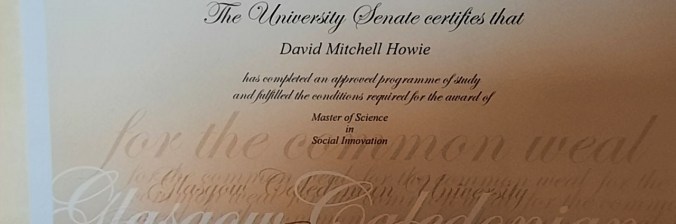
I graduated from the OU in 2019 with a BA (Hons) PPE. Back to GCU, this time to study Social Innovation. Remember I said I had not learned to write academically in 2014? In 2021, I still had much to learn about academic writing. On reflection, I was accepted into the class because of my unpaid experience in Scotland’s third sector, not my academic achievements. After a resit or two, I was allowed to complete my dissertation.   My dissertation question answered, “Why is there a subjective well-being premium in voluntary sector employment?”  

I completed my dissertation thanks to my supervisor, Dr Tom Montgomery. I graduated from GCU in 2021 with an MSc in Social Innovation.

Social Innovation is business ethics. At least, that is how I view it.  

Note that this is NOT a blog post. Like the other writings, it is a rough draft of the book I want to write.
Human Rights (Scotland) Act [2026?]

The human rights lived-experience board meeting, taking place on Monday 21 November, shall focus on what key performance indicators to measure, to inform that the human rights act is achieving the desired outcome. This blog post will ask the readers three questions, question one will ask the reader how well you feel human rights are protected in Scotland right now. Question two will ask the reader what you think is the most important human rights issue in Scotland today. Question three will ask the reader how hopeful they are feeling that the new human rights bill will be successful in realising human rights for people in Scotland. After each question, there shall be a short discussion about the contemporary issues directly impacting the question.

What is the Human Rights (Scotland) act?

For international readers and national readers that do keep up to date with politics or the third sector, Human Rights (Scotland) Bill/Act is an act of the Scottish Parliament that will incorporate the UN Human Rights conventions into Scots law. Wait, it gets more interesting, the Scottish Government only has responsibility for devolved matters. Reserved matters are still the responsibility of the UK Government. What then does the devolved/reserved conflict as it relates to the power of Governments/Parliaments mean for the human rights of people living in Scotland? that is the question this blog will look to answer.       

How well do you feel human rights are protected in Scotland right now?

For international readers, this question and the two questions that follow will be hard or impossible to answer. While you- the international readers may have difficulties answering the questions, I would suggest that you continue reading. From an international relations lens, the Human Rights (Scotland) Bill/Act speaks volumes about the character of the Scottish Government/Parliament.

Turning attention to the question of how well you feel human rights are protected in Scotland right now. As a citizen of Scotland, I would conclude there is room for improvement. Poverty in Scotland 2021: Towards 2030 without poverty, tells you all you need to know about human rights violations in Scotland. While the case of Awaab Ishak, see here, is in England. Scotland’s housing situation is not much better. In Scotland today (2018)

2 per cent (51,000) of all households are overcrowded

19 per cent of homes have some level of urgent disrepair to a critical element and just 1 per cent had extensive disrepair

2 per cent (40,000) of homes (at the time of writing) do not meet the ‘Tolerable Standard  

0.7 per cent (18,000) have both condensation and some level of penetrating or rising dampness

(Cain, 2021, p. 212)

As the data above shows Scotland has to do much more to improve housing if the goal of the Scottish Government is to protect people living in Scotland from human rights violations.

What do you think is the most important human rights issue in Scotland today?

These questions that am putting to the readers are the questions the human rights lived experience board will answer on Monday. Therefore it is only fair to the reader, that the choices are made clear. Which options from the list are the most important human rights issue(s) in Scotland today?

  • Access to justice
  • Poverty
  • Disabled people’s rights
  • Women’s rights
  • Refugee and asylum seekers’ rights
  • Environmental rights
  • Older people’s rights
  • Children and young people’s rights
  • Something else
  • They’re all important- I can’t separate them all!

Readers may think, that because I referenced Poverty in Scotland 2021: towards 2030 without poverty. That I would say poverty is the most important human rights issue in Scotland today. If this is your thinking, I can inform you, you are completely incorrect. All choices above are equally important. To try to focus on one or two of the choices above without seeing the holistic picture is, hazardous to health.  

I have a seat on the Human Rights (Scotland) Bill lived-experience board because I am a member of the Health and Social Care Alliance Scotland. The third-sector organisations in Scotland know that a holistic co-produced model is required to achieve human rights in Scotland for all citizens.

What would human rights for all citizens look like? Given the political structure of Scottish society, only the Scottish Government and parliament can answer that question. In the decision section, I try and help the Scottish Government make the correct choice.     

How hopeful are you feeling that the new human rights bill will be successful in realising human rights for people in Scotland?

I recognise that this blog has not provided the reader with enough information to come to a balanced conclusion. I can, however, inform the reader that I am not hopeful, am probably more sceptical. Why sceptical you may ask. I said above that from an international relations lens, the human rights bill makes Scotland compliant with international policy. Therefore Scotland becomes viewed as open and outward-looking. Scotland should be viewed in this light. Scotland is a fantastic country with vast potential. With that said, If Scotland continues with the top-down approach to government, in which human rights are focused on access to justice and not on well-being and dignity then I see no outcome where the new human rights bill will be successful in realising human rights for people in Scotland.           

Discussion

Readers may or may not know of my background. If you do not, I was diagnosed with a brain tumour at the age of four. see the home page for more information. I have over ten years of experience in the third sector, I also have two undergraduate and one MSc degree. The reader must understand I conclude that the human rights (Scotland) bill will not have the outcome desired, based on 34 years of living with the side effects of a childhood brain tumour, 13 years as a member of the political party that governs Scotland, 10 years volunteering in the third sector- which includes Scottish government boards, and, three trimesters completing a masters degree in Social Innovation.

I would like to think my opinion carries some legitimacy. Yes am cynical, however, I hope am proven incorrect. I shall not hold my breath. The reason I am so pessimistic about the outcome is I believe the funding model for the third sector is unsustainable. Once the Human Rights (Scotland) Bill becomes the Human Rights (Scotland) Act [2026?] a lot of the burden is going to land on the table, not of civil servants but on the table of third-sector organisations. I have said this before the third sector in Scotland, at least third-sector organisations that are directly funded by the Scottish Government are civil servants by proxy. I believe these proxy civil servants act as a second chamber to the Scottish Parliament, and I would not change this framework. For the Human Rights (Scotland) Act [2026?] to have the desired outcome, there is a requirement to think outside the box. Bring forward the fourth sector.  

So there is no ambiguity, In Scottish policy farmwork and academia, there is no fourth sector.  Social Enterprise in practice and theory is defined as the third sector. Nicholls (2010) makes two observations about Social enterprises. (1) there is no definitive consensus about what the term means (2) the research agenda for the field is not yet clearly defined. Two points I want to make. The first point is academia and Scottish policy are wrong, Social enterprises are not operating in the third sector. The second point is Nicholls is also completely incorrect. Angela Constance when Cabinet Secretary for Communities, Social Security and Equalities has a foreword in Scotland’s Social Enterprise Strategy which makes direct reference to Robert Owen and New Lanark. My argument is simple New Lanark is the definitive consensus of what a social enterprise is. And, research agenda was set between 1785-1968. For readers that do not know the history of New Lanark click on the link here.  

I can hear the angry neo-liberal supporters, that’s in past. That is not how we do things in the contemporary UK, we like capitalism. Am sure Robert Owen would have considered himself a capitalist. It is said The Wealth Of Nations is simply the best book on political economy ever written (Butler, 2010, p.viii). The contemporary UK could have looked so different if Robert Owen had written The Wealth Of Citizens.

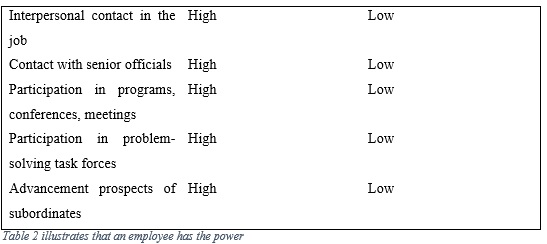
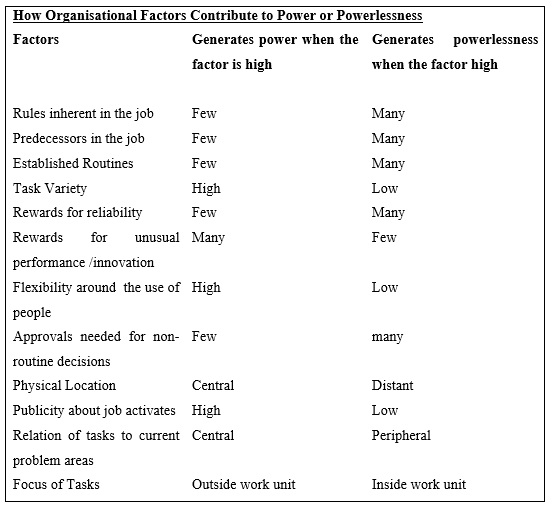
If readers require a more contemporary view of what a social enterprise is read The Social Entrepreneur: Making Communities work by Andrew Mawson. I’ll go on record and say Mawson is the only lord I would consider supporting based solely on the book. What though do Owen and Mawson have in common? They both understand the importance of stakeholdership. Ever since completing my MSc dissertation on the question: ‘why is there a subjective well-being premium in voluntary sector employment?’ I have become convinced that a stakeholdership model must Incorporate Rosabeth Moss Kanter’s thinking on power and powerlessness in the workplace. Figures 1 and 2 summaries Kanter’s thinking.

Figures 1 and 2 copied from my dissertation

Kanter’s argument is that when the factor is high employees have power or subjective well-being. My argument is when that when power is in the hand of employees that work for social enterprises. That power can be extended into the communities the social enterprise operates.  

Conclusion

The purpose of this blog is to inform the reader of the process of the Human Rights Bill/Act. This bill has not yet reached the parliamentary stage. Therefore it is impossible to know how members of the Scottish Parliament (MSPs) will react to the bill at the first reading. If MSPs react in the same way as me, then expect a lively debate and a lot of amendments. Note debate and a lot of amendments are not to be discouraged. Debate and amendments are a sign of power. As I said above we cannot afford the Human rights bill to be empowered from the top down. Yes, we have the human rights lived experience board. My concern is what happens to the people on the lived experience board after the Scottish government decides it no longer needs the board. I say to the reader, the Scottish Government, and, The Human Rights Consortium Scotland I effusively welcome lived experienced boards. I add, however, lived experienced boards must be more than short-term talking shops.

I said above that my dissertation answered the question ‘why is there a subjective well-being premium in third-sector employment?’. My conclusion to that question is important for how social policy transitions from the third sector to the fourth sector. My conclusion to my dissertation question was; yes, there is a subjective well-being premium in third-sector employment but only when employment is sustainable and achieves an external improvement. For example, employees of the Scottish Human Rights Consortium have a well-being premium/power because their employment provides citizens of Scotland with human rights. Here is the catch well-being premium/power is provided by the Scottish Government or the city council, as it is these institutions which enable change via innovative policy change. I fundamentally believe there is a need for third-sector organisations that act as the second chamber of the Scottish Parliament. Perhaps a sounding board for the Scottish Government is a better way to look at it. I take the view though that the third sector is not sustainable. Therefore society must move toward the social enterprise fourth sector model. The Fourth Sector model is the only model that will provide subjective well-being to every employee in the sector while providing business growth indicators (BGI’s) and Key performance indicators (KIPs) that will monitor human rights from a well-being dignity lens and not access to justice lens.

Recommendations

I was planning to go into some detail on my social enterprise’s business model. How it focuses on the well-being economy while encapsulating the well-being economy in side the circular economy.  My social enterprise will use BGI’s that are focused on corporate social responsibility and use KIPs that are directly linked to The UN Sustainable Development Goals. I feel, however, that splitting the more technical aspects into another blog or support document may be more useful to the reader.    

I am hoping to have a zoom meeting in February/March regarding my social enterprise. I do recommend reader join that meeting. Details to follow.  

Legitimacy

In previous blog posts, readers will remind me saying: living with the long term conditions caused by a medulloblastoma diagnosis results in disillusion with society and the inability to identify the self within the social norms of society. I have tried to explain how having no sense of the self is like having no idea of who you are. I have without prevail tried to achieve acknowledgement of this feeling. The look of complete blankness on the faces of friends and family is soul-destroying. If my brain was nothing more than a biological machine I would possibly hit the reset button- full restart. One problem the human brain is not a biological machine (not only). Our brains, our memories, define who we are.

Eleanor Roosevelt once said

I am who I am today because of the choices I made yesterday.

Elenore Roosevelt

That quote is 100 per cent correct. Who we are as individuals is past dependent. I just want to say to anyone that has ever verbalised the words: “only you can change your life”. You have no idea how frustrating and condescending that sentence is. To anyone that has been on the receiving end of that sentence, I apologise, the person that muttered this sentence has no understanding of the impact it had.   

Yes, who we are as individuals have a past dependency, just like social policy and the environmental conundrum humanity finds itself. As individuals and as a society,  we have a choice. We can stay on the road to self-destruction or we get off and try another path. How though? If our paths are past dependent, how can we change the path?  

I will admit I don’t know how to get off the path. Sometimes I think it would be simpler to go back and apply for nine to five jobs. That is a path, however, that the brain just will not go. I know there is no self at the end of that path or anywhere in the discourse of it.

My younger brother runs a successful copy write company. His company tagline is Short, Sharp, Straight to the point. I guess  I would not make a good copywriter. My point is this. As humans, we want simple things in life. Things like a home, a job, a community, clothing and food. A simple list correct? All basic human rights?

I remember Zach Braff aka J.D in an episode of Scrubs saying something like

Your work colleagues truly do become your family.

J.D

I think the above conclusion only holds true when the following premises follow

  1. You have a sense of belonging in your workplace
  2. There are other persons like you in your workplace.

Remember that Short, Sharp, Straight to the point tagline? Yes, that one. That is how we want to run our lives, our work, our relationships. The problem is, for 14 million disabled people and everyone else that feels they do not belong. There is nothing Short, Sharp, Straight to the point about anything in life. Except for that verbalised statement

“Only you can change your life”.  

My point is this. Despite nothing being Short, Sharp, Straight to the point – the way society wants it. Everything I have said has lived experience behind it. In a sense when policymakers say they want people who have lived experience to inform policy. What I take away is: policymakers want experts by experience to inform social change. However, as experts by experience have no understanding of the path walked, this is where experts by experience, legitimacy must stop.  

Fundamentally I disagree. I strongly believe people who have lived experience are best placed to develop innovative solutions to complex problems. For clarification what I have said about policymakers, including policy networks is subjective, based on my lived experience. Perhaps I am a little frustrated that I have been volunteering in the third sector for ten years and am unable to find an employment position in the sector. Perhaps am more frustrated that I look at the Scottish third sector and see box-ticking shadow, civil servants. Nothing against civil servants. It is just when you have been in and around the third sector you tend to hold third sector employees to higher standards. Nothing against my political colleagues either. Essentially what I want the reader to take away here is I have a lifetime of lived experience. I am an expert by experience ten times over. I am also, however,  a PPE undergraduate and Social Innovation postgraduate graduate. I see myself not only as an expert by experience but also as an expert by academic experience. I have more lived experience than most disabled people. I also have more academic experience than most non-disabled people. You would therefore think. Would you not? Those expressions of no perception of the self or no idea who I am as a person would be received in good faith-“bona fides”. Giving the legitimacy my lived and academic experience should carry. Instead, my views are met with confusion, bewilderment and disbelief. I should be grateful After all, I have a dead-end job, am underemployed and I lived longer than the five years the medical model said I should.