Where are my Human Rights?

All human beings are born free and equal in dignity and rights. They are endowed with reason and conscience and should act towards one another in aspirit of [personhood}

artical one UN Convention on Human Right

The problem is, the United Nations soft law is no more use than the bible when it comes to providing citizens with dignity and rights. There have been more add-ons to the Universal Declaration of Human Rights. Then acknowledgements from the UK Government that trickle-down economics just does not work. Where are my Human Rights? Perhaps the title of this blog could have been “[did] the free market revolution” (Benerria, 2003, p.3) steel my Human rights? As Richard Wilkinson and Kate Pickett (2009, p.262) point out “… profit would still lead companies to act in anti-social ways”. While anti-social is in opposition to social enterprise. It is not a breach of Human Rights. Since February 2022 I have been a member of the Scottish Government’s Human rights bill lived experience board. Why? Why am I a board member of the Scottish Government’s Human rights bill lived experience board? Noted above, I make it clear, that the free market is not the cause of Human Rights violations. If I am not a board member of the Scottish Government’s Human rights bill lived experience board to correct the wrongs of the free market. Then I must be on the Scottish Government’s Human rights bill lived experience board to correct the failures of the public sector. There is an add-on question that is outwith the scope of this blog. Is it not the job of the third sector to look after the failures of the public sector?

In 1973 the world economy had become reliant on oil and was facing raw material shortages that were pushing up prices (Banerjee & Duflo 2010, p.146). Not too much has changed. Has it? At this time I what the reader to think about economic and social rights.

The rights to & the rights from

If unpaid activities were valued [1995 prices] at prevailing wages, they would [have] amounted to $16 trillion or about 70 per cent of total world output (Beneria, 2003 p.74)

Gender, Development and Globazation

What sex in society is likely to do unpaid activities? Women. Think about that, not only is the contemporary cost of living crisis an infringement on economic and social rights. It is also an infringement on gender development. At today’s meeting on Disabled people and unpaid carers with third-sector colleagues’, there was a consensus that the cost of living was in breach of economic and social rights. I add here that due to the majority of unpaid carers having xx chromosomes. Women more than men are likely to be hit harder and are more likely to have their human rights violated due to the cost of living crises.

There was also an agreement that the support offered by governments, is not enough to cover the cost of living rises. The view that government support lacks the requirements to mitigate the cost of living crises is supported by The Health and Social Care Alliance Scotland. Who recommended the Scottish Government increase payments to Scottish citizens receving benefits. Health and Social Care Alliance Scotland note there are groups in society, which their recommendations will not help.

As I pointed out in the afternoon’s meeting, additional payments to disabled people and unpaid carers’ is the ethical thing to do.

All I have known is crises

As one of my co-workers said at today’s meeting ” [citizens’]’ health is affected [by this cost of living increase]. However, as pointed out in yesterday’s Human Rights meeting by John (not real name) “as someone born in 2002, all I’ve known is crises. If this is how our young people are feeling. Society has a mental health pandemic coming.

I started this section with the heading the rights to and the rights from. As a citizen of Scotland, you have the right to a fair trial. the right to housing, the right to live in the community, and, the right to food. this post would be longer than my dissertation if I was to go over all the rights.

Scottish Human Rights bill: when?

the short answer. By the end of the parliamentary session. Why not sooner? Well… the Scottish Government are trying to incorporate four international treaties into Scot law. The Government needs to get the bill/act correct, let us give them some time to do just that. As the Scottish government’s civil servant said yesterday

the delay gives more time to get the bill correct

Scottish Government Civil Servant

Conclusion

I have notes for three meetings. I could have written a PhD paper with the quotes I wrote down. However, I want to get this blog published tonight- October 06. I also know that The Scottish Human Rights Commission. The Health and Social care Alliance Scotland. And many other third-sector partners shall publish better blogs and posts than I could write in a few hours. Saving me time, and providing me more sleeping time.

Am going to do something you should never do. Am going to introduce a new topic in the conclusion. What is next for the Scottish Human Rights bill? I have it on good authority the next meeting will be on monitoring. How will we know if the Human Rights Bill is working?

I have a few ideas, however, I would like to hear the reader’s thoughts in the comments.
Scottish Business Week 2022

This month shall be paramount in developing A-LEAF going forward. It all starts today with Scottish Business Week 2022. Business, What Business? What am I in Business to do? Well, it is not to build up the funds in my bank account. If increasing my account balance was the goal. I could have continued my hunt for employment with the Scottish Government or Glasgow City Council. No. am in business to build a better me. And, to build resistance in Scottish Communities.

Earlier this morning I found out Rule_ette_out (Darren) win the Alliance Scotland self-management award. Darren offers peer-to-peer support for people struggling with gambling addictions. Darren’s story got me thinking about A-LEAF’s Purpose, Values, and, Vision. Not only A-LEAF’s Purpose, Values, and, Vision but also my own. What makes me the person I am today. What makes me have the Purpose, Values, and, Vision I have today? In another blog post, I concluded that my childhood Medulloblastoma was the reason I am the same person today as the child I once was. Nigel Warburton- writing the textbook ‘The Self for the Open University module A222 Exploring Philosophy, would be so proud of me. I have to amend that conclusion. You see the Entrepreneur genius test says am a Dynamo Genius. What is a Dynamo Genius? It’s me, I just told you that. Dynamo Genius, such as myself, use your Frontal lobe more than other parts of the brain. When the location of the Medulloblastoma in the brain. Being a Dynamo Genius completely makes sense.

Am a dreamer, I have my head in the clouds. I want to save the world one community at a time. Yes, that sounds about right. When Ben Freedman & Craig Carey- authors of 4th Sector Entrepreneurship say fourth sector organisations take on the Purpose, Values, and, Vision of their owners. That is also true. I have still to define A-LEAf’s PVVs. They will be up on the A-LEAF page of the website later today. With the A-LEAF website up ASAP.

On Wednesday I have a meeting with the Scottish Government’s Human rights lived experience board. What I am about to suggest is that Human Rights are the writings of Dynamo Genius. Or you could look at it another way. After World War Two the Frontal lobe of world leaders took over their brains- all world leaders became Dynamo Geniuses.

The fact that everyone can think with their Frontal lobe after a major life-changing event. Opens up the question. Why as societies as Human beings, can we not Upstream?

To stop the cats from drowning in the river, find out why there are so many cats in the river in the first place.

paraphrased from Upstream by Dan Heath

I started this blog off by pointing out it Is Scottish Business week. As a Business leader, to be. I want to put to my colleagues at the Scottish Business week. Should we not be in the business of adding more people to our boards that think with their Frontal lobes?

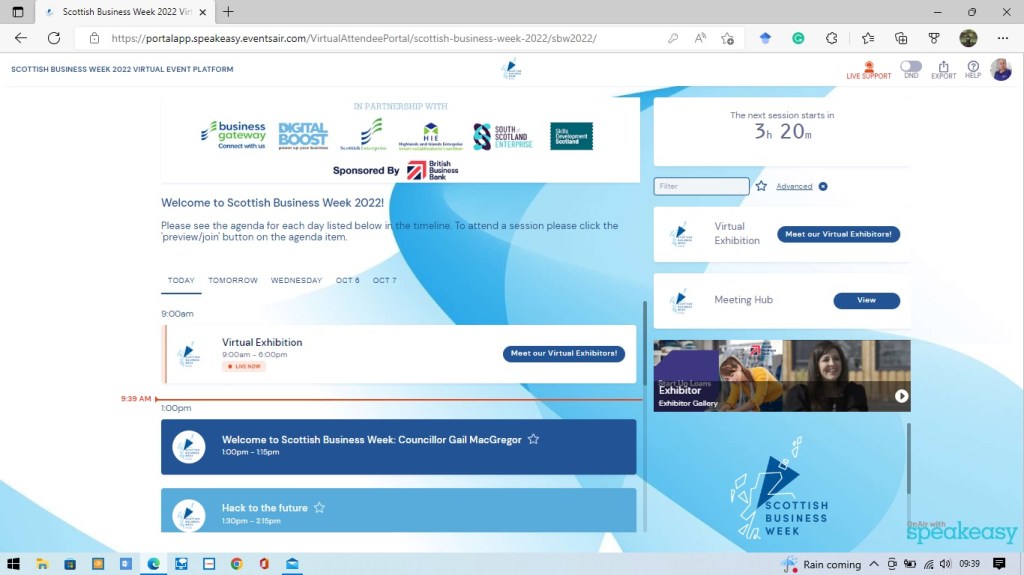
Scottish Business week portal view.

This would be a good place to end this blog post. However, am not going to do that. Am going to ask a question. Two questions. Question one of two. Given Darren’s exigency to support others. And given we all know someone like Darren. Why is it not all our Business to support the Darren’s in our Scottish communities?

Final question. Wednesday’s Scottish Government’s Human rights lived experience board meeting is on the cost of living. And, given that it is widely known that people who require access to self-directed support have the highest cost of living. Why is it not all our business to reduce the cost of living for
everyone in our Scottish societies?     

Why identity matters.

A day after this website went live (second time) I had a meeting with my colleague to discuss the next stages for A-LEAF. This website/blog(s) is the launching site for A-LEAF- as well as my personal blog site. My colleague’s reaction was:

I like the website/blog, however, I did not get the ‘person’ vs human, philosophy on the landing page (paraphrased).

Matheson, 2022

After considering my colleague’s intervention I have concluded that there is a requirement for additional clarification on “person” vs human. Homing in on how I see ‘person’ as my identity and human as the physical body. Is any of this making sense? No? okay, let us try a different approach.

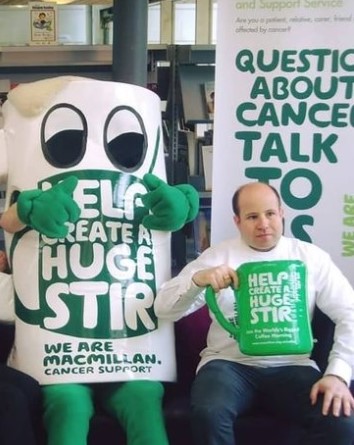
Objectively- what can be proven without a doubt. I am the child (human) that was diagnosed with a Medulloblastoma aged four. However, my lived experiences of growing up with the long-term side effects and the barriers to society the Medulloblastoma caused has shaped the ‘person’ I am today. To be clear what am saying is if it was not for the Medulloblastoma I would not have volunteered with Macmillan Glasgow Libraries in 2010.

This was where the journey started with the third sector in 2010. Never did I think in 2022 I would be weeks off registering my own company after completing my MSc in Social Innovation.   

I never would become involved with Cancer Support Scotland‘s child charity Youth Cancer Forum Scotland, I never would have taken an interest in charity law. More importantly, I never would have become a member of Health & Social care Alliance Scotland, Inclusion Scotland, Glasgow Disability Alliance, however, the utmost important connection to the Medulloblastoma childhood diagnosis which lead to volunteering with MacMillian; I would not have completed my MSc in social innovation and I would not be in a position to start a social enterprise today.

so let us consider the question again.

what makes a person the same person despite changes over time?

WARBURTON, 2011

A Medulloblastoma childhood diagnosis makes me the same person over time. I never did get that. I have Dr. Anne Smith for the enlightenment. I thanked Anne for providing me with this insight in my acknowledgments to my dissertation. My thanks are, now on record for the world to see.

Now I know I am the same ‘person’ today. As I was when I was four. The question remains if it was not for social norms and medical models. would I be the same ‘person’ today as I was when I was four? After all, no one in Locke’s time was living thirty-four years after a Medulloblastoma childhood diagnosis.

One last thought. A Ph.D. student once asked me:

“Does studying Social Innovation make you want to start a social enterprise”

Ph.D student, 2020

No, it is not the MSc in Social innovation that makes me want to start A-LEAF. it is the answer to the question:

would removing the inequalities social norms and medical models, result in me becoming a different person from the four-year-old me?

No, It is too late for me! The four-year-old I was in 1987 is the same ‘person’ I am today. The question remains if it was not for social norms and medical models. would I be the same ‘person’ today as I was when I was four?

The answer to this question is important for all childhood cancer patients today.

COP26 and the SDGs

Previous posts have focused on my identity- who I am. Who I am is shaped by lived experiences. As readers of earlier blog posts will recall am a childhood medulloblastoma survivor and a Social Innovation Masters (MSc) graduate. As an MSc graduate am frustrated, several actors frustrate me. Writing this blog instead of working on my social enterprise frustrates me. Working a dead-end job frustrates me. Dependency on other people frustrates me. What aggravates me presently is COP26- climate conference. COP26 is essential to the survival of the planet. The fact that COP26 is happening and happening in Glasgow is not the source of my aggravation. The source of my aggravation policymakers are talking and not acting. Additionally am extremely frustrated via the inability or denial of policymakers to accept free-market capitalism as the source of climate change. Furthermore, my aggravation is exemplified via the ploy to use children as a social marketing tool as a last resort because policymakers are too spineless to regulate the free markets.      

The preceding posts took a non-academic writing style. This post, however, shall follow academic best practices. The literature in this blog is informed principally from two Open University modules Doing Economics: People, Markets and Policy and International Relations: Continuity and Change in Global Politics. I have not completed any additional academic research into climate. My knowledge of the subject is second hand or indirect learning.

The main reason for this post is my webpage on the SDGs has been receiving numerous hits in the past few days. Providing readers with clarification on my position on the SDGs was an obligation. I support the UN SDGs. No one should be surprised by that revelation. My first exposure to the SDGs evades me. 2019 the date I started studying Social Innovation with Glasgow Caledonian University possibly. While I have no memory of my first academic paper to reference the SDGs, vividly I recall my introduction to international law and the UN. Brown 2014, p. 60 proposes the UN oversee a “range [of] highly formalised diplomacy”.  Brown’s definition runs parallel to what Green says in his ted talk in 2015. Green focuses on the UN millennium goals, principally the reduction of global poverty. Providing evidence that global poverty in 2015 was 12 per cent of the world’s population, however, Green champions poverty reduction by praising economic growth. I have already said I have no academic background in C02. However, data provided by our world in data shows atmospheric concentrations of CO2  have continued to rise. I, therefore, suggest an increase in CO2 emissions is a negative externality of economic growth.

 Yesterday I tweeted asking why

“Has COP26 resulted in everyone becoming so interested in climate action?”

Howie, 2021. 

The answer may lay in Welfare economics.

The relationship between human welfare and different ways of making social choices

Anand, 2014, p. 407

Anand goes on to suggest that

Welfare economics is interested in the philosophical and ethical foundations of our understanding of human welfare and well-being (ibid)

Anand’s use of the word our is interesting. The word choice could suggest an unconsciousness othering. A few world leaders have indeed fallen into the othering trap throughout COP26.   

Unconsciousness othering, however, is understandable, as Kenneth Waltz’s literature is required textbook reading for political students. Waltz’s theory

That there is a rigid distinction to be drawn between domestic and international politics

(Brown, 2014, p. 101)

finds replication in society via the phrase charity starts at home.

To tackle goal 13 of the SDGs- climate change. World leaders are required to do three things. One, incorporate all seventeen SDGs into their climate change plans. Two move away from Kenneth Waltz’s thinking. Three recognise free-market capitalism has been the fundamental cause of CO2  emissions.

Initially, I was going to write an extended blog. Transitioning from the first section above to the next section on liberalism and global governmentality, however, I will pause for feedback.

If this blog style is to your preference, please comment with constructive feedback.  

References   

Anand, P (2010) ‘Welfare economics and social choice’, in Anand, P, Himmelweit, S, Mackintosh M, Santos C, Simonetti R and Stone H. (Ed[s]) Doing Economics: People, Markets and Policy, Milton Keynes, the Open University

Brown, W (2014) ‘Introducing international relations’, in Brown, W, Corry, O and Czajka, A (ed[s]) in ‘International Relations: Continuity and Change in Global Politics’, Milton Keynes, Open University.

Brown, W (2014) ‘Theoretical reflections: realism and liberalism’, in Brown, W, Corry, O and Czajka, A (ed[s]) in ‘International Relations: Continuity and Change in Global Politics’, Milton Keynes, Open University.

Green, M (2015) how can we make the world a better place by 2030. November. Available at: How We Can Make the World a Better Place by 2030 | Michael Green | TED Talks – YouTube (Accessed: 2 November 2021).  

Howie, D (2021) [Twitter] 1 November 2021. Available at: David Howie BSc, BA(Hons), MSc 🏴󠁧󠁢󠁳󠁣󠁴󠁿 🇪🇺 (@Social_equality) / Twitter (Accessed 2 November 2021).

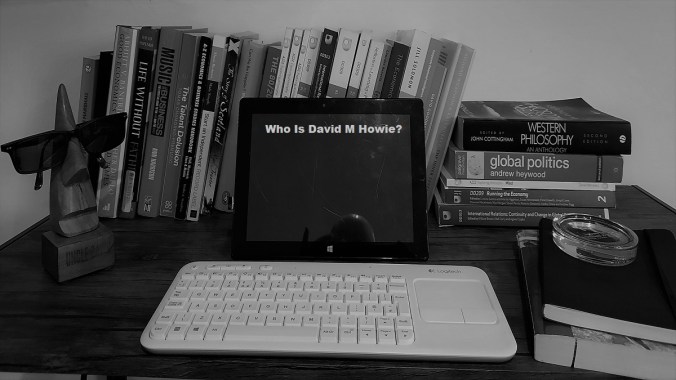
Who is David M Howie?

Who is David M Howie? A question I have asked myself on several occasions. The answer has always evaded a conclusion. I became very interested in the notion of human being vs “person” while studying philosophy at the Open University. The idea that David M Howie could be the same human being as the five-year-old diagnosed with a brain tumour. However, could be a completely different person thirty-three years after diagnosis, is an intriguing concept. So who is David M Howie? Let us address the obvious. David M Howie is a son, a brother, an uncle, an MSc graduate and a citizen of the UK. Hence the dot UK of the URL. The list above is what I am. Not who I am. IF I cannot identify who I am. By what I am. It stands to reason that no other person can identify, who they are. By what they are.                

Nothing I have said above is intended to sound condescending. In philosophy when attempting to convince the reader of the legitimacy of the argument the premises which follow the conclusion must also be true. For example, Plato concluded Socrates is human. The argument went something like:

  • All human beings have two legs (in Plato’s time)
  • Socrates has two legs.
  • Socrates must be human.

They were simpler times.  That said, however, contemporary policy development follows the same basic principles. What I am about to say may sound a little condescending. All am doing is highlighting facts. More men than women sit on executive boards. The gender pay gap is still a major issue. Per head of population, more non-disabled people than disabled people will work. Those disabled people that do work are likely underemployed (like myself). Here is the controversial statement if you are white, male, non-disabled and privately educated you are more likely to be in a position of power. Again that is not intended to be controversial. It is a demographical and geographical fact.                   

 let me ask myself that question again. Who is David M Howie? He is a dreamer. I dream of a reduction in inequality. I dream of a society where “othering” is not a thing. And I dream of a society where my lived experience and education will be taken as legitimacy and provide an opportunity for a better tomorrow.

In previous blogs, I have quoted that inspirational speech from Rocky. In case you don’t know the one am referring to here is the link. 2 minutes and 45 seconds in rocky says

Until you start believing in yourself, you are not going to have a life.

Rocky Balloa 2006

My problem could be believing in myself a little too much. Perhaps in a society, that favours white, male, non-disabled and privately educated citizens people who are experts by experience and have the academic background to support their argument still are not supposed to dream. Perhaps my life is a struggle for equality. Perhaps that is who David M Howie is.

Diversity, Inclusion, and Belonging

 My initial blog post, “hello WordPress”, illustrated- to the best of my ability how the social model of disability is essential to building back better from COVID-19 and Brexit. This post will develop the foundations on which the previous post lay.  The fundamental point raised from the initial blog post; as a disabled person that has been living with sight and hearing difficulties since five years old, due to a childhood Medulloblastoma, I am best placed as an expert by experience to develop the policies required for me to live well in the future. Let me clarify. As a disabled person, I know what products and services I require to create inclusion for myself in society. However, 14 million disabled people are living in the UK. I am not, no one could be. An expert by experience, of 14 million long term conditions. An expert by experience, though, is the pedestal, citizens place the social security system.

Do not consider what am about to say, as an attack on our political institutions. As a Politics, philosophy and economics graduate, my view of the UK political institutions is they are dated, they are crumbling and they need a refit. Without improvements to political institutions, promptly, I am sceptical about how society can create inclusion for 14 million disabled citizens. At this point, I would like to remind readers it is not about inclusion. It is about belonging. My latest podcast discussed lived experiences, at 11:00 minutes in I talk about diversity, inclusion and belonging. I have said somewhere in the past I don’t feel I fully belong to any group in society. I have the privilege of having membership in several disabled peoples organisations. However, I have always perceived I don’t fully belong. I know the not belonging is a subjective perception. Perhaps it is just a barrier as a “person” I have placed on my-“self”.   

Am going to let the reader into a secret here. I have no idea what am going to write in regards to these blog posts before text appears on paper. Anyone that has written academic papers will know how good it feels just to have a blank page and have the ability to rabbit on. There is something to be said for academic writing style though. If using academic English, 364 words would not have been required to define what I mean by “person” and “self”.         

I have eventually got around to reading Joseph LeDoux book Synaptic Self: How Our Brains Become Who We Are. Get your copy here. I bought the book in 2015, I’ve just never found the time to read within my schedule. As LeDoux 2002, p 13 points out

Before we go looking for the essence of a person in the brain, it would help to have some conception of what we are seeking.     

LeDoux, 2002, p. 13

What we seek, is a definition of “person” and “self”. Luckily for me and the reader The Open University provided me with a copy of “The Self” written for A222 by Nigel Warburton. “Person” as I am using the term here is the same as John Locke used it in the Seventeenth-century.

You can be the same man as you were ten years ago without being the same person     

Warburton, 2011, p. 36

On my home page, I ask the question if I do not remember the child, I once was. Am I still him? Locke would say no. Me, I don’t know. Did I become active in the third sector because of the child I once was-  but have little to no memory of? Or because I think society is unethical. The Open University provided me with a book on Ethics too. Chapter 2 is on Bentham and Mill: maximising happiness. Perhaps I look at society as been unjust and that is why I strive to better myself and society via the third sector. 

Before returning to the idea of belonging, I am required to consider, if I am not the same “person” as the child with the Medulloblastoma. Who am I? Where can I find “the self”? The self, Hume thinks

[is] some kind of construction of the mind, not something which exists independently of our patterns of thought.    

Warburton, 2011, p.61

Hume’s thinking is not too far off from what LeDoux is saying in the Synaptic self, even if LeDoux’s methods and analysation of the data is a lot more scientific.  

Now the reader has an understanding of what I mean by “person” and “self”, let me explain why I do not feel I fully belong in disabled person’s organisations. Whilst studying professional practice- a module for my MSc. I had a light bulb moment- recognising my professional and personal identity is linked to my lived experience of growing up with the side effects of childhood Medulloblastoma. Despite the revelation, however, something subconsciously is preventing a full belonging to the group.            

Another group where I no longer perceive I fully belong is in political networks. Disengagement here is difficult to explain. I stood for vetting- candidate selection twice. The real reason why I have distanced myself from party politics, is, as I now see party politics as exclusion and alienating. As I said above I am not attacking our political institutions or any political party. Again I just perceive after several years of achieving nothing in politics, that I no longer belong in the political circle. I have friends in high positions in politics, I am grateful for my time spent campaigning for political candidates. From a professional and personal perspective, however,  having studied politics, philosophy and economics and then my MSc in social innovation the political system just is not working. The political systems, despite the UN conventions, sustainable development goals, European human rights – the international political systems cannot bring about diversity,  inclusion and belonging. When I came to that understanding, as a person, I have no place in society to belong.

Having a perception of not belonging is why I came up with the prospect of A-LEAF. If you are still reading, I do hope you will rally behind my call for diversity, inclusion and belonging (DIBs) alongside the social-platinum model.      

Our societies are diverse; to a point our societies have inclusion. Belonging is what we seek!    

If you enjoy these posts let me know by tweeting and voting.

Hello WordPress

My first post written for WordPress


Have you stumbled on my website or blog for the first time? Have you found my landing page by mistake? If so, you presently could be a little bewildered. You could and should be asking questions. The foremost question on your mind should be why? Not necessary why you have never questioned your “personal identity” before. The why question you should be asking is why it is important to ask how “personal identity” is shaped via geographic locations and lived experiences.   

Hello WordPress, I am David M Howie. Fasten your seatbelts. You are about to go on a rollercoaster ride. This rollercoaster will make you feel happy, sad, upset and even a little angry. Predominantly, though this rollercoaster will leave you asking what. What was society thinking? What was my role in all of this?

Mark Athinson chief executive of the disability charity Scope told the Huffington post there are almost 14 million people in the UK living with a disability. To put that in perspective the population of Scotland is 5.47 Million. The population of Wales is 3.25 Million and the population of Northern Ireland is 1.9 million. If like me you identify as disabled, you are probably hitting a downwards dip on the rollercoaster, you may even feel a little sick. If you do not identify as disabled. If this is all new to you. Tighten your seatbelt. The rollercoaster is about to go down the rabbit hole.

As a four-year-old child, I was diagnosed with a Medulloblastoma. As a result of the Medulloblastoma, I have grown up with long term conditions which include but are not limited to visual and hearing issues. Are my readers in the know about the social model of disability? If not see the definition provided by Scope here. Why is the social model of disability important to me? As I said above I have sight issues caused by the Medulloblastoma. This statement is not one hundred per cent correct. It is correct to say I have sight issues – constant double vision. Wearing glasses that prevents vision in my right eye (any eye) removes my double vision. Personally, the opportunity cost of buying glasses that limits my vision to one eye is better than not been able to see an LCD computer screen at all. I say LCD computer screen because while completing my first undergraduate degree back in 2001-2005 using Cathode-ray tube (CRT) monitors I had no issues seeing the monitors at all. My story is just one example of how society has disabled an individual. There are another 14 million stories in society. So why is it important for me to have the reader understand the social model? I have to buy glasses- not covered by the NHS- so I can be part of the community. So I can go to work. So I can go to University and so I can start my social enterprise. In a sense, I am lucky, I can pay to disable myself to fit in with the social norms of society. Go me – joking! How many of the 14 million disabled people in the UK cannot?   

On the off chance, you missed my camouflaged attempt at humour, I choose to disable myself not because of my childhood Medulloblastoma but because society has made technological advances. Here is where it gets more ironic, whilst completing my MSc I used Grammarly to aid with grammar and spelling. Capitalism 101. Society disables citizens because the policy used to measure how well a society is performing is based on GDP growth, not citizen well-being. Let me untangle my thinking and prevent any confusion.

21-year-old me graduates university, ready to take on the world. One problem the world is not a nice place. To quote Rocky Balboa

“It will, beat you to your knees and keep you there if you let it…nobody will hit as hard as life” 

Balboa, 2006

The rollercoaster is about to do a 360. You may virtually want to find something to break.  

I have been involved in the Scottish third sector for over ten years. In these ten years, I have tried to improve my life and the lives of the other 14 million disabled people in society. Here is the problem. Society does not want citizens with high subjective well-being. If citizens are happy, citizens are not spending. Think about it. The reason you buy a product or purchase a good is to solve a problem. I have a problem in that I cannot see the new computer monitors. Therefore, I have to become a consumer of glasses that allow me to see LCD and other new computer monitors. Additionally, due to problems retaining information in early education, I am now required to use Grammarly and read aloud word functions at additional personal cost. Like the rollercoaster, my academic career is almost at the tipping point. I have my MSc and I have no plans to pursue a PhD. Therefore I need to get a paid career and make my way in society. Like the rollercoaster the final destination is clear. What is not clear is will the outcome follow incremental milestone achievements or be a steep drop off the Clift.  

The end will come

Life, like the rollercoaster, will end. In life as in the ride, the final destination is unavoidable. Unlike the rollercoaster which is fixed as it is- if not replaced. In life, human well-being can be shaped by policy. A policy implemented that is designed to include all (as many) citizens, is in the best interest of society overall.  Perhaps am been egotistical here, I do not care. I have been living with the side effects of Medulloblastoma since the age of four- I believe rather well. I have two undergraduate degrees (paid for by the Scottish government) and an MSc in social innovation. I have achieved this despite typing this with only sight in one eye- because the technology behind my laptop, prevents me from seeing the laptop screen. Additionally, I purchased private hearing aids- I don’t hear high pitched sounds. There is that “why” question again. Why did I purchase private hearing aids? Because it is simpler to receive good customer service at Specsavers than it is to receive an appointment with the NHS.    

And there you have it. “What” disables citizens? Money! You are having the privilege of reading this blog post because I had savings and could pay for glasses that blind me in one eye. I had £4k+ to pay for my MSc. I had £1k to pay for private hearing aids and I had £24 a month (something like that) to pay for Grammarly. You are at the end. Not of the journey, that is just starting. You have reached the end of seeing disabled people as others but only if you take off your blinders. Unfortunately, I cannot.  

If you like this post give it a thumbs up